• Home
  • About Us
    • Physics Administration
    • Directions
    • Awards
    • Student Awards
    • Make a Donation
    • News
      • Research News
      • Department News
      • Newsletters
    • PTK Policy
  • People
    • All
    • Faculty
      • Current
      • Emeritus
      • Adjunct
      • Affiliate
      • Research Professors
    • Research Scientists
    • Postdocs
    • Staff
    • Lecturers
    • Visitors
    • Graduate Students
  • Research
    • Research Areas
      • AI and Physical Sciences
      • Astro Metrology
      • Atomic, Molecular & Optical
      • Biophysics
      • Chemical Physics
      • Condensed Matter Experiment
      • Condensed Matter Theory
      • Cosmic Ray Physics
      • Elementary Particles
      • Gravitation Experiment
      • Gravitational Theory
      • High Energy Physics
      • Nonlinear Dynamics, Chaos and Complex Systems
      • Nuclear Physics
      • Particle Astrophysics
      • Physics Education Research
      • Plasma Physics
      • Plasma Theory
      • Quantum Science and Technology
      • Quarks, Hadrons and Nuclei
      • Space Physics
    • Centers & Institutes
  • Academics
    • OSES Home (Student Services)
    • OSES News
    • Undergraduate Program
      • Prospective Students
      • Apply Now
      • Degree Requirements and Policies
      • Scholarships
      • Undergraduate Research
      • Advising
      • Undergraduate Forms
      • Undergraduate Events
      • Departmental Honors
      • Society of Physics Students
      • FAQ
      • Undergraduate Student Committee
    • Graduate Program
      • Prospective Students
      • Open House
      • Degree Requirements
      • Graduate Resources
      • Deadlines and Forms
      • PhD Defenses
        • PhD Defenses 2026
        • PhD Defenses 2025
        • PhD Defenses 2024
        • PhD Defenses 2023
        • PhD Defenses 2022
        • PhD Defenses 2021
        • PhD Defenses 2020
        • PhD Defenses 2019
        • PhD Defenses 2018
        • PhD Defenses 2017
        • PhD Defenses 2016
      • Events
      • Scholarships & Awards
      • Qualifier
      • Graduate Student Organizations
      • FAQ
    • Student Opportunities
      • GRAD-MAP
      • Graduate Student Organizations
      • Outreach Volunteering
      • Society of Physics Students
      • NSF S-STEM Program
      • Undergraduate Research
      • The Noether Physics Society
      • Undergraduate Quantum Association
    • Courses
    • Academic Support
    • NSF S-STEM Program
    • Teaching Assistants
  • Events
    • Calendar
    • Physics Colloquia
    • W.J. Carr Lecture
    • Research Interaction Team (RIT) Math/Physics
    • Mechanick Quantum Biology Lecture
    • Irving and Renee Milchberg Endowed Lectureship
    • Charles W. Misner Endowed Lectureship in Gravitational Physics
    • Charles W. Misner Memorial Symposium
    • John S. Toll Endowed Lecture
    • Prange Prize Lecture
    • Maryland Day
    • Outreach
      • Outreach Home
      • Physics is Phun
      • Discovery Days
    • Summer Programs
      • Physics Makers Camp
      • Physics of Quidditch
      • Science Discovery Camp
      • Advanced Physics Summer Program
      • Toolkit for Success
    • CUWiP
    • Vortex Makerspace
    • QURiSE Conference
  • Services
    • Building Access Requests
    • Computing Services
    • Conference Room Reservations
    • Department Operations Directory
    • Electronic and Mechanical Development
    • Hiring Procedures
    • Lecture Demo
    • Mental Health Resources
    • Parking
    • Physics Ombudspersons
    • Printing Services
      • Poster Print Request
    • Proposal Submissions
    • Purchase Order
    • Suggestion Box
    • Textbook Information
  • Give
  1. Home
  2. About Us
  3. News
  4. Department News

Written on 25 January 2021.

Taylor Receives Department of Commerce Gold Medal

Adjunct Professor Jake Taylor has been recognized by the federal government for his role in expanding U.S. policy and efforts in the fiercely competitive field of quantum information science.

Taylor, a physicist at the National Institute of Standards and Technology(link is external) (NIST), is the recipient of the 2020 Gold Medal Award from the Department of Commerce.

This is the highest award given by the department, which oversees activities at NIST. It recognizes individuals or groups that provide extraordinary, notable or prestigious contributions that reflect favorably on the department and impact its mission.

Taylor was specifically cited for his work in the White House Office of Science and Technology Policy (OSTP), where he served from 2017–2019 and spearheaded an initiative to expand and coordinate federal efforts involving quantum computing, sensing, and communication research and development.

While at OSTP, Taylor interacted with a multitude of federal agencies and external stakeholders to craft a comprehensive U.S. policy in quantum science, organized the quantum information science (QIS) community, and worked closely with policy teams both within and outside the White House to integrate administration approaches with legislative efforts and enable effective execution of the nation’s expanded QIS research agenda.

The result was the National Quantum Initiative Act(link is external), passed unanimously by the U.S. Senate and signed into law on December 21, 2018.

The legislation commits the federal government to providing $1.2 billion to fund activities promoting quantum information science over an initial five-year period; additional funding was also approved by Congress in its session ending January 1, 2021, leading to more than $350 million for FY 2021 alone.

One important aim of the plan is to create new research centers that bring together academics from different disciplines—such as computer science, physics and engineering—to help conduct experiments and train future quantum researchers. Eight of these centers were launched in 2020, led by the National Science Foundation and the Department of Energy.

The law also encourages large companies and startups to pool some of their knowledge and resources in joint research efforts with government institutes. It also supports the Quantum Economic Development Consortium(link is external), which Taylor helped lay the groundwork for while at NIST in 2017 and at OSTP in the following years.

Finally, the legislation calls for coordination of activities and outreach, both areas that Taylor actively engaged in. This included the creation of the National Quantum Coordination Office(link is external), in which Taylor served as the first director; the launch of the Q–12 education partnership(link is external) to enable middle and high school curriculum development and teaching of quantum concepts; and the launch of quantum.gov(link is external), which serves as a central home for federal QIS research and development.

“I am honored to receive the Gold Medal Award from the Department of Commerce, and feel a tremendous sense of gratitude to the quantum information science community for coming together to focus on a positive approach to change,” says Taylor.

Many voices in concert have enabled the U.S. to expand its resolution to advance new discoveries in quantum computing and quantum information science, Taylor adds.

“But there’s no sleeping on the job,” he says. “The national quantum coordination office and the federal, academic, and private sector teams all have a tremendous amount left to do. Still, I believe the foundation laid by myself and others at the start of this decade have put us in a place where the work moving forward will have the most impact—from enhancing middle school curriculums to building large-scale quantum computers.”

Taylor is a Fellow of the Joint Quantum Institute and of the Joint Center for Quantum Information and Computer Science. He reseasrches  hybrid quantum systems, applications of quantum information science, and fundamental questions about the limits of quantum and classical behavior.

A Fellow of the American Physical Society and the Optical Society of America, Taylor is also the recipient of the Department of Commerce Silver Medal, the IUPAP C15 Young Scientist Award, the Samuel J. Heyman Service to America Medal: Call to Service, the Presidential Early Career Award for Science and Engineering, and the Newcomb Cleveland prize of the AAAS. He has published more than 150 scientific papers, several book chapters, and holds numerous patents in quantum technologies.

Adapted from a story originally published by QuICS
Written on 18 December 2020.

Parker, Jawahery Discuss Findings in Symmetry Magazine

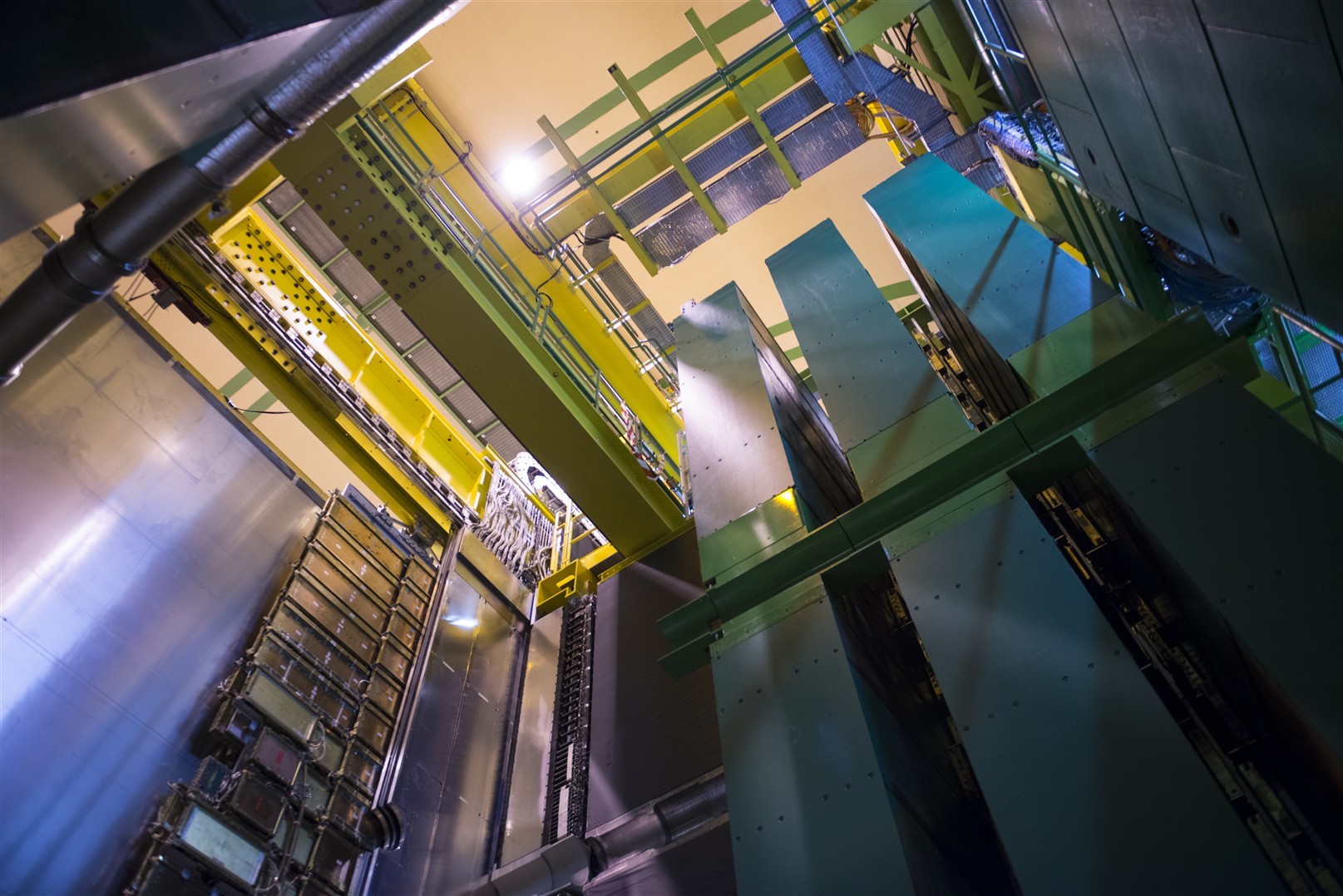
LHCb experiment. Image courtesy of CERN.LHCb experiment. Image courtesy of CERN.In November 2020, the LHCb collaboration announced a major new development, based on data collected during LHC Run 2, confirming and significantly strengthening an anomalous observation in decays of B mesons. 

Postdoc Will Parker and Distinguished University Professor Hassan Jawahery of the UMD flavor physics group recently discussed their work and "matter-antimatter weirdness" in Symmetry magazine. 

The 2020 result followed the LHCb's previous observation of CP violation in decays of D mesons. That finding was rated a Physics World Breakthrough of the Year finalist for 2019.

The Symmetry story is posted here: https://www.symmetrymagazine.org/article/lhcb-finds-more-matter-antimatter-weirdness-in-b-mesons

Written on 24 November 2020.

Kollár Receives Air Force Young Investigator Grant

Assistant Professor Alicia Kollár has been awarded a grant by the Air Force’s Young Investigator Research Program (YIP). She is one of 36 early-career researchers around the US to receive the three-year, $450,000 award.

Kollár plans to develop a new breed of superconducting devices for studying quantum computing and quantum simulation. The devices will build upon an already successful platform—superconducting qubits connected together by photonic cavities—to create new interactions between qubits and new ways of connecting qubits together.Air Force Office of Scientific Research

“These systems realize artificial photonic materials for microwave photons with unprecedented levels of versatility and control,” says Kollár. “They can even be used to make lattices which cannot be found in nature, including things as exotic as lattices in curved hyperbolic spaces. Thanks to the generous support of the Air Force Office of Scientific Research, we can now truly embark on harnessing this effect for new types of interactions and spin models.”

The YIP received more than 215 proposals this year, for research into everything from basic physics to machine learning and network science. Xiaodi Wu, a Fellow of the Joint Center for Quantum Information and Computer Science and an assistant professor of computer science at UMD, was also awarded a YIP grant this year.

Original story by Chris Cesare: https://jqi.umd.edu/news/kollar-receives-air-force-young-investigator-grant

Written on 23 November 2020.

Das Sarma, Monroe Named 2020 Highly Cited Researchers

Sankar Das Sarma and Chris Monroe are included on the Clarivate Web of Science Group’s 2020 roster of Highly Cited Researchers(link is external) r, which recognizes influential scientists for their highly cited papers over the preceding decade. Both are Distinguished University Professors and Fellows of the Joint Quantum Institute. Clarivate Highly Cited

Das Sarma is Director of the Condensed Matter Theory Center and holds the Richard E. Prange Chair. Monroe holds the Bice Zorn Professorship and is a Fellow of the Joint Center for Quantum Information and Computer Science.

Das Sarma has been included every year that the list has been released. This is Monroe’s second consecutive year receiving the distinction.

Das Sarma explores the theories behind condensed matter physics, statistical mechanics and quantum information, while Monroe performs experiments related to atomic physics and quantum information science. Both researchers have contributed new ideas that pushed the boundaries of the burgeoning field of quantum computing.

Original story by Bailey Bedford: https://jqi.umd.edu/news/two-jqi-fellows-named-2020-highly-cited-researchers


(link sends e-mail)
 

Written on 12 November 2020.

PRB Highlights Work of Das Sarma and Hwang

To mark the 50th anniversary of Physical Review B, editors selected “milestone” papers that have made lasting contributions to condensed matter physics, including one co-written by Distinguished University Professor Sankar Das Sarma.pr50 social cropped ratio 0

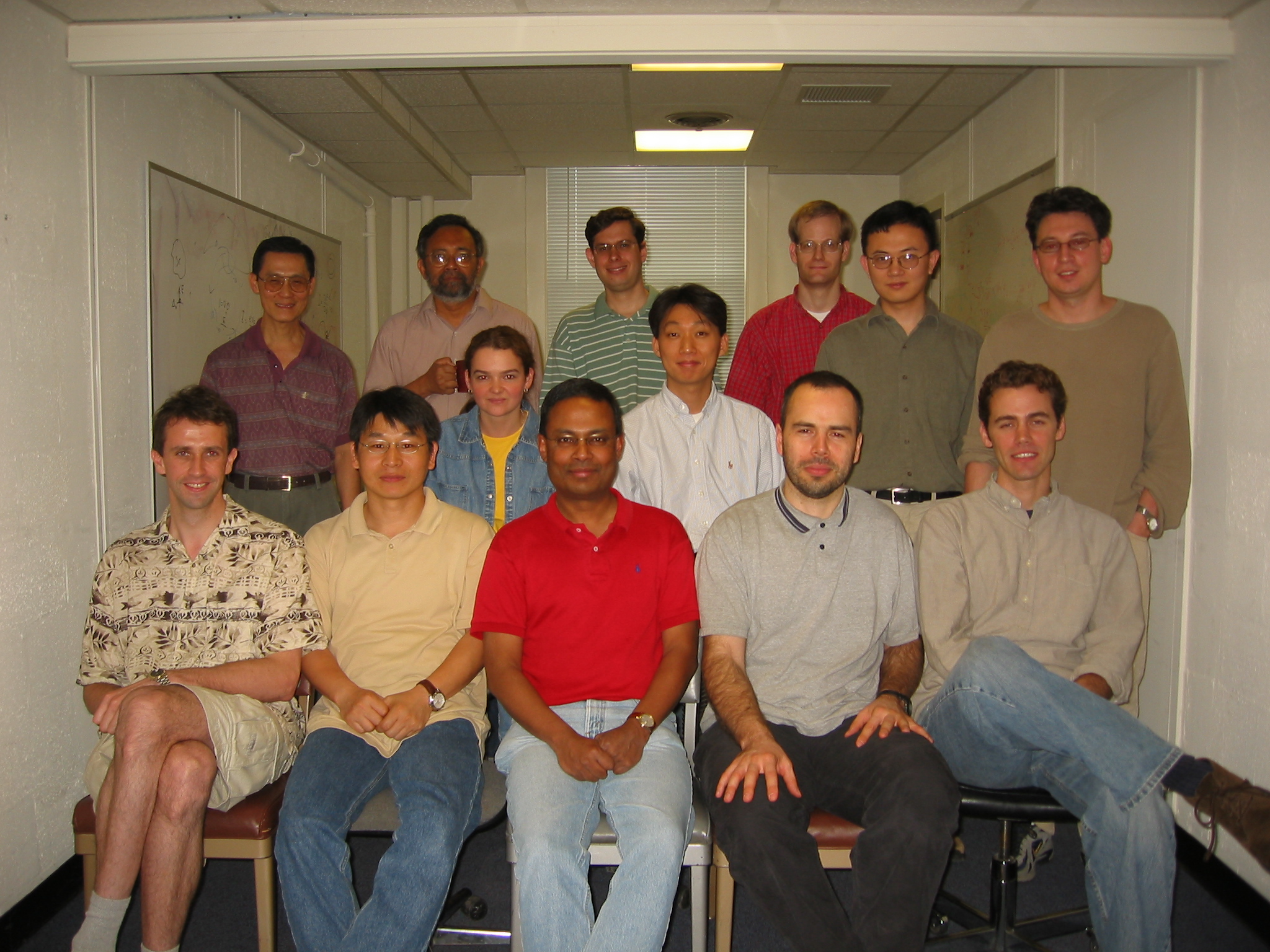
Das Sarma wrote the selected paper, Dielectric function, screening, and plasmons in two-dimensional graphene, with Euyheon Hwang. Hwang earned his doctorate in 1996 under Das Sarma, and after appointments as a UMD research associate and assistant research scientist, accepted a faculty post at Sungkyunkwan University (SKKU) in South Korea.  He is one of about 100 of Das Sarma’s students and postdocs who have gone on to faculty appointHwang DasSarma 2003Euyheon Hwang (seated, yellow shirt) and Sankar Das Sarma (red shirt) with CMTC colleagues in 2003.ments.

Hwang and Das Sarma have written about 120 articles together, including 88 papers in PRB from 1994 to 2019.

The milestone paper was published in 2007 and has 1,744 citations. In it, the authors developed a many body theory for the dynamical dielectric function of doped graphene at an arbitrary wave vector and frequency.   The dielectric function directly determines many physical properties, including electrical and optical properties.  This ‘milestone’ publication by Hwang and Das Sarma has been instrumental not only in the development of the fundamental physics of graphene, but has also ushered in the technological field of ‘graphene plasmonics’ which is being widely pursued worldwide for practical engineering use in optics and photonics.

Das Sarma, the Richard E. Prange Chair in Physics, is a Distinguished University Professor, a Fellow of the Joint Quantum Institute, and the director of the Condensed Matter Theory Center. He is internationally known for his work on topological quantum computation, Majorana physics, spin quantum computation, many body phenomena, quantum localization and nonequlibrium statistical mechanics, and has recently entered into the study of twisted bilayer graphene and higher-order topological systems. Google Scholar counts 90,227 citations and calculates an h-index of 124.


(link sends e-mail)
 

More Articles …

  1. Nick Butch Honored by NIST
  2. PRA Highlights Work of Ian Spielman
  3. Monroe Elected OSA Fellow
  4. Beverly Berger Receives APS Isaacson Award
  5. UMD Welcomes 16-year-old Ph.D. Student

Page 52 of 155

  • 47
  • 48
  • 49
  • 50
  • 51
  • 52
  • 53
  • 54
  • 55
  • 56
  • Physics Administration
  • Directions
  • Awards
  • Student Awards
  • Make a Donation
  • News
    • Research News
    • Department News
    • Newsletters
  • PTK Policy

College and Department Links

Department of Physics

Physical Sciences Complex
4296 Stadium Dr
College Park, MD 20742
Phone: 301.405.3401

Information

  • Campus Directory
  • Undergraduate Research
  • Scholarships
  • Prospective Undergraduates
  • Directions & Transit
  • Web Accessibility
© 2026 University of Maryland - Department of Physics
Top
  • Home
  • About Us
    • Physics Administration
    • Directions
    • Awards
    • Student Awards
    • Make a Donation
    • News
      • Research News
      • Department News
      • Newsletters
    • PTK Policy
  • People
    • All
    • Faculty
      • Current
      • Emeritus
      • Adjunct
      • Affiliate
      • Research Professors
    • Research Scientists
    • Postdocs
    • Staff
    • Lecturers
    • Visitors
    • Graduate Students
  • Research
    • Research Areas
      • AI and Physical Sciences
      • Astro Metrology
      • Atomic, Molecular & Optical
      • Biophysics
      • Chemical Physics
      • Condensed Matter Experiment
      • Condensed Matter Theory
      • Cosmic Ray Physics
      • Elementary Particles
      • Gravitation Experiment
      • Gravitational Theory
      • High Energy Physics
      • Nonlinear Dynamics, Chaos and Complex Systems
      • Nuclear Physics
      • Particle Astrophysics
      • Physics Education Research
      • Plasma Physics
      • Plasma Theory
      • Quantum Science and Technology
      • Quarks, Hadrons and Nuclei
      • Space Physics
    • Centers & Institutes
  • Academics
    • OSES Home (Student Services)
    • OSES News
    • Undergraduate Program
      • Prospective Students
      • Apply Now
      • Degree Requirements and Policies
      • Scholarships
      • Undergraduate Research
      • Advising
      • Undergraduate Forms
      • Undergraduate Events
      • Departmental Honors
      • Society of Physics Students
      • FAQ
      • Undergraduate Student Committee
    • Graduate Program
      • Prospective Students
      • Open House
      • Degree Requirements
      • Graduate Resources
      • Deadlines and Forms
      • PhD Defenses
        • PhD Defenses 2026
        • PhD Defenses 2025
        • PhD Defenses 2024
        • PhD Defenses 2023
        • PhD Defenses 2022
        • PhD Defenses 2021
        • PhD Defenses 2020
        • PhD Defenses 2019
        • PhD Defenses 2018
        • PhD Defenses 2017
        • PhD Defenses 2016
      • Events
      • Scholarships & Awards
      • Qualifier
      • Graduate Student Organizations
      • FAQ
    • Student Opportunities
      • GRAD-MAP
      • Graduate Student Organizations
      • Outreach Volunteering
      • Society of Physics Students
      • NSF S-STEM Program
      • Undergraduate Research
      • The Noether Physics Society
      • Undergraduate Quantum Association
    • Courses
    • Academic Support
    • NSF S-STEM Program
    • Teaching Assistants
  • Events
    • Calendar
    • Physics Colloquia
    • W.J. Carr Lecture
    • Research Interaction Team (RIT) Math/Physics
    • Mechanick Quantum Biology Lecture
    • Irving and Renee Milchberg Endowed Lectureship
    • Charles W. Misner Endowed Lectureship in Gravitational Physics
    • Charles W. Misner Memorial Symposium
    • John S. Toll Endowed Lecture
    • Prange Prize Lecture
    • Maryland Day
    • Outreach
      • Outreach Home
      • Physics is Phun
      • Discovery Days
    • Summer Programs
      • Physics Makers Camp
      • Physics of Quidditch
      • Science Discovery Camp
      • Advanced Physics Summer Program
      • Toolkit for Success
    • CUWiP
    • Vortex Makerspace
    • QURiSE Conference
  • Services
    • Building Access Requests
    • Computing Services
    • Conference Room Reservations
    • Department Operations Directory
    • Electronic and Mechanical Development
    • Hiring Procedures
    • Lecture Demo
    • Mental Health Resources
    • Parking
    • Physics Ombudspersons
    • Printing Services
      • Poster Print Request
    • Proposal Submissions
    • Purchase Order
    • Suggestion Box
    • Textbook Information
  • Give