Undergraduate students wishing to study Physics at the University of Maryland must first apply to and be accepted by the university. For more information about applying to UMD, visit the Office of Undergraduate Admissions website.
Students who are interested in learning more about the Physics major are welcome to contact the department to schedule a visit and talk with an academic advisor.
To schedule a visit, or a zoom session with an advisor, please email !
Prospective graduate students should visit the page for Graduate Prospective Students.
About Our Undergraduate Program
For information on the degree requirements for the Physics major, view our Degree Requirements.
Prospective Student FAQs
If your question is not answered in the information below, feel free to contact an academic advisor at .
Why study physics at UMD?
The University of Maryland offers unique opportunities and advantages for students interested in studying physics. Students receive the benefits of attending a large school, including access to a variety of research opportunities and subdisciplines, amplified by the university's geographic location. As the only public research university inside the Washington, DC beltway, students have the opportunity to do research with collaborators at nearby national institutions, including the National Institute of Standards and Technology, NASA Goddard Space Flight Center and US Army Research Laboratory. If you're interested in studying physics, UMD is a special place to do it!
How many Physics majors are there at UMD?
There are approximately 350 Physics majors enrolled at the university. Physics majors typically enjoy small class sizes and lectures set in classrooms, not large lecture halls, taught exclusively by professors, not TAs.
What classes will I need to take for the Physics major? How long does it take to graduate?
A list of courses and a sample graduation plan can both be found here. The program is designed to allow most students to graduate in no more than four years, provided they enter the university prepared to take Calculus 1 in their first semester.
How does Advanced Placement and International Baccalaureate credit apply for Physics majors?
Advanced Placement credit applies towards required Physics major courses as follows:
- AP Calculus AB - score of 4 or 5 = MATH140 (Calculus 1)
- AP Calculus BC - AB subscore of 4 or 5 = MATH140 (Calculus 1)
- AP Calculus BC - score of 4 or 5 = MATH141 (Calculus 2)
- AP Physics C Mechanics - score of 4 or 5 = PHYS171 (Introductory Physics 1: Mechanics & Relativity)
- AP Physics C Electricity & Magnetism - score of 5 = PHYS272 (Introductory Physics 2: Fields)*
*Students who earn AP credit for PHYS272 may still be advised to take the course at UMD. Students will be able to discuss these options with their academic advisor when they register for their first semester of courses during summer orientation.
AP Physics 1 and 2 and IB Physics HL will count for elective credit for Physics majors.
For a full list of how AP and IB courses transfer to the university, visit the Transfer Credit Services website.
What are the opportunities for undergraduate research?
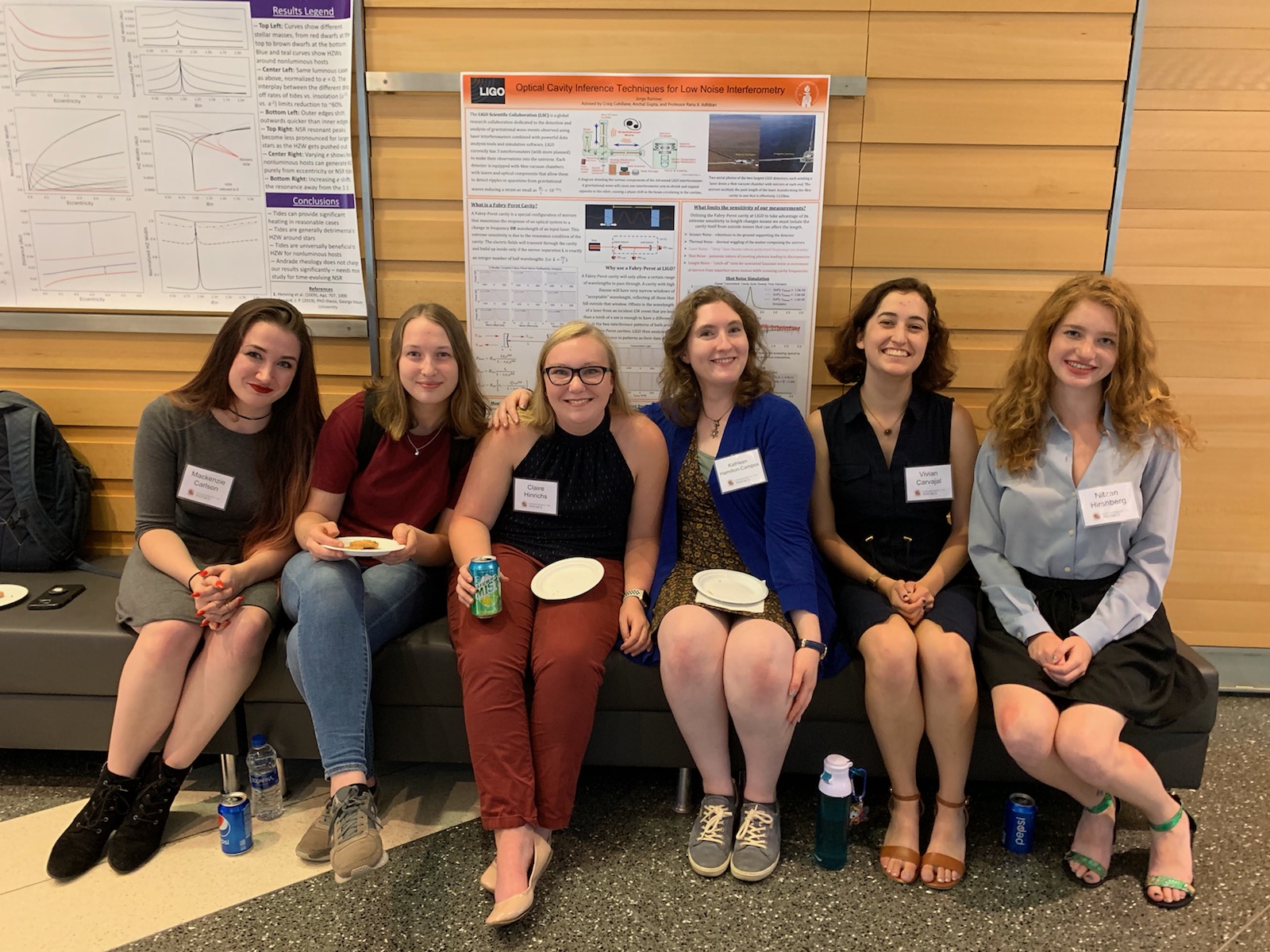
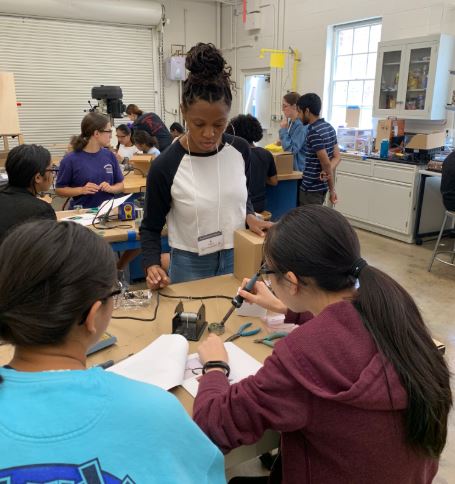
We strongly encourage all Physics majors to get involved in research early during their time in the department. The best way to learn what it's like to be a professional physicist is to get in the lab! We hold an annual Undergraduate Research Fair in the fall, where professors present on their research and offer students a chance to learn more and discuss opportunities for long-term lab positions. Students can also participate in research for credit, as approved by the sponsoring professor and their advisor.
What opportunities are available for Physics majors after graduation?
Many of our Physics majors will go on to graduate school, most frequently in Physics but also in related fields like astronomy, geophysics, atmospheric and oceanic science, and engineering. Of graduates who go on to work immediately after graduation, nationally roughly two-thirds of students work in the private sector, while others teach high school, work for the government (including in national laboratories), and join the military. More information is avaialble from the American Institute of Physics.
How can students get involved in the department?
The Physics Department organizes a wide variety of events designed to immerse students in the research, culture, and community of the department. These include Maryland Day, the All-Majors Meeting, the Undergraduate Research Fair, and the Undergraduate Research Showcase. Click here for more information about events.