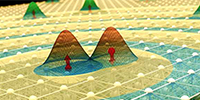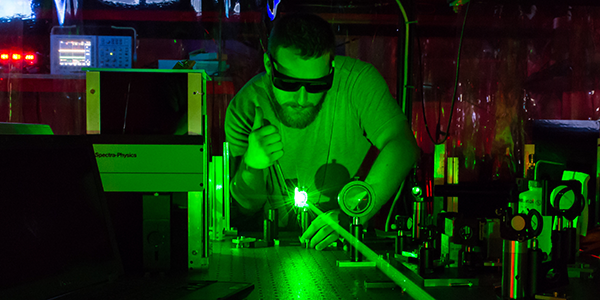
Quantum researchers study systems that harness the rules of the low-energy microscopic world to process information in new ways, distinct from conventional digital logic. The field brings together theorists and experimentalists who study a variety of systems, from neutral atoms and ions to photonic chips and topological materials. Major future applications of quantum information science include quantum computers capable of finding speedy solutions to certain computational problems, machines tailormade for simulating quantum physics and high-precision sensors.
Personnel












Research Areas
- Quantum computation, experiment and theory
- Quantum networks
- Quantum simulation
- Quantum materials (superconductivity, magnetism, strongly correlated electron physics, and topological matter)
- Quantum sensors
- Theoretical condensed matter physics
- Quantum optics
- Atomic physics-based precision measurements
- Strong field physics
- Bose Einstein condensates and degenerate Fermi gases
Related Centers and Institutes:
- Condensed Matter Theory Center
- Institute for Research in Electronics and Applied Physics
- Joint Center for Quantum Information and Computer Science (QuICS)
- Joint Quantum Institute
- Quantum Materials Center
- Quantum Technology Center
Quantum News
New Chip-Based Frequency Combs Demonstrate Potential for Portable Atomic Clocks
The world would look radically different without rulers and measuring tapes that fit into a pocket. Carpenters, fashion designers and engineers rely on these trusty tools to check the size of...
Quantum Device Simulates Matter “Popping” into Existence
A team led by faculty at the Duke Quantum Center (DQC) , in collaboration with researchers at the JQI, has used a small number of atoms to simulate an aspect of the extreme physics at play in modern...
Researchers Unlock High-Res View of 2D Materials by Doing a Microscopic Twist
By rapidly twisting a microscopically small tip back and forth, researchers at the University of Maryland (UMD) have unlocked a new way to detect subtle changes on the surface of a material flexing...