
John Biddle (Ph.D. ’13, physics) is often inspired by a challenging problem at work: How do you locate, identify or inspect something that you can’t actually see?
“It’s something that’s very interesting to me—how do you learn something about a particular thing without necessarily seeing it? How can you look inside a box without ever opening it or figure out what's under the ground,” he said. “It’s very interesting exploring the technologies you can use to see things and testing the different types of sensors that are out there to see if you can get them to work.”
Biddle is the senior scientist at Spectrohm, a McLean, Virginia tech startup where he’s developing smarter sensing technologies that can ‘see’ inside everything from shipping boxes to backpacks. The company aims to disrupt the screening and inspection industry by providing a safe, cost-effective way to screen the billions of cargo containers, e-commerce packages and personal items that travel worldwide every year but often go uninspected.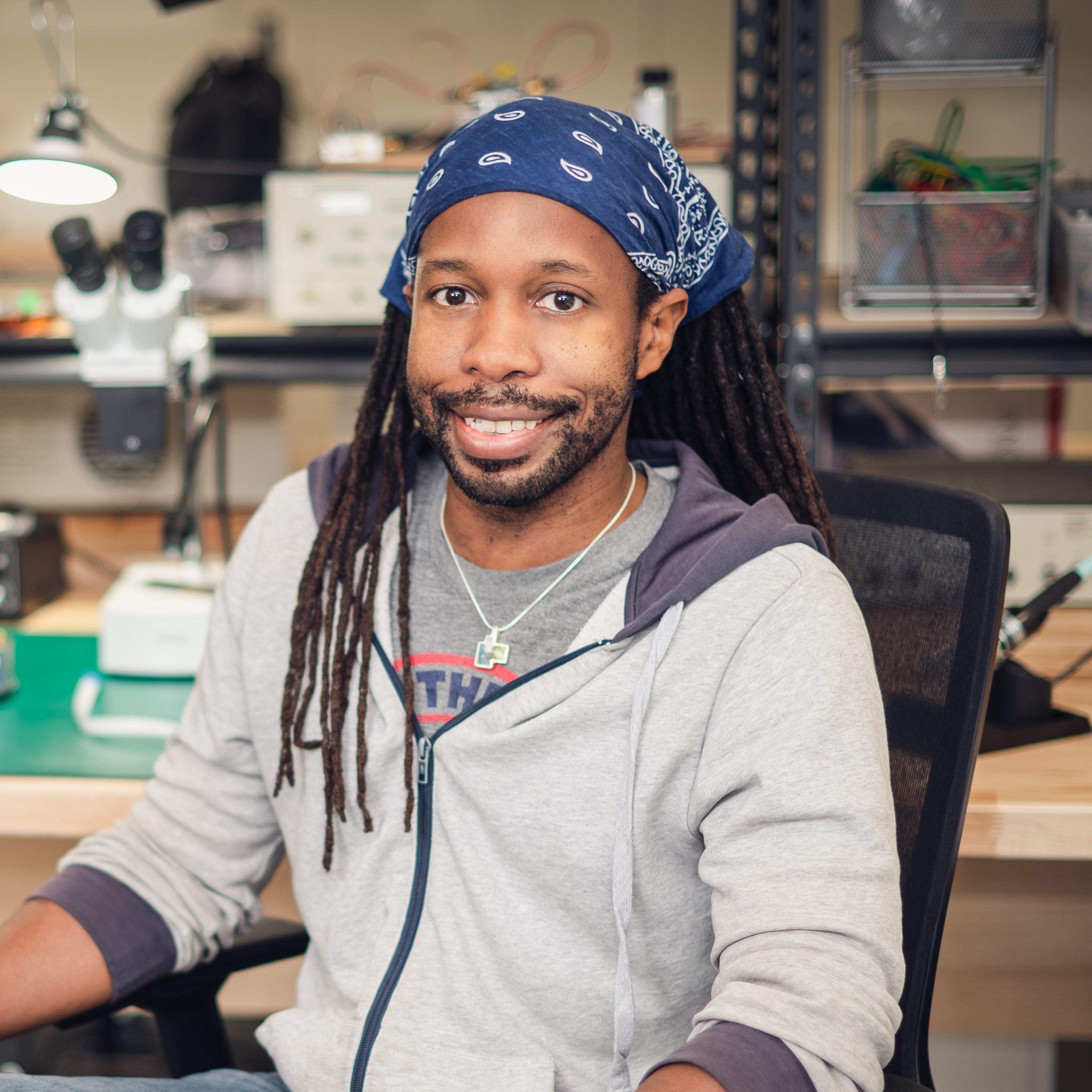 John Biddle
Instead of X-rays or manual searches, Spectrohm’s unique approach uses radio frequency imaging technology paired with artificial intelligence to rapidly inspect packages and identify prohibited or dangerous contents—imagine a system that can scan a backpack crammed full of stuff and quickly determine whether the liquid in a plastic bottle inside is water, milk or gasoline.
“We’re piloting a system called CheckStream, and that system would be used to look at, say, a backpack or a bag, identify what’s in it and decide whether there is a threat inside it or not,” Biddle explained. “Another system called CargoStream is for applications like mail and package screening, cargo and commercial inspection, and that’s our more advanced system that’s basically creating internal images of what’s inside.”
The goal is to create problem-solving automated sensing systems that are safe, cost-effective and user-friendly.
“There are a lot of packages that are sent around the world that are allowed to go through without actually being checked, because there are so many and the cost of going through all of them would be pretty high with current technology,” Biddle said. “We’re trying to lower that barrier to make the screening process easier.”
Discovering the beauty of physics
Growing up in Little Rock, Arkansas, Biddle was an inquisitive kid who competed in math contests and tinkered with Radio Shack electronics kits. His fascination with science took him all the way to Harvard, where, as an undergraduate, he discovered the beauty of physics.
“I think it was when I first took my electricity and magnetism courses, where I thought, wow, this is really cool stuff. Once you kind of get past that initial barrier of entry, you can see things that look kind of beautiful; you also see how so many things can be explained with just very few first principles,” he said. “That really intrigued me.”
In 2004, after graduating with a degree in physics and electrical engineering, Biddle landed a position as a research associate at the Institute for Defense Analyses (IDA), a nonprofit Washington, D.C. think tank, where he got his first introduction to sensing technology.
“I landed in the science and technology division, where they were consulting about acquiring new technologies,” Biddle said. “At the time, there was a big focus on landmines and improvised explosive devices, so there were plenty of new technologies claiming they could either detect or mitigate these threats. And the question for us was how could we test to see if these technologies work.”
In 2006, inspired by the colleagues with physics doctorates he worked with at IDA—including many who studied at the University of Maryland—Biddle decided to take his physics education to the next level. He began his graduate work in condensed matter physics at UMD, exploring Anderson localization and quasi-disordered systems and doing innovative research with his advisor, Distinguished University Professor Sankar Das Sarma.
“He was well-known in the field, and what was great was that he was on top of a lot of different topics, so he always had a good sense of the next big thing people were working on,” Biddle recalled. “I would typically do a lot of research on my own and then come back and do a gut check with him. And then, at some point, he’d say, ‘Okay, we're at the point where I think this is going to turn into a publication.’ So, I had three or four research publications during that time.”
‘It’s cutting-edge research, and it’s fun’
After earning his Ph.D., Biddle joined IDA’s research team full time, continuing his work with sensing systems.
“I looked at a wide range of different sensing technologies like ground-penetrating radar, metal detection and acoustics to see how accurately they could identify what’s underground or what’s inside a package,” he explained. “I enjoyed the challenge.”
Then one night in 2019, a decision to attend a D.C. Tech Meetup event opened the door to a whole new opportunity.
“The founder of Spectrohm and I happened to sit next to each other,” Biddle explained, “and it was one of those things where the person next to you turns to you and says, ‘What do you do?’ And I said, ‘I'm a physics Ph.D., and I've been working on sensing technology. And he was like, ‘Really? I happen to be working on sensor technology too.’ The rest is history.”
In 2021, Biddle made the move to Spectrohm, and since then, he’s been drawing from his physics background and sensing experience to work on the company’s high-speed inspection systems, applying his scientific skills in ways he would have never envisioned a decade ago.
“There's a lot of applied physics because I'm doing lots of electricity and magnetism modeling. We have to turn these signals from the sensing technology into something that’s human-interpretable. So that involves taking certain sensors, having a model for how we think the sensors will respond and then doing essentially an inverse problem—we have a sensor output, so what can we say about what's inside the portal,” Biddle explained. “They’re hard problems, but it's cutting-edge research, and it's fun.”
And Biddle believes they’re just scratching the surface of what these innovative sensing technologies can do.
“There could be plenty of applications,” Biddle said, “like security situations where you have people coming in with bags and backpacks, but you want to check to make sure their bags don't have a threat without using very cumbersome technology like X-rays. Or for logistics, if you have a lot of products going down the assembly line, and you want to check to make sure things are okay without manually inspecting every single item on the line. Our technology can do that.”
As Spectrohm’s products begin to enter the marketplace, Biddle still sees more testing and problem-solving on the road ahead. But it’s work he enjoys, science that’s challenging and especially meaningful because he’s making a difference.
“There’s definitely something rewarding about this work, and it's not just seeing the research come to fruition,” he said. “Most of all, seeing your work turn into an actual product and being able to say, ‘We made that,’ that’s very cool. Having that kind of impact, making something that makes someone's life easier