
They helped design and build the IceCube Neutrino Observatory’s data storage, analysis and real-time alert systems, and they currently play a major role in operating the observatory and analyzing the data.
Francis Halzen, a professor of physics at the University of Wisconsin–Madison, was awarded the 2026 Nobel Prize in physics on October 6, "for decisive contributions to the IceCube Neutrino Observatory and the discovery of high-energy neutrinos of astrophysical origin." Halzen proposed using the deep Antarctic ice under the South Pole as a neutrino detector in 1988 and has led the effort since. In announcing the prize, the Nobel Committee noted that he "has led an international team of researchers and engineers."
That team now includes about 450 scientists from 14 countries and 58 institutions, including the University of Maryland. The Maryland IceCube team joined the collaboration 25 years ago, before IceCube’s construction began, and hosts one of its largest collaborating groups. The group currently includes faculty members Greg Sullivan, Kara Hoffman, Erik Blaufuss, Michael Larson and Brian Clark; software engineer Don La Dieu; postdoctoral scholars Bennett Brinson and Rachel Procter-Murphy; and graduate students Taylor St Jean, Emma Tintinger and Aishwarya Vijai. Over the years, the group has advised 17 graduate students.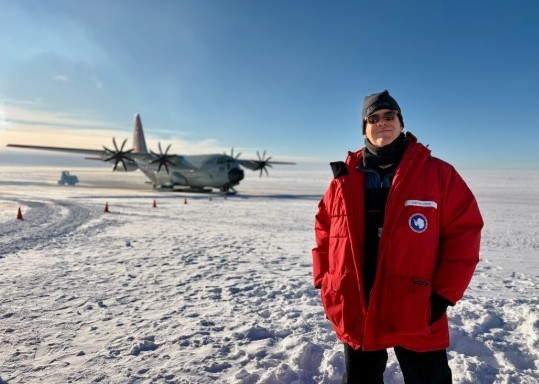 Erik Blaufuss (above) and Rachel Procter-Murphy (below) at South Pole station, Antarctica this past season (Dec 2025 - Feb 2026) Credit: E. Blaufuss
UMD physicists helped lead the design and construction of IceCube’s computer data systems, developed the software used to analyze the data and built an alert system that allows telescopes worldwide to make coordinated observations of interesting events within minutes. They currently play a major role in operating the observatory and lead a major share of the collaboration's data analysis.
“This year's Nobel Prize in physics recognizes a transformative vision that opened a new window on the universe. I congratulate Francis Halzen and the entire IceCube team on this well-deserved honor,” said Amitabh Varshney, dean of UMD’s College of Computer, Mathematical, and Natural Sciences. “We are proud of the University of Maryland researchers who contributed to this vision over a quarter century and continue to advance neutrino astronomy and deepen our understanding of the cosmos’s most powerful phenomena.”
Running the detector
The IceCube Neutrino Observatory consists of a cubic kilometer of Antarctic ice with more than 5,000 light sensors, buried up to 2.5 kilometers deep. It has recorded data nearly continuously since its completion in 2011. A National Science Foundation-funded maintenance and operations program keeps it that way, covering everything from the computers at the South Pole to the software that turns raw flashes of light into usable data. To support this effort, the Maryland group maintains several core software systems responsible for the analysis, filtering and simulation of IceCube data. UMD has the largest role in this effort, outside of the University of Wisconsin, with Physics Professor Greg Sullivan as the Maryland lead for maintenance and operations since 2010 and Physics Research Scientist Erik Blaufuss recently assuming that role. Sullivan also served as IceCube's spokesperson as the completed detector began operating and the collaboration made its first observation of cosmic neutrinos.
“This recognition for Francis is very well deserved,” Sullivan said. “There is no question that without his vision and perseverance there would be no field of neutrino astronomy. I always recall the time about 35 years ago when I first met Francis at a workshop and he was advocating for building a neutrino telescope of one cubic kilometer in scale in the South Pole ice. At first blush, I thought to myself he was crazy! But, fortunately for me, after talking with him over time, he convinced me of his vision. I joined as the lead scientist from UMD at the start of the formal IceCube project over two decades ago. I am very grateful to his leadership and vision, which have benefited so many of us, including a large IceCube group that has grown at UMD.”
Physics Assistant Research Scientist Michael Larson is now the collaboration's technical lead, responsible for the detector's technical operation across all member institutions.
"IceCube is a unique instrument,” Larson said. "The bulk of our detector is frozen into the Antarctic glacier, so we can’t easily fix the sensors if things go wrong; everything must work the first time and continue working for years. Researchers around the world are constantly working together to keep the detector running in these extreme conditions and hundreds more are working to improve the science we can do with it every day."
Doing the science
Kara Hoffman, Professor and Chair of UMD’s Department of Physics, is the principal investigator of the collaboration's current analysis program, which supports the work of turning billions of recorded events into published results. Her research ranges from gamma-ray burst searches to next-generation detection techniques.
“The science reach of IceCube has far exceeded its original design goals,” Hoffman said. “Not only have we discovered astrophysical neutrinos, but we are making world-competitive measurements of neutrino oscillations and, thanks to the alert program developed at UMD, we are playing an essential role in astronomy.”
Blaufuss led the creation of IceCube's real-time alerts, which notify telescopes worldwide, usually within a minute, when the detector sees a likely cosmic neutrino. On September 22, 2017, one of those alerts led observatories to a flaring blazar, TXS 0506+056. IceCube then searched its archive and found an earlier burst of neutrinos from the same direction. The two results, published in the journal Science in 2018, made TXS 0506+056 the first strong candidate source of high-energy cosmic neutrinos. Blaufuss was also lead author on the 2019 expansion of the alert program, and the alerts are now a routine part of multimessenger astronomy.
“Notifying the physics community quickly when IceCube detects an astrophysical neutrino enables other telescopes to make the observations that will be critical in identifying and understanding the cosmic sources of these neutrinos,” Blaufuss said.
Physics Assistant Professor Brian Clark previously led the collaboration's diffuse working group, which measures the flux of astrophysical neutrinos at the center of this year's prize. He now chairs IceCube's speakers committee, which decides who presents the collaboration's results at conferences worldwide.
"Measuring the neutrino flux is hard because the signal is faint and spread across the whole sky” Clark said. “You have to understand your detector well enough to trust a teeny signal over a large background. That took years of careful work from many people, and our group is proud to have been part of it."
Maryland's science contributions are broad. Blaufuss chaired IceCube's gamma-ray burst working group when the collaboration searched about 300 bursts and found no neutrinos, contradicting 15 years of predictions. That 2012 result published in the journal Nature, which drew on a UMD graduate thesis, ruled out gamma-ray bursts as a major source of cosmic rays. UMD researchers have also contributed to IceCube's measurements of neutrino oscillations with DeepCore, the detector's densely instrumented inner core. Recent work from the group has focused on finding multi-messenger counterparts to neutrinos by searching for neutrinos coincident with TeV gamma-ray sources, bright optical flashes and tidal disruption events. They have also searched for the yet-undiscovered flux of extremely high-energy neutrinos, above the PeV scale, which was named to Physical Review Letters “Collection of the Year” in 2025.
What's next
The IceCube collaboration finished deploying the IceCube Upgrade early this year. The first major expansion since 2011, it adds hundreds of new sensors in a dense cluster at the center of the IceCube array. It will sharpen IceCube's understanding of the glacial ice properties and of low-energy neutrinos, and it is a step toward the proposed IceCube-Gen2, roughly eight times larger than the current IceCube detector. Maryland also contributed to that work on the ice: Blaufuss and Rachel Procter-Murphy, then a Ph.D. student, traveled to the South Pole to help bring the Upgrade online.
Maryland is also helping develop IceCube-Gen2 itself, the proposed next-generation observatory that would take neutrino astronomy to the next level. Gen2 would combine a much larger optical array with a radio array spread across the ice surface, built to catch rare neutrinos at energies far beyond IceCube's reach. UMD is a leader in that radio technique. Hoffman pioneered the technique on the Askaryan Radio Array (ARA) at the South Pole, and Clark works on both ARA and the Radio Neutrino Observatory in Greenland (RNO-G).