
Three Assistant Professor members of the Quantum Materials Center (QMC), who joined the UMD Department of Physics as new faculty in the last three years, have been honored for groundbreaking research on understanding and manipulating novel multi-layered materials at the atomic scale.
Aaron Sternbach was chosen for both a Department of Energy (DOE) Early Career Award and a Faculty Early Career Development (CAREER) Award from the National Science Foundation (NSF). Sternbach’s DOE proposal for “terahertz near-field spectroscopy of twisted 2D materials and few-layer heterostructures” will be funded for $875,000 over five years. The NSF will support his work on “collective motion of ferroelectric polarization in van der Waals dihalides” with $699,999 over five years.
Ryo Mori has also received a DOE Early Career Award of $875,000 for his project, “light-Induced nonequilibrium in antiferromagnetic van der Waals semiconductors: Electronic, excitonic, and spin-coupled origins.”
Shu Yang Frank Zhao has been selected for the 2026 Lee Osheroff Richardson Science Prize based on his “contributions to unconventional superconductivity in layered crystals and their interfaces.”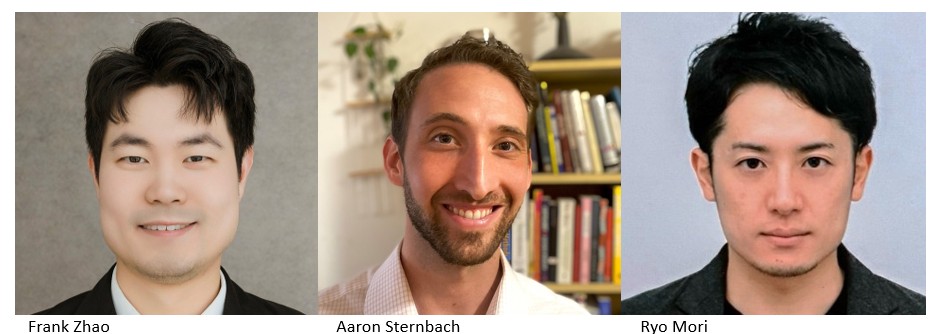
Sternbach earned his Ph.D. at Columbia University and accepted an Energy Frontiers Postdoctoral Fellowship there before joining UMD in 2024. Mori joined UMD in 2025 after completing his Ph.D. and postdoctoral research at the University of California, Berkeley, and serving as a research associate at the Institute for Solid State Physics of the University of Tokyo. Zhao also joined the university in 2025, having received his Ph.D. at Harvard University followed by a postdoctoral appointment at MIT.
Sternbach’s work involves determining and controlling the properties of layered materials, which assemble as sheets of one-atom-thin layers. (To visualize this, imagine two sheets of window screen laid one atop the other. Rotating the relative angles of the sheets produces a range of different patterns depending on the angle.) There’s a huge library of these layered materials with fascinating and useful attributes. Layer-by-layer assembly of heterostructures – stacks in which each layer is an entirely different material – at selected relative twist angles creates additional exciting opportunities to engineer properties by design. Examining these materials using terahertz light – with frequencies of trillions of cycles per second – can reveal many of the behaviors of layered materials that are relevant for the speed, energy cost, and heat generated by electronic devices.
Microscopically studying those terahertz vibrations, however, is seriously challenging. Most high-quality 2D materials explored in research labs are tiny. Their local properties can’t be clearly resolved at terahertz wavelengths that range from about 3 mm to 0.03 mm. So Sternbach’s research group is employing a very small metal tip held just above the layer that acts somewhat like a lightning rod to “superfocus” terahertz radiation onto the materials, providing a spatial resolution around 10 billionths of a meter. That’s about 5,000 times sharper than the wavelength of the light itself, equivalent to seeing a single pebble on a football field. The technique will advance understanding of how stacked two-dimensional materials can alter lossless electronic transport as well as engineer heat and polarization.
Mori’s research investigates how light can affect the properties of layered magnetic semiconductors in which electronic behavior and magnetism are closely intertwined. A major challenge is identifying the microscopic processes responsible for the changes observed when these materials are exposed to light. For example, changes in electron populations or interactions can produce similar signals in conventional optical measurements.
To identify the underlying mechanisms, Mori’s team will use short laser pulses to excite the materials and then analyze the electrons released when a second light pulse is applied. This approach, called photoemission spectroscopy, will track changes in electron energies, motion, and spin – the quantum property underlying magnetism. The measurements will help distinguish changes in electron populations from changes in their interactions and coupling to magnetic order. By comparing several materials, the team will identify which responses are shared and which depend on a material’s particular properties. The goal is to establish principles for opto-spintronics: using light to control electronic behavior involving spin.
Zhao’s group is advancing condensed matter physics by employing new techniques and materials to measure and manipulate unconventional superconductivity – which cannot be explained by the standard theories – in various kinds of man-made bilayer superconductors incorporating copper. Many of those cuprate materials are prone to degradation of their electrical properties in the presence of moisture, and when their surfaces are heated, even to room temperature.
To address that problem, Zhao co-developed an unusual device fabrication technique using a “glove box” scale enclosure that duplicates the functionality of a nanometer-scale device fabrication cleanroom, but inside an argon environment without any chemicals. In that environment, he has been able to create a novel superconducting state at the interface between two cuprate crystal layers, where one layer is rotated to an 45 degree angle relative to the other. Such a bilayer supports an unusual form of high-temperature superconductivity. In related work, Zhao has discovered a new superconducting crystal that survives up to extremely strong magnetic fields.
“All three faculty are new members of our center that came in the last three years, and it is an amazing accomplishment to have all three achieve such accolades so early in their careers” said Johnpierre Paglione, Professor of physics and Director of QMC. “Seeing not only one, but TWO of them receive the DOE Early Career award is incredible, and to my knowledge unprecedented. We are extremely excited to see where Frank, Ryo and Aaron are going to take their research in the future, and are already seeing how their collaborative efforts are strengthening QMC.”
“We are so proud of the accomplishments of this extraordinary cohort of young scientists. The department looks forward to supporting their future endeavors” said Kara Hoffman, Professor and Chair of the Department of Physics.