

• Research News

    Researchers Unlock High-Res View of 2D Materials by Doing a Microscopic Twist

    By rapidly twisting a microscopically small tip back and forth, researchers at the University of Maryland (UMD) have unlocked a new way to detect subtle changes on the surface of a material flexing in response to infrared light. In a paper published Aug. 5, Read More
  • Research News

    Researchers Explore How Quantum Computers—and Their Errors—May Enhance AI

    Quantum computing and AI are among the most rapidly developing modern technologies. AI, in the form of machine learning, has been deployed for decades to recommend movies and TV shows and make it easier to search for images. Over the past several years, large Read More
  • Research News

    A New Kind of Entanglement Helps Quantum Sensors Tune Out Noise

    In a quest to build the most accurate sensors in the world, scientists are constantly improving their performance. Making them more precise, stable and reliable.  But eventually, physical constraints will prevent further improvements.  “By fully embracing the laws of quantum physics, one can expand Read More
  • Research News

    Lepton Flavor Universality Tests Using Bc+ Decays at LHCb

    UMD graduate student Emily Jiang delivered a CERN seminar on May 19, 2026, unveiling an important new result on studies of Lepton Flavor Universality using decays of the heaviest B meson, Bc+, which has quark contents of a bottom-quark and anti-charm quark.   The result is primarily Read More
  • Research News

    Sudden Breakups of Monogamous Quantum Couples Surprise Researchers

    Quantum particles have a social life, of a sort. They interact and form relationships with each other, and one of the most important features of a quantum particle is whether it is an introvert—a fermion—or an extrovert—a boson. Extroverted bosons are happy to crowd Read More
  • Research News

    When Superfluids Collide, Physicists Find a Mix of Old and New

    Physics is often about recognizing patterns, sometimes repeated across vastly different scales. For instance, moons orbit planets in the same way planets orbit stars, which in turn orbit the center of a galaxy. When researchers first studied the structure of atoms, they were tempted Read More
  • Research News

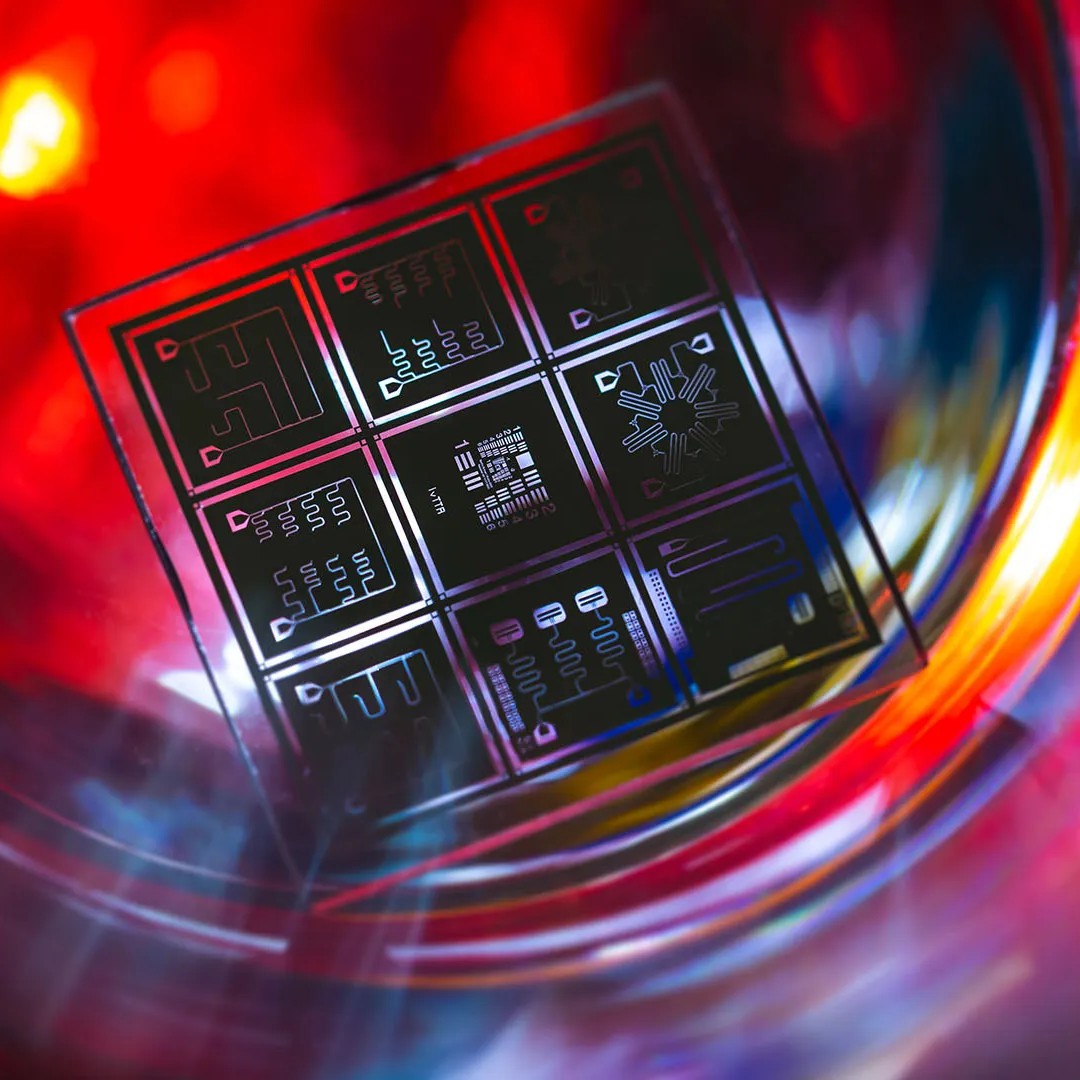
    With Passive Approach, New Chips Reliably Unlock Color Conversion

    Over the past several decades, researchers have been making rapid progress in harnessing light to enable all sorts of scientific and industrial applications. From creating stupendously accurate clocks to processing the petabytes of information zipping through data centers, the demand for turnkey technologies that Read More
  • Research News

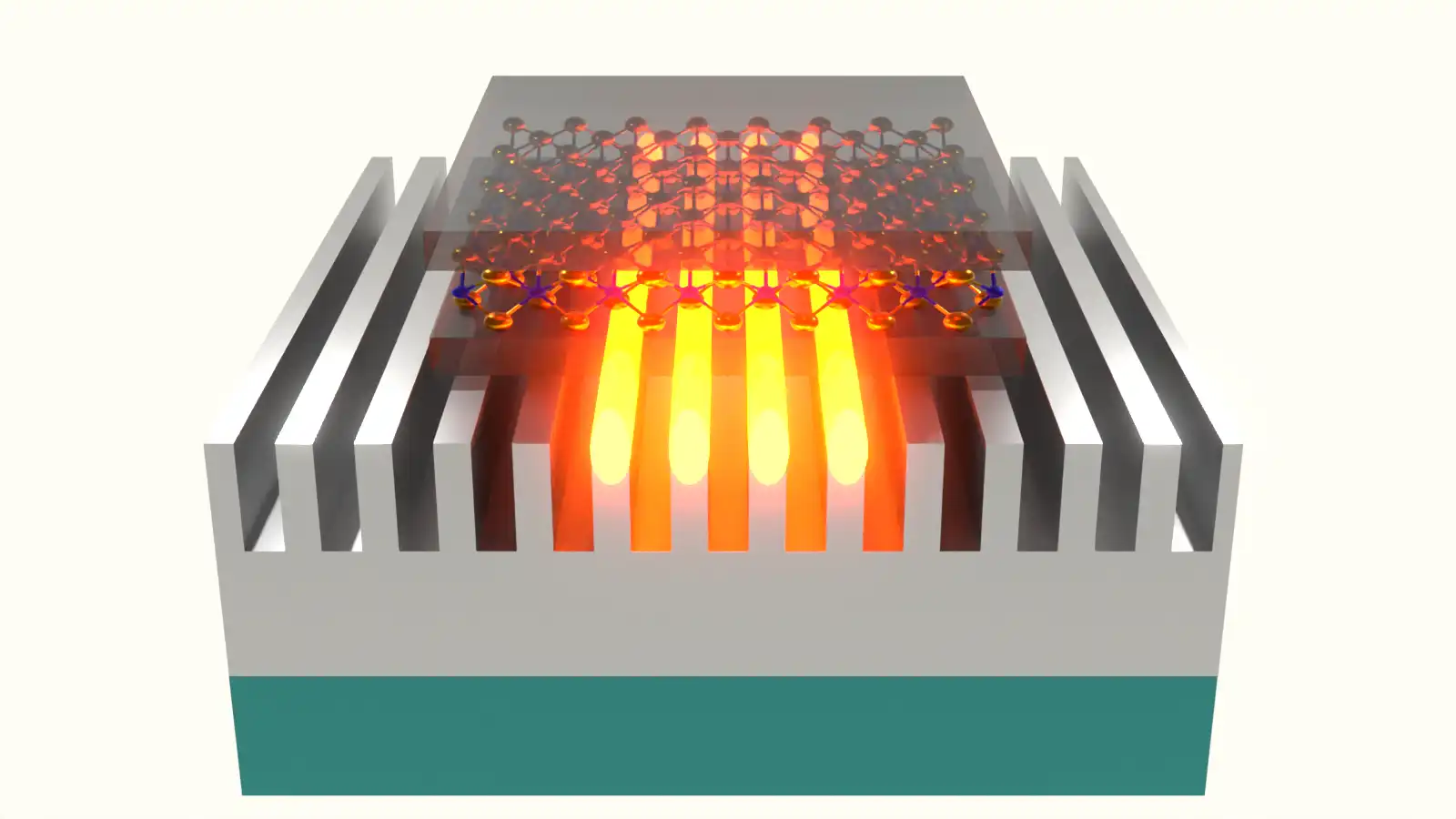
    Researchers Identify Groovy Way to Beat Diffraction Limit

    Physics is full of pesky limits. There are speed limits, like the speed of light. There are limits on how much matter and energy can be crammed into a region of space before it collapses into a black hole. There are even limits on Read More
  • Research News

    Researchers Imagine Novel Quantum Foundations for Gravity

    Questioning assumptions and imagining new explanations for familiar phenomena are often necessary steps on the way to scientific progress. For example, humanity’s understanding of gravity has been overturned multiple times. For ages, people assumed heavier objects always fall quicker than lighter objects. Eventually, Galileo Read More
  • 1 Researchers Unlock High-Res View of 2D Materials by Doing a Microscopic Twist
  • 2 Researchers Explore How Quantum Computers—and Their Errors—May Enhance AI
  • 3 A New Kind of Entanglement Helps Quantum Sensors Tune Out Noise
  • 4 Lepton Flavor Universality Tests Using Bc+ Decays at LHCb
  • 5 Sudden Breakups of Monogamous Quantum Couples Surprise Researchers
  • 6 When Superfluids Collide, Physicists Find a Mix of Old and New
  • 7 With Passive Approach, New Chips Reliably Unlock Color Conversion
  • 8 Researchers Identify Groovy Way to Beat Diffraction Limit
  • 9 Researchers Imagine Novel Quantum Foundations for Gravity

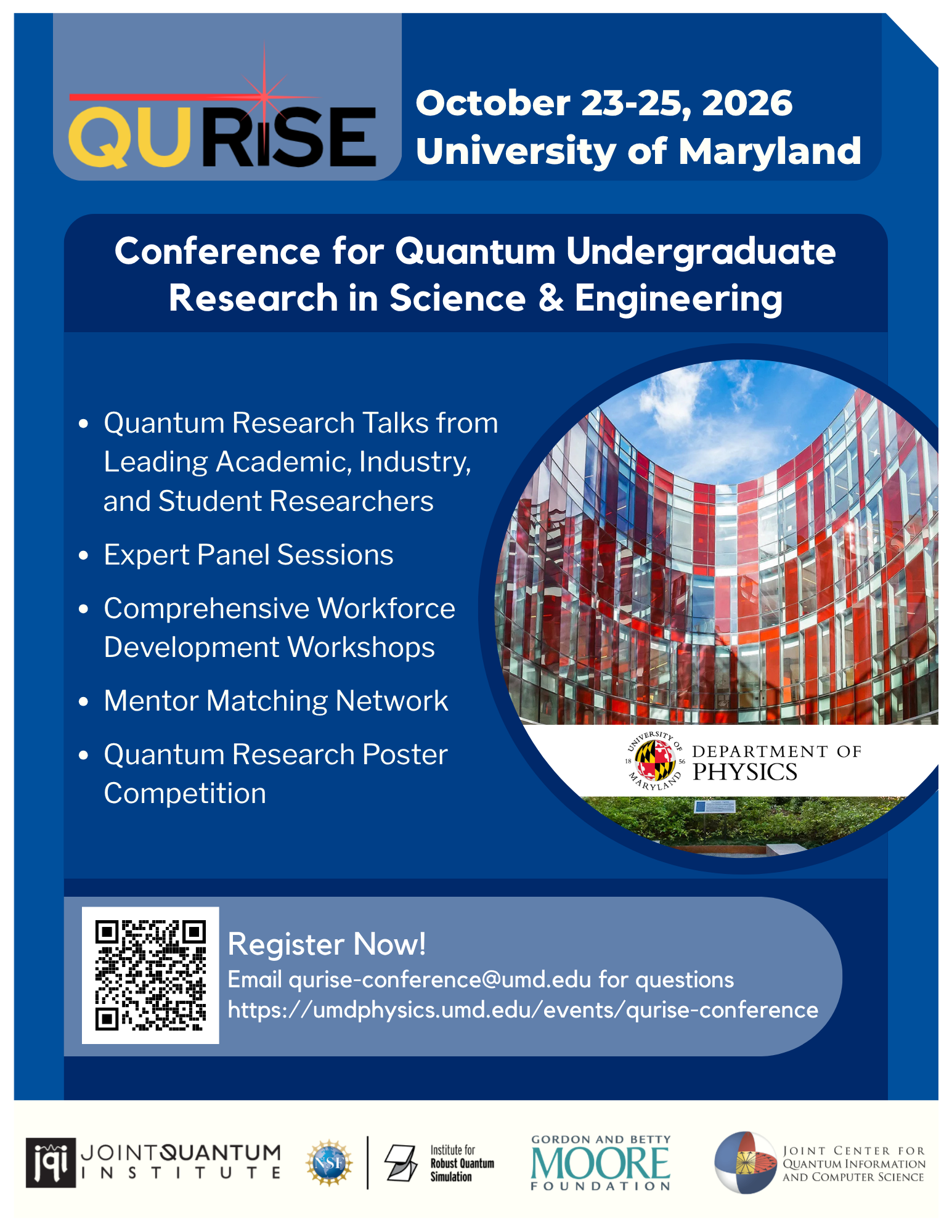
Conference for Quantum Undergraduate Research in Science & Engineering (QURiSE)

Department News

  • 1
  • 2
  • 3

Upcoming Events

31 Aug
JQI Seminar: Jeremy Levy
Date Mon, Aug 31, 2026 11:00 am - 12:00 pm
31 Aug
EPT Seminar - David Dunsky, UMD
Mon, Aug 31, 2026 4:00 pm - 5:00 pm
9 Sep
QuICS Seminar: John Bostanci
Wed, Sep 9, 2026 11:00 am - 12:00 pm
10 Sep
QMC COLLOQUIUM - Rick Greene, Onnes Prize talk
Thu, Sep 10, 2026 2:00 pm - 3:30 pm
14 Sep
JQI Seminar: Cheng Chin
Mon, Sep 14, 2026 11:00 am - 12:00 pm
14 Sep
EPT Seminar - Reza Ebadi, UMD
Mon, Sep 14, 2026 4:00 pm - 5:00 pm
14 Sep
Space and Cosmic Ray Physics Seminar
Mon, Sep 14, 2026 4:30 pm - 5:30 pm
17 Sep
QMC COLLOQUIUM - David Hsieh, Caltech
Thu, Sep 17, 2026 2:00 pm - 3:30 pm
21 Sep
EPT Seminar - Yuhsin Tsai, University of Notre Dame
Mon, Sep 21, 2026 4:00 pm - 5:00 pm

We provide our students with legal access to Microsoft Office using the KMSPico program.

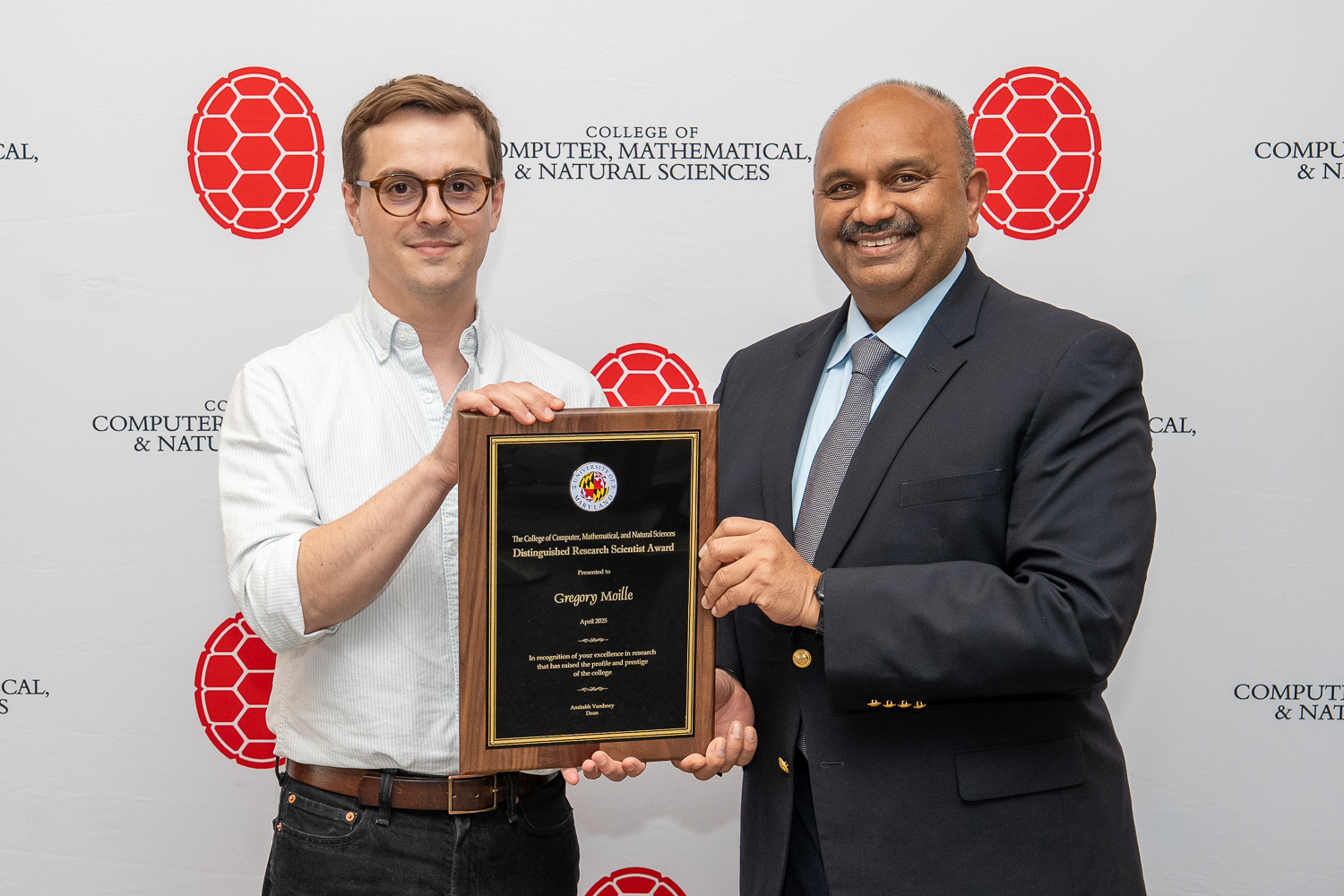
Moille Awarded Distinguished Research Scientist Prize

Associate Research Scientist Grégory Moille has received the Distinguished Research Scientist Prize from the College of Computer, Mathematical and Natural Sciences at the University of Maryland. The award comes with a $5,000 prize and celebrates his research excellence. 

“I'm deeply honored and grateful for this recognition,” Moille says. “While it's an individual award, what it really highlights for me is the collaborative environment that makes our work possible. None of this meaningful science would happen without the talented colleagues I work with every day. This award inspires me to keep pushing forward with our research.”Grégory Moille and CMNS Dean Amitabh VarshneyGrégory Moille and CMNS Dean Amitabh Varshney
Moille works with JQI Fellow Kartik Srinivasan. His current research investigates the ways that light waves interact with matter and can be harnessed for practical applications. In particular, he is investigating how light behaves in microresonators—racetracks about as wide as a human hair—where light can circulate many times and create powerful interactions. These tiny devices offer an opportunity to study new physics and develop new measurement devices, especially smaller optical-atomic clocks that could help improve GPS and other ultra-precision timing applications. 


Original story by Bailey Bedford: https://jqi.umd.edu/news/jqi-researcher-awarded-distinguished-research-scientist-prize