• Home
  • About Us
    • Physics Administration
    • Directions
    • Awards
    • Student Awards
    • Make a Donation
    • News
      • Research News
      • Department News
      • Newsletters
    • PTK Policy
  • People
    • All
    • Faculty
      • Current
      • Emeritus
      • Adjunct
      • Affiliate
      • Research Professors
    • Research Scientists
    • Postdocs
    • Staff
    • Lecturers
    • Visitors
    • Graduate Students
  • Research
    • Research Areas
      • AI and Physical Sciences
      • Astro Metrology
      • Atomic, Molecular & Optical
      • Biophysics
      • Chemical Physics
      • Condensed Matter Experiment
      • Condensed Matter Theory
      • Cosmic Ray Physics
      • Elementary Particles
      • Gravitation Experiment
      • Gravitational Theory
      • High Energy Physics
      • Nonlinear Dynamics, Chaos and Complex Systems
      • Nuclear Physics
      • Particle Astrophysics
      • Physics Education Research
      • Plasma Physics
      • Plasma Theory
      • Quantum Science and Technology
      • Quarks, Hadrons and Nuclei
      • Space Physics
    • Centers & Institutes
  • Academics
    • OSES Home (Student Services)
    • OSES News
    • Undergraduate Program
      • Prospective Students
      • Apply Now
      • Degree Requirements and Policies
      • Scholarships
      • Undergraduate Research
      • Advising
      • Undergraduate Forms
      • Undergraduate Events
      • Departmental Honors
      • Society of Physics Students
      • FAQ
      • Undergraduate Student Committee
    • Graduate Program
      • Prospective Students
      • Open House
      • Degree Requirements
      • Graduate Resources
      • Deadlines and Forms
      • PhD Defenses
        • PhD Defenses 2026
        • PhD Defenses 2025
        • PhD Defenses 2024
        • PhD Defenses 2023
        • PhD Defenses 2022
        • PhD Defenses 2021
        • PhD Defenses 2020
        • PhD Defenses 2019
        • PhD Defenses 2018
        • PhD Defenses 2017
        • PhD Defenses 2016
      • Events
      • Scholarships & Awards
      • Qualifier
      • Graduate Student Organizations
      • FAQ
    • Student Opportunities
      • GRAD-MAP
      • Graduate Student Organizations
      • Outreach Volunteering
      • Society of Physics Students
      • NSF S-STEM Program
      • Undergraduate Research
      • Women in Physics
      • Undergraduate Quantum Association
    • Courses
    • Academic Support
    • NSF S-STEM Program
    • Teaching Assistants
  • Events
    • Calendar
    • Physics Colloquia
    • W.J. Carr Lecture
    • Research Interaction Team (RIT) Math/Physics
    • Mechanick Quantum Biology Lecture
    • Irving and Renee Milchberg Endowed Lectureship
    • Charles W. Misner Endowed Lectureship in Gravitational Physics
    • John S. Toll Endowed Lecture
    • Prange Prize Lecture
    • Maryland Day
    • Outreach
      • Outreach Home
      • Physics is Phun
      • Discovery Days
    • Summer Programs
      • Physics Makers Camp
      • Physics of Quidditch
      • Science Discovery Camp
      • Advanced Physics Summer Program
      • Toolkit for Success
    • CUWiP
    • Vortex Makerspace
    • QURiSE Conference
  • Services
    • Building Access Requests
    • Computing Services
    • Conference Room Reservations
    • Department Operations Directory
    • Electronic and Mechanical Development
    • Hiring Procedures
    • Lecture Demo
    • Mental Health Resources
    • Parking
    • Physics Ombudspersons
    • Printing Services
      • Poster Print Request
    • Proposal Submissions
    • Purchase Order
    • Suggestion Box
    • Textbook Information
  • Give
  1. Home
  2. About Us
  3. News

Written on 26 January 2023. Posted in Department News.

When Higgs Fly

When Christopher Palmer was a physics graduate student at UC San Diego, he had to decide whether to specialize in supersymmetry or search for the Higgs boson.

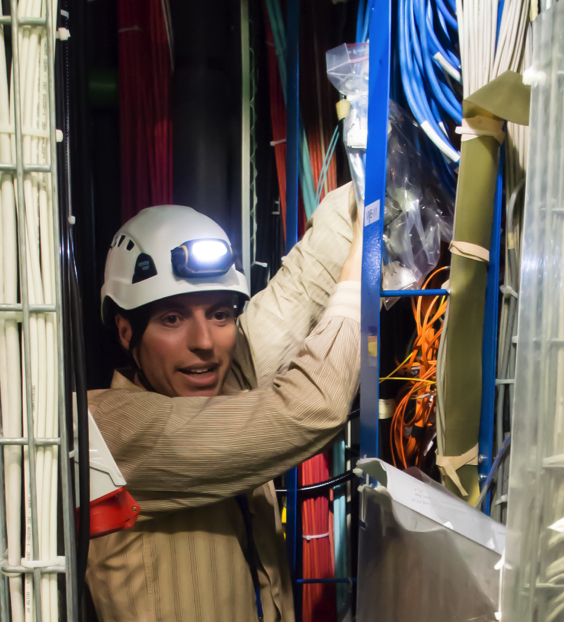
Though there was no experimental evidence of the Higgs boson’s existence at the time, Palmer was convinced that this elusive elementary particle—believed to be linked to a field that gave mass to everything in the universe—was somewhere out there.Chris PalmerChris Palmer

“The Higgs boson is such a cornerstone of a very well-established theory called electroweak theory,” Palmer said. “It could be a lack of imagination on my part, but I could not imagine the Higgs boson not existing.”

He trusted his gut and dedicated his studies to the Higgs, which set him on course to Switzerland to join one of the experiments at the Large Hadron Collider (LHC) beginning in 2010. Luck was on his side, and he ended up being part of the research group that recorded the highest number of Higgs bosons in their analyses, contributing to the particle’s official discovery the following year.

He hasn’t looked back since. In March 2021, Palmer became an assistant professor of physics at the University of Maryland, where he continues to study the Higgs in search of the next big discovery.

‘Deeply weird’ physics

Palmer’s first academic love wasn’t actually physics—it was math.

“I loved math in high school, so I thought, ‘Yeah, I’ll do math in college,’ but that was sort of my ‘hobby major’—and I’m glad it was because I ended up not enjoying mathematical proofs that much,” he said with a laugh.

A fascination with what existed “beyond Earth” prompted Palmer to declare a second major in astronomy as an undergraduate student at USC. But it wasn’t until he took an upper-level course in quantum mechanics—and became enamored with its mathematical intricacies—that he developed a deeper appreciation for physics. 

“It was a new way to use many different aspects of math,” Palmer said. “There’s linear algebra and complex numbers. Taking these integrals and mixing all that up in a pot was really fun for me. But there was also some new physics that was deeply weird, and I couldn’t get enough of it.”

Palmer needed only one quantum mechanics course to meet the requirements of an astronomy major but enjoyed it so much that he took two. After graduating with a bachelor’s degree in mathematics and astronomy in 2007, he took a short drive south to UC San Diego to continue his studies—this time as a Ph.D. student in physics.

Right place, right time

Once Palmer decided to search for the Higgs boson, he joined the Compact Muon Solenoid (CMS) experiment at the LHC. Palmer teamed up with a group that was looking for evidence of the Higgs boson’s decay into two photons during proton-proton collisions.

This turned out to be a serendipitous assignment. His group ultimately saw an enormous excess of Higgs bosons in their analysis. 

“At the time in 2011, no one else at CMS had actually seen much of anything in their data, and in my analysis there was the biggest excess of Higgs boson particles in any of CMS’ searches,” Palmer said. “The discovery was literally happening at my fingertips.”

Palmer was so focused on the work that he didn’t have time to get excited about the actual discovery of the Higgs boson, which was confirmed and publicized in 2012.

“There was a whole lot of double- and triple-checking everything in early 2012. I wasn’t sleeping all that much,” he said. “I got excited afterward.” 

With one major discovery under his belt, Palmer was hooked on Higgs. After earning his Ph.D. in 2014, he became a postdoctoral researcher at Princeton University, where he participated in luminosity experiments and studied the Higgs boson’s decay to bottom quarks—the “most elusive decay” anyone had observed up to that point. 

In 2021, Palmer joined UMD with plans to study signatures of the Higgs boson in greater detail and depth, while also having the flexibility to explore other research interests down the line. 

“One of the things that I really love about this department is that there are so many different types of research that are represented by the faculty,” Palmer said. “In 10 years, if I want to do something different, I don’t know any place where it would be easier.”

Continent-spanning research

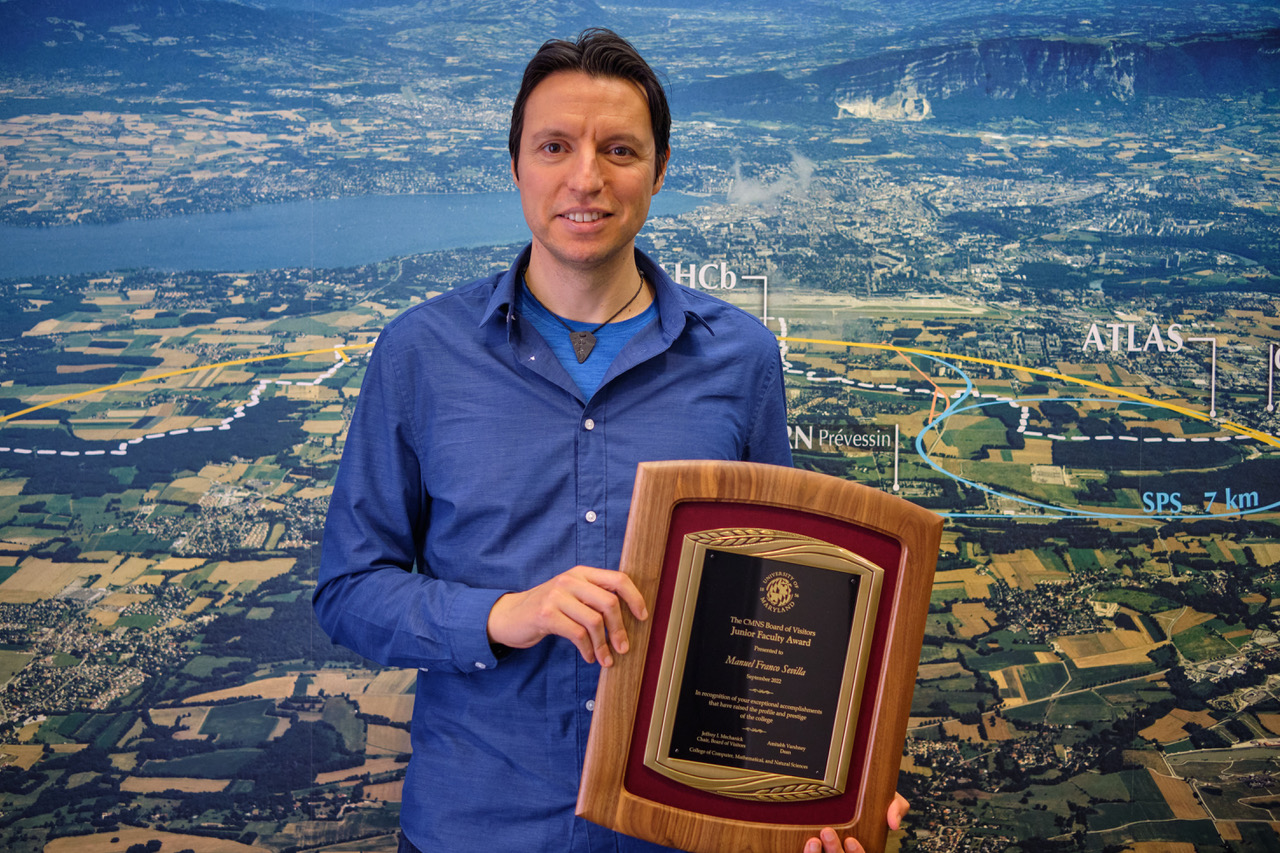
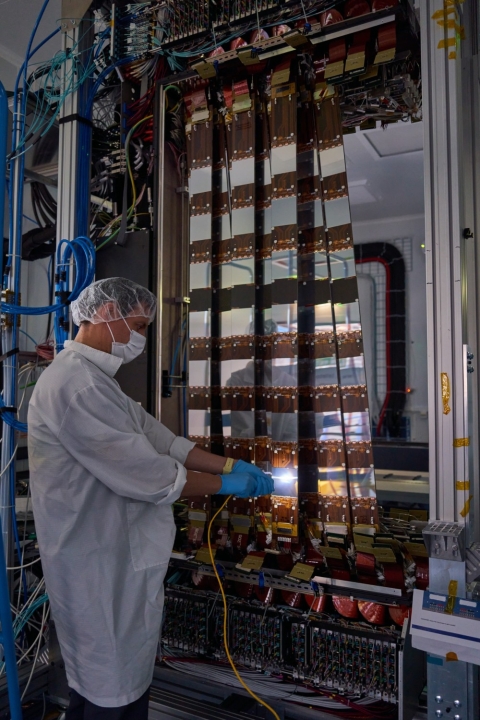
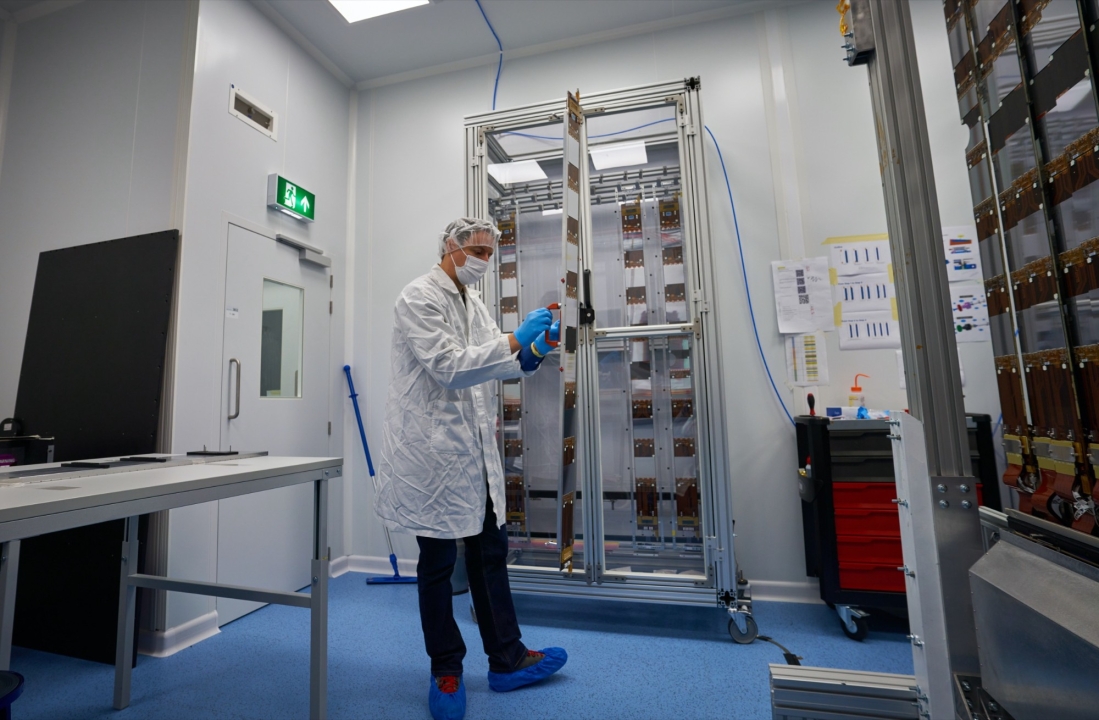
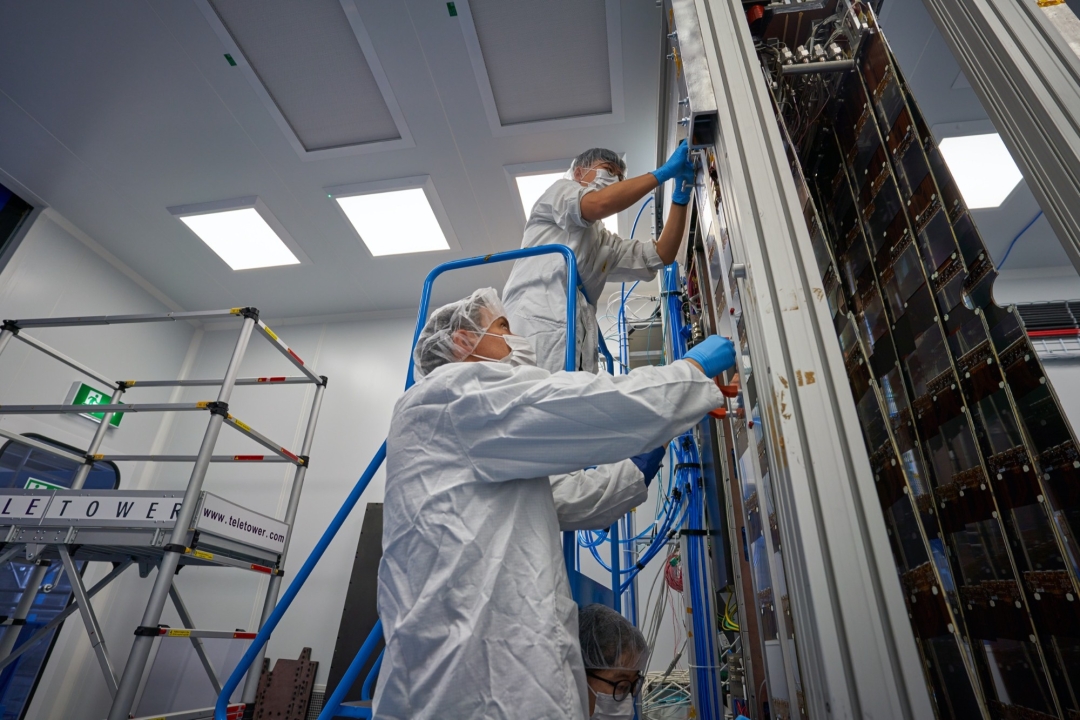
Palmer continues to participate in LHC experiments, and much of his work can be done without ever leaving campus. He is part of a team that is studying a new CMS detector, called the MIP Timing Detector, that will more precisely measure charged particles. Because the CMS experiment will need to be operational at -30 degrees Celsius, Palmer and his team are building a cold box at UMD to test components of the detector under extreme conditions.

This research is funded by a Department of Energy grant, which also supports the work of Physics Professor Sarah Eno and Associate Professor Alberto Belloni. Though all three faculty members are involved in LHC experiments, Palmer said they each have their own interests and areas of expertise, which keeps things interesting.

“It’s nice to see what other people are doing, and you don’t always get that when you work in a group that has all the same physics interests,” Palmer said. “It’s also good for the students because they really get to see what is going on in vastly different corners of the experiment, which is important in a giant experiment like CMS that has 3,000-some people in it.” 

In addition to his research, Palmer works to make physics a more inclusive field and is currently exploring ways to improve student mentorship and support for students from historically underrepresented groups. He serves on the executive committee of the American Physical Society’s Forum on Diversity & Inclusion, as well as the College of Computer, Mathematical, and Natural Sciences’ Diversity & Inclusion Advisory Council. He is also the director of Pathway to Physics PhD (P3), a UMD fellowship program that offers fully funded physics degrees, with priority given to applicants from historically Black colleges and universities and minority-serving institutions.

Eye on the collider

When he’s not busy with campus initiatives or teaching classes, Palmer keeps tabs on the data flowing out of the LHC. A monitor next to his office door displays numbers and charts showing the latest data from LHC experiments, including the luminosity measurements that Palmer specializes in. 

“Most of the time I’m engaged in my classes and meetings and other things that I’m immediately involved with,” Palmer said, “but I’m always keeping an eye on what’s going on at the LHC out of the corner of my eye.”

Palmer’s research—and a touch of luck—brought him face-to-face with some of the biggest discoveries in physics. When the next uncharted phenomenon shows up in an experiment, Palmer doesn’t want to miss it.


Written by Emily Nunez

Written on 23 January 2023. Posted in Research News.

Twisting Up Atoms Through Space and Time

One of the most exciting applications of quantum computers will be to direct their gaze inwards, at the very quantum rules that make them tick. Quantum computers can be used to simulate quantum physics itself, and perhaps even explore realms that don’t exist anywhere in nature.

But even in the absence of a fully functional, large-scale quantum computer, physicists can use a quantum system they can easily control to emulate a more complicated or less accessible one. Ultracold atoms—atoms that are cooled to temperatures just a tad above absolute zero—are a leading platform for quantum simulation. These atoms can be controlled with laser beams and magnetic fields and coaxed into performing a quantum dance routine choreographed by an experimenter. And it’s also straightforward to peer into their quantum nature using high-resolution imaging to extract information after—or while—they complete their steps.

Now, researchers at the Joint Quantum Institute (JQI) and the NSF Quantum Leap Challenge Institute for Robust Quantum Simulation (RQS), led by former JQI postdoctoral fellow Mingwu Lu and graduate student Graham Reid, have coached their ultracold atoms to do a new dance, adding to the growing toolkit of quantum simulation. In a pair of studies, they’ve bent their atoms out of shape, winding their quantum mechanical spins around in both space and time before tying them off to create a kind of space-time quantum pretzel.

They mapped out the curvy space-time shape they created and reported their results in the journal Physical Review Letters last summer. In a follow-up experiment, they watched as their atoms transitioned between different winding shapes and found a rich structure inaccessible to simple, stationary atoms. They published this result in Physical Review Letters in September.

The windings they studied are related to the mathematical field of topology—the classification of objects according to the number of holes they have. Donuts are topologically identical to hula hoops and coffee mugs since they each have one through-hole. But donuts are distinct from eyeglass frames, which have two holes, or pretzels, which have three.

This deceptively simple classification of shapes has been surprisingly impactful in physics. It has explained things like the quantum Hall effect, which produces a precisely repeatable electrical resistance used to define the resistance standard, and topological insulators, which may one day serve as components of robust quantum computers.

In two experiments with ultracold atoms, researchers explored the landscape of different topological shapes they could create in space and time. (Credit: craiyon.com with modifications by Dina Genkina/JQI)In two experiments with ultracold atoms, researchers explored the landscape of different topological shapes they could create in space and time. (Credit: craiyon.com with modifications by Dina Genkina/JQI)In physical settings—be it solid chunks of metal or ultracold atoms—the topology that physicists care about isn’t really related to the shape of the actual material. Rather, it’s the shape taken by the quantum waves that travel within the material. Often, physicists look at an intrinsic property of quantum particles called spin and how it winds as a particle speeds up or slows down within the solid chunk.

Most solids are crystals, made up of a regular grid extending every which way in a repeating pattern of equally spaced atoms. For free-floating electrons inside this grid, hopping over from one atom to another identical one makes no difference—the landscape is exactly the same as far as the eye can see. A similar grid pops up in the landscape of electron speeds—things may change as the electron starts accelerating, but at certain speeds, the landscape will look the same as if it wasn’t moving at all.

But position and velocity are only two properties of the electron. Another is spin. Spin can behave somewhat independently as position and velocity change, but when the position is shifted by one site or velocity is shifted by one velocity “site,” the spin must remain unchanged—another reflection of the symmetry present in the crystal. But in between two sites or two velocity “sites” anything goes. The winding shape that the spin draws out before coming back to where it started is what defines the topology.

In the world of quantum simulation, ultracold atoms can emulate electrons in a crystal. The role of the crystal is played by lasers, creating a repeating pattern of light for the ultracold atoms to inhabit. The atoms’ location and speed similarly acquire a repeating pattern, and the atomic spins trace out shapes that define the topology.

In their winding experiment, Lu and his labmates devised a two-dimensional crystal, but not in the usual two dimensions of a sheet of paper. One of the dimensions was in space, like the direction along a thin thread, while the other was time. In this sheet composed of space and time, the spin of their atoms drew out a curious shape as a function of the atoms’ velocity in the time-space crystal.

“Topology is defined on surfaces,” says JQI Fellow Ian Spielman, the principal investigator on the research and the associate director for research at RQS . “One of the dimensions defining the surface can be time. This has been known for a while theoretically but is only now being tested experimentally.”

To create a surface that winds in both space and time, the researchers shined lasers from two directions and a radio-frequency magnetic field from above onto their cloud of ultracold atoms. The lasers and magnetic field combine to create areas of higher and lower energy that atoms are pushed away from or drawn towards, like an egg carton for the atoms to live inside of. This carton had a peculiar shape: instead of two rows of slots like in a regular dozen you’d find in a grocery store, there was only one row. And each slot of the carton was made up of two sub-slots (see picture below). This gave the repeating crystal-like pattern along a line in space.

By adjusting how the lasers and magnetic fields align with each other, the team could shift the whole pattern over to the side by one sub-slot (see picture). But they didn’t just swiTwo laser configurations that the researchers switched between rhythmically to wind their atoms through space and time (Credit: Mingwu Lu/JQI).Two laser configurations that the researchers switched between rhythmically to wind their atoms through space and time (Credit: Mingwu Lu/JQI).tch it once. They rhythmically shook the egg carton back and forth between the two. This rhythmic shaking created a repeating pattern in time, akin to the repeating spatial pattern of nuclei in a crystal.

To do this, they had to make sure their laser egg-carton, as well as the timing of the strobe, were just right. “The hardest part was just getting the timing right,” says Graham Reid, a graduate student in physics and one of the authors on the work. “This experiment really relies on very precise timing of things that you don't know a priori, so you just have to do a lot of tuning.”

After a lot of fine-tuning, however, they experimentally imaged the spin of the atoms in this time-space crystal. They mapped out the winding of the spin as it traversed both time and space on its way back to where it started. This way, they directly measure the winding topology they’d constructed.

Following up on this work, they used the same laser pattern to do a very different topology-related experiment. Instead of looking at a topology in space and time, they focused on just the spatial dimension. This time, they prepared their atoms in different ways: all spin down, all spin up, or a mix.

These weren’t natural, comfortable states for the atoms in the laser pattern they created, and, eventually, the atoms would settle to their more natural states—their equilibrium states. But along the way, they could capture freeze frames of several different topological shapes—some that would never occur but for an instant. These results have revealed new mysteries that the researchers are eager to investigate.

“There are two big questions that I think would be great to answer,” Spielman says. “The first is that the space and time topology result really only worked at a fine-tuned timing. I wonder if there is a way to make that robust. Second, for out-of-equilibrium topology, I am interested to see what happens when we quickly switch between a wider variety of topological states.”

Original story by Dina Genkina: https://jqi.umd.edu/news/twisting-atoms-through-space-and-time

In addition to Spielman, who is also a fellow at the National Institute of Standards and Technology, Reid, and Lu, who is now at Atom Computing, authors on the papers included Amilson Fritsch, a former postdoctoral fellow at JQI now at the University of Sao Paulo Sao Carlos, and Alina Piñeiro, a graduate student in physics at JQI.


Written on 20 January 2023. Posted in Research News.

Nearly 50-meter Laser Experiment Sets Record in Campus Hallway

It's not at every university that laser pulses powerful enough to burn paper and skin are sent blazing down a hallway. But that’s what happened in UMD’s Energy Research Facility, an unremarkable looking building on the northeast corner of campus. If you visit the utilitarian white and gray hall now, it seems like any other university hall—as long as you don’t peek behind a cork board and spot the metal plate covering a hole in the wall.A laser is sent down a UMD hallway in an experiment to corral light as it makes a 45-meters-long journey.A laser is sent down a UMD hallway in an experiment to corral light as it makes a 45-meters-long journey.

But for a handful of nights in 2021, UMD Physics Professor Howard Milchberg and his colleagues transformed the hallway into a laboratory: The shiny surfaces of the doors and a water fountain were covered to avoid potentially blinding reflections; connecting hallways were blocked off with signs, caution tape and special laser-absorbing black curtains; and scientific equipment and cables inhabited normally open walking space.

As members of the team went about their work, a snapping sound warned of the dangerously powerful path the laser blazed down the hall. Sometimes the beam’s journey ended at a white ceramic block, filling the air with louder pops and a metallic tang. Each night, a researcher sat alone at a computer in the adjacent lab with a walkie-talkie and performed requested adjustments to the laser.

Their efforts were to temporarily transfigure thin air into a fiber optic cable—or, more specifically, an air waveguide—that would guide light for tens of meters. Like one of the fiber optic internet cables that provide efficient highways for streams of optical data, an air waveguide prescribes a path for light. These air waveguides have many potential applications related to collecting or transmitting light, such as detecting light emitted by atmospheric pollution, long-range laser communication or even laser weaponry. With an air waveguide, there is no need to unspool solid cable and be concerned with the constraints of gravity; instead, the cable rapidly forms unsupported in the air. In a paper accepted for publication in the journal Physical Review XPhysical Review X the team described how they set a record by guiding light in 45-meter-long air waveguides and explained the physics behind their method.

The researchers conducted their record-setting atmospheric alchemy at night to avoid inconveniencing (or zapping) colleagues or unsuspecting students during the workday. They had to get their safety procedures approved before they could repurpose the hallway.

“It was a really unique experience,” says Andrew Goffin, a UMD electrical and computer engineering graduate student who worked on the project and is a lead author on the resulting journal article. “There's a lot of work that goes into shooting lasers outside the lab that you don't have to deal with when you're in the lab—like putting up curtains for eye safety. It was definitely tiring.”

 Left to right Eric Rosenthal, a physicist at the U.S. Naval Research Laboratory; Anthony Valenzuela, a physicist at the U.S. Army Research Lab; and Goffin align optics at a porthole in the wall in order to send the laser beam from the lab down the hallway. The white dotted lines show the approximate beam path before and after the optics redirected it. Left to right Eric Rosenthal, a physicist at the U.S. Naval Research Laboratory; Anthony Valenzuela, a physicist at the U.S. Army Research Lab; and Goffin align optics at a porthole in the wall in order to send the laser beam from the lab down the hallway. The white dotted lines show the approximate beam path before and after the optics redirected it. All the work was to see to what lengths they could push the technique. Previously Milchberg’s lab demonstrated that a similar method worked for distances of less than a meter. But the researchers hit a roadblock in extending their experiments to tens of meters: Their lab is too small and moving the laser is impractical. Thus, a hole in the wall and a hallway becoming lab space.

“There were major challenges: the huge scale-up to 50 meters forced us to reconsider the fundamental physics of air waveguide generation, plus wanting to send a high-power laser down a 50-meter-long public hallway naturally triggers major safety issues,” Milchberg says. “Fortunately, we got excellent cooperation from both the physics and from the Maryland environmental safety office!”

Without fiber optic cables or waveguides, a light beam—whether from a laser or a flashlight—will continuously expand as it travels. If allowed to spread unchecked, a beam’s intensity can drop to un-useful levels. Whether you are trying to recreate a science fiction laser blaster or to detect pollutant levels in the atmosphere by pumping them full of energy with a laser and capturing the released light, it pays to ensure efficient, concentrated delivery of the light.

Milchberg’s potential solution to this challenge of keeping light confined is additional light—in the form of ultra-short laser pulses. This project built on previous work from 2014 in which his lab demonstrated that they could use such laser pulses to sculpt waveguides in the air.

The short pulse technique utilizes the ability of a laser to provide such a high intensity along a path, called a filament, that it creates a plasma—a phase of matter where electrons have been torn free from their atoms. This energetic path heats the air, so it expands and leaves a path of low-density air in the laser’s wake. This process resembles a tiny version of lighting and thunder where the lightning bolt’s energy turns the air into a plasma that explosively expands the air, creating the thunderclap; the popping sounds the researchers heard along the beam path were the tiny cousins of thunder.

But these low-density filament paths on their own weren’t what the team needed to guide a laser. The researchers wanted a high-density core (the same as internet fiber optic cables). So, they created an arrangement of multiple low-density tunnels that naturally diffuse and merge into a moat surrounding a denser core of unperturbed air.

The 2014 experiments used a set arrangement of just four laser filaments, but the new experiment took advantage of a novel laser setup that automatically scales up the number of filaments depending on the laser energy; the filaments naturally distribute themselves around a ring.

The researchers showed that the technique could extend the length of the air waveguide, increasing the power they could deliver to a target at the end of the hallway. At the conclusion of the laser’s journey, the waveguide had kept about 20% of the light that otherwise would have been lost from their target area. The distance was about 60 times farther than their record from previous experiments. The team’s calculations suggest that they are not yet near the theoretical limit of the technique, and they say that much higher guiding efficiencies should be easily achievable with the method in the future.

“If we had a longer hallway, our results show that we could have adjusted the laser for a longer waveguide,” says Andrew Tartaro, a UMD physics graduate student who worked on the project and is an author on the paper. “But we got our guide right for the hallway we have.”Distributions of the laser light collected after the hallway journey without a waveguide (left) and with a waveguide (right). Distributions of the laser light collected after the hallway journey without a waveguide (left) and with a waveguide (right).

The researchers also did shorter eight-meter tests in the lab where they investigated the physics playing out in the process in more detail. For the shorter test they managed to deliver about 60% of the potentially lost light to their target.

The popping sound of the plasma formation was put to practical use in their tests. Besides being an indication of where the beam was, it also provided the researchers with data. They used a line of 64 microphones to measure the length of the waveguide and how strong the waveguide was along its length (more energy going into making the waveguide translates to a louder pop).

The team found that the waveguide lasted for just hundredths of a second before dissipating back into thin air. But that’s eons for the laser bursts the researchers were sending through it: Light can traverse more than 3,000 km in that time.

Based on what the researchers learned from their experiments and simulations, the team is planning experiments to further improve the length and efficiency of their air waveguides. They also plan to guide different colors of light and to investigate if a faster filament pulse repetition rate can produce a waveguide to channel a continuous high-power beam.

“Reaching the 50-meter scale for air waveguides literally blazes the path for even longer waveguides and many applications”, Milchberg says. “Based on new lasers we are soon to get, we have the recipe to extend our guides to one kilometer and beyond.”

Story by Bailey Bedford. Images by Intense Laser-Matter Interactions Lab, UMD.

In addition to Milchberg, Goffin and Tartaro, Aaron Schweinsburg and Anthony Valenzuela from the DEVCOM Army Research Lab, and Eric Rosenthal from the Naval Research Lab are also authors and Ilia Larkin, a former UMD graduate student and current systems engineer at KLA, is a co-lead author.

Publication information: https://journals.aps.org/prx/accepted/8707dK4dIb91a60bb6df4e56bdc44a53b2267be80

PI affiliations: Howard Milchberg is jointly appointed to the departments of Physics and Electrical and Computer Engineering and is affiliated with the Institute for Research in Electronics and Applied Physics.

This work is supported by the Office of Naval Research (N00014-17-1-2705 and N00014-20-1-2233), the Air Force Office of Scientific Research and the JTO (FA9550-16-1-0121, FA9550-16-1-0284, and FA9550-21-1-0405), the  Army Research Lab (W911NF1620233) and the Army Research Office (W911NF-14-1-0372).

Written on 17 January 2023. Posted in Department News.

Jonathan D. Moreno Named Third Milchberg Lecturer

Jonathan D. Moreno,  the David and Lyn Silfen University Professor at the University of Pennsylvania, gave the third Irving and Renee Milchberg Endowed Lecture on Tuesday, April 4, 2023.

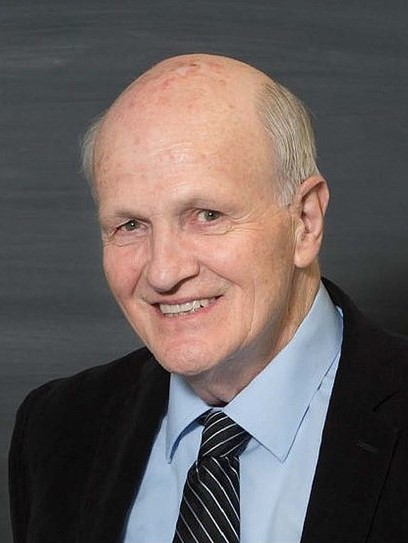
Moreno's talk addressed Bioethics and the Rules-Based International Order.   Jonathan Moreno. Credit: University of PennsylvaniaJonathan Moreno. Credit: University of Pennsylvania

Moreno, an elected member of the National Academy of Medicine, studies medical ethics and health policy, the history and sociology of science, and philosophy. He received  his Ph.D. in philosophy from Washington University in St. Louis and was an Andrew W. Mellon post-doctoral fellow. His book The Body Politic: The Battle Over Science in America was a Kirkus Reviews Best Book of the Year and a Scientific American Book Club selection. More recently, he wrote Everybody Wants to Go to Heaven but Nobody Wants to Die: Bioethics and the Transformation of Healthcare in America with former Penn President Amy Gutmann.

Moreno received the 2018 Lifetime Achievement Award of the American Society for Bioethics and Humanities. 

The Irving and Renee Milchberg Endowed Lectureship was established by Prof. Howard Milchberg and his wife Rena, to remember Howard's parents, who survived the Holocaust and the distortions of truth that accompanied and facilitated it.  Milchberg’s mother and father, who died in 2017 and 2014, respectively, never received formal education, but Milchberg describes them as “remarkably open-minded and tolerant” and as “wide-ranging thinkers and skeptics.” 


Written on 10 January 2023. Posted in Research News.

Electrons Take New Shape Inside Unconventional Metal

One of the biggest achievements of quantum physics was recasting our vision of the atom. Out was the early 1900s model of a solar system in miniature, in which electrons looped around a solid nucleus. Instead, quantum physics showed that electrons live a far more interesting life, meandering around the nucleus in clouds that look like tiny balloons. These balloons are known as atomic orbitals, and they come in all sorts of different shapes—perfectly round, two-lobed, clover-leaf-shaped. The number of lobes in the balloon signifies how much the electron spins about the nucleus.

That’s all well and good for individual atoms, but when atoms come together to form something solid—like a chunk of metal, say—the outermost electrons in the atoms can link arms and lose sight of the nucleus they came from, forming many oversized balloons that span the whole chunk of metal. They stop spinning about their nuclei and flow through the metal to carry electrical currents, shedding the diversity of multi-lobed balloons.

Now, researchers at the Quantum Materials Center (QMC) at the University of Maryland (UMD), in collaboration with theorists at the Condensed Matter Theory Center (CMTC) and JQI, have produced the first experimental evidence that one metal—and likely others in its class—have electrons that manage to preserve a more interesting, multi-lobed structure as they move around in a solid. They experimentally studied the shape of these balloons and found not a uniform surface, but a complex structure. This unusual metal is not only fundamentally interesting, but it could also prove useful for building quantum computers that are resistant to noise. The researchers published their findings recently in the journal Physical Review Research.Atomic orbitals at different angular momentum values (labeled with numbers) form a variety of shapes. (Credit: adapted from Geek3, CC BY-SA 4.0, via Wikimedia Commons)Atomic orbitals at different angular momentum values (labeled with numbers) form a variety of shapes. (Credit: adapted from Geek3, CC BY-SA 4.0, via Wikimedia Commons)

“When I first discovered this, I was so excited,” says Hyunsoo Kim, a former postdoctoral researcher at QMC and lead author of the work. “But it took years to fully study, because it's not a conventional concept and also experimentally very challenging to collect high-quality data.”

Back in 2011, the team first discovered that the metal in question—yttrium platinum bismuth, or YPtBi—could become a superconductor. Some materials become superconductors at low enough temperatures, losing all resistance to electrical current. YPtBi was an unlikely candidate for superconductivity because it has many fewer mobile, current-carrying electrons than most superconductors. But, to the researchers’ surprise, it became superconducting anyway. Furthermore, the way it behaved when exposed to a magnetic field provided evidence that it was no ordinary superconductor.

At the time, the researchers suspected that the shape of the electron orbitals was to blame and concluded that electrons that spin about themselves and trace out more circles in space—that is, electrons with higher angular momentum—were forming an unprecedented state of superconductivity.

“We had what I would call circumstantial evidence that the superconductivity is made up of these higher angular momentum electron pairs,” says Prof. Johnpierre Paglione, the director of QMC, and the head of the experimental group in this collaboration. “But there was really no direct evidence of these high angular momentum electrons.”

To gather more direct evidence in the new experiments, the team raised the temperature and studied the material in its normal, non-superconducting state. Then, they performed a classic measurement that maps out something akin to the collective atomic orbital for all the electrons floating around in the metal.

Peering inside a metal, one sees atoms arranged in neat repeating grids, called a crystal lattice. In a crystal, the atomic orbitals of the outermost electrons morph into one another. This allows the electrons to travel far from their original nucleus and carry current through the metal. In this solid setting, a version of orbital balloons still exists, but it’s more common to visualize them not in space—where there are many huge and unwieldy orbitals—but as a function of the speed and direction of the traveling electrons. The fastest moving electrons in the crystal form their own balloon, a collective analog of atomic orbitals known as a Fermi surface.

The shape of the Fermi surface reflects the structure of the underlying crystal, which usually bears no resemblance to the orbital structure of single atoms. But for materials like YPtBi with very few mobile electrons, the Fermi surface is not very big. Because of this, it retains some of the properties of electrons that hardly move at all, which sit at the center of the Fermi surface.

“The fact that nature figures out counter-intuitive atomic arrangements that allow the Fermi surface to retain signatures of the atomic orbitals is rather cool and intricate,” says Jay Deep Sau, JQI Co-Director and Fellow and a theoretical collaborator on the new paper. 

To uncover this cool, counter-intuitive Fermi surface, the researchers stuck a YPtBi crystal inside a magnetic field and measured the current flowing through the crystal as they tuned the field. By rotating the direction of the magnetic field, they were able to map out the speed of the fastest electrons in every direction. They found that, akin to a higher angular momentum atomic orbital, the Fermi surface has a complex shape to it, with peaks and troughs along certain directions. The high symmetry of the crystal itself would normally lead to a more uniform, ball-like Fermi surface, so it was a surprise to find a more complicated structure. This pointed to the possibility that the collective electrons were exhibiting some of the higher angular momentum nature of atomic orbitals.

Indeed, theoretical calculations by the CMTC team showed that the experimental results matched up with a high angular momentum model, leading the team to claim the first experimental observation of a high-angular momentum metal. The team cautions that even this experimental evidence could still be incomplete. What they measured depends not only on the Fermi surface but also on other properties of the electrons, such as their effective mass and the distribution of their velocities. In their work, the team systematically studied the angular dependence of these other quantities and demonstrated that it would be extremely unlikely for them to cause the observed peaks and troughs.

In addition to being fundamentally novel, this higher angular momentum metal has potential applications for quantum computing. There are predictions that some exotic superconducting states could give rise to properties that are unaffected by the noise that happens at any one point. These properties might be able to encode quantum bits, potentially allowing for the creation of quantum computers that are much more robust. Whether YPtBi is exotic in the right way for this to occur remains to be seen, but the new work is a significant step toward figuring it out.

“There's many pieces to the puzzle of understanding exactly what kind of superconductor you have and whether you can exploit it to do quantum computation,” says Paglione. “There are some experimental challenges to get the rest of the pieces of the puzzle. But I think we're a good chunk of the way there.”

Original story by Dina Genkina: https://jqi.umd.edu/news/electrons-take-new-shape-inside-unconventional-metal

In addition to Kim, Paglione, and Sau, authors on the paper included Junhyun Lee, a former postdoctoral fellow at CMTC, Halyna Hodovanets, a former assistant research scientist at QMC now an assistant professor of Physics at Missouri University of Science and Technology, and Kefeng Wang, a former postdoctoral fellow at QMC now a research project manager at Rutgers University. Hyunsoo Kim is now an assistant professor of Physics at Missouri University of Science and Technology.


More Articles …

  1. Faculty, Staff, Student and Alumni Awards & Notes
  2. Two Light-Trapping Techniques Combine for the Best of Both Worlds
  3. December Physics Discovery Days!
  4. UMD Establishes Endowed Professorship in Quantum Computing

Page 42 of 203

  • 37
  • 38
  • 39
  • 40
  • 41
  • 42
  • 43
  • 44
  • 45
  • 46
  • Physics Administration
  • Directions
  • Awards
  • Student Awards
  • Make a Donation
  • News
    • Research News
    • Department News
    • Newsletters
  • PTK Policy

College and Department Links

Department of Physics

Physical Sciences Complex
4296 Stadium Dr
College Park, MD 20742
Phone: 301.405.3401

Information

  • Campus Directory
  • Undergraduate Research
  • Scholarships
  • Prospective Undergraduates
  • Directions & Transit
  • Web Accessibility
© 2026 University of Maryland - Department of Physics
Top
  • Home
  • About Us
    • Physics Administration
    • Directions
    • Awards
    • Student Awards
    • Make a Donation
    • News
      • Research News
      • Department News
      • Newsletters
    • PTK Policy
  • People
    • All
    • Faculty
      • Current
      • Emeritus
      • Adjunct
      • Affiliate
      • Research Professors
    • Research Scientists
    • Postdocs
    • Staff
    • Lecturers
    • Visitors
    • Graduate Students
  • Research
    • Research Areas
      • AI and Physical Sciences
      • Astro Metrology
      • Atomic, Molecular & Optical
      • Biophysics
      • Chemical Physics
      • Condensed Matter Experiment
      • Condensed Matter Theory
      • Cosmic Ray Physics
      • Elementary Particles
      • Gravitation Experiment
      • Gravitational Theory
      • High Energy Physics
      • Nonlinear Dynamics, Chaos and Complex Systems
      • Nuclear Physics
      • Particle Astrophysics
      • Physics Education Research
      • Plasma Physics
      • Plasma Theory
      • Quantum Science and Technology
      • Quarks, Hadrons and Nuclei
      • Space Physics
    • Centers & Institutes
  • Academics
    • OSES Home (Student Services)
    • OSES News
    • Undergraduate Program
      • Prospective Students
      • Apply Now
      • Degree Requirements and Policies
      • Scholarships
      • Undergraduate Research
      • Advising
      • Undergraduate Forms
      • Undergraduate Events
      • Departmental Honors
      • Society of Physics Students
      • FAQ
      • Undergraduate Student Committee
    • Graduate Program
      • Prospective Students
      • Open House
      • Degree Requirements
      • Graduate Resources
      • Deadlines and Forms
      • PhD Defenses
        • PhD Defenses 2026
        • PhD Defenses 2025
        • PhD Defenses 2024
        • PhD Defenses 2023
        • PhD Defenses 2022
        • PhD Defenses 2021
        • PhD Defenses 2020
        • PhD Defenses 2019
        • PhD Defenses 2018
        • PhD Defenses 2017
        • PhD Defenses 2016
      • Events
      • Scholarships & Awards
      • Qualifier
      • Graduate Student Organizations
      • FAQ
    • Student Opportunities
      • GRAD-MAP
      • Graduate Student Organizations
      • Outreach Volunteering
      • Society of Physics Students
      • NSF S-STEM Program
      • Undergraduate Research
      • Women in Physics
      • Undergraduate Quantum Association
    • Courses
    • Academic Support
    • NSF S-STEM Program
    • Teaching Assistants
  • Events
    • Calendar
    • Physics Colloquia
    • W.J. Carr Lecture
    • Research Interaction Team (RIT) Math/Physics
    • Mechanick Quantum Biology Lecture
    • Irving and Renee Milchberg Endowed Lectureship
    • Charles W. Misner Endowed Lectureship in Gravitational Physics
    • John S. Toll Endowed Lecture
    • Prange Prize Lecture
    • Maryland Day
    • Outreach
      • Outreach Home
      • Physics is Phun
      • Discovery Days
    • Summer Programs
      • Physics Makers Camp
      • Physics of Quidditch
      • Science Discovery Camp
      • Advanced Physics Summer Program
      • Toolkit for Success
    • CUWiP
    • Vortex Makerspace
    • QURiSE Conference
  • Services
    • Building Access Requests
    • Computing Services
    • Conference Room Reservations
    • Department Operations Directory
    • Electronic and Mechanical Development
    • Hiring Procedures
    • Lecture Demo
    • Mental Health Resources
    • Parking
    • Physics Ombudspersons
    • Printing Services
      • Poster Print Request
    • Proposal Submissions
    • Purchase Order
    • Suggestion Box
    • Textbook Information
  • Give