Jesse Anderson Retires Following 34-Year Career in the Department

As he finished his career in the Army with a posting at the old Walter Reed Hospital in Northwest Washington, Jesse James Anderson decided to enroll at the nearby University of Maryland in College Park in 1983. Ever industrious, he took two jobs: one as a carpenter in residential services, and another at the Stamp Student Union information desk. One day, in a Stamp elevator, a friend dared him to talk to a female student sharing the lift.  “And I did,” says Anderson, recalling the day he met his wife Danna.  “It worked out well for us.”

Danna Anderson studied in College Park for two years before transferring to the University of Maryland, Baltimore, to pursue her degree in medical technology. The couple moved to Charm City, where they have resided ever since. When she completed her practicum at Johns Hopkins University, Danna was immediately offered a staff position, and now supervises the Core Lab at JHU Hospital.

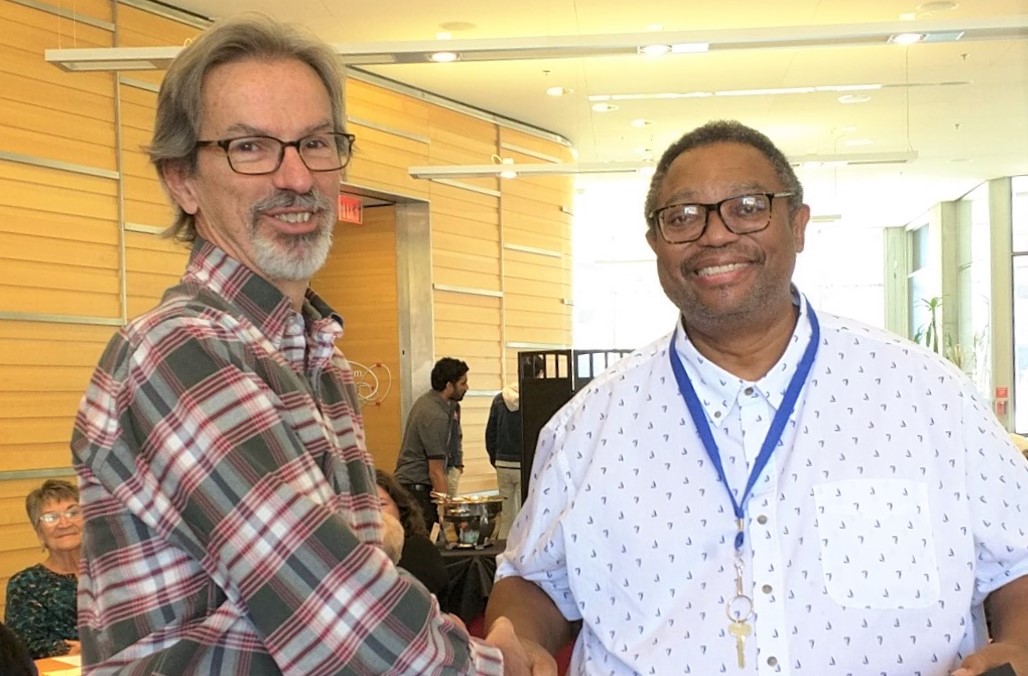
Despite the distance, Jesse Anderson chose to stick with UMD. He spotted and applied for a job in the physics machine shop, and was hired as a storekeeper under manager Frank Desrosier.  “I was studying electrical engineering and learning applied math, which made the shop stuff fun,” he said. “I was very interested in scientific methods and materials, and I learned a lot about metals.”  Over the course of a decade managing the Physics Material Store, he switched his studies to industrial technology, learning machining, drafting and lathe work, all of which he found intriguing and refreshing after his seven years in the Army, which were spent in somewhat monotonous finance and accounting work.Steve Rolston and Jesse Anderson at the 2018 staff awards.Steve Rolston and Jesse Anderson at the 2018 staff awards.
But military service had imparted meticulous record keeping habits that caught the attention of the physics purchasing manager, Camille Vogts. “I think she liked my paperwork,” chuckled Anderson. Vogts was often invited to vendor expos, which she regularly asked Anderson to attend. He recalls these outings as highlights of his UMD years, as they featured up-and-coming, whiz-bang technological developments in machining and laboratory devices. “Those shows were amazing to see,” Anderson recalls.

When an opening arose in the physics receiving office, personnel director Lorraine DeSalvo urged Anderson to apply. “I watched when he first arrived as the storekeeper in the shop,” said DeSalvo. “You just know when you see that sparkle in someone, that willingness and even eagerness to take on some new responsibilities.”

During his stint in receiving, Jesse and Danna enjoyed a four-week vacation, traveling to California to see Jesse’s brother. Upon his return, he found that business director Dean Kitchen had decided to expand his duties. “Dean said, ‘Well, if you’re good with receiving, you can likely handle purchasing, too,’” Anderson recalled.  And after the sudden death of purchasing manager Bob Dahms in 2013, Anderson’s purview expanded further.

From that time until his retirement in December 2021, Anderson faced a relentless workload that included the dizzying logistics of the 2014 move into the Physical Sciences Complex and the resultant need to coordinate purchasing, shipping and receiving for loading docks in separate buildings, ensuring a very busy life. And then, in March 2020, the campus abruptly ceased operations for all save a few staffers. Staying home was not an option for Anderson. During the COVID-19 shutdown, he continued to come to campus daily in support of the department.

“COVID was a lot,” Anderson said. “Managing the loading docks, sending up the mailed paychecks, dealing with the picked-up-in-person paychecks. Just a lot to manage.” Al Godinez, who staffed the Toll Building loading dock for many years, retired in December 2020. “Al urged me to consider retiring, too, but that would have been hard on the department,” Anderson said. And so he persevered for another year, until more normal operations were underway and a replacement could be hired.

For his efforts during the shutdown, Anderson received the first Lorraine DeSalvo Chair's Endowed Award for Outstanding Service, presented virtually by physics chair Steve Rolston in December, 2020.

“Jesse is amazing,” DeSalvo said. “He was always there, and has always gone above and beyond. I was so happy that he received the first DeSalvo Award.”  Anderson is the only physics employee to receive the department’s “outstanding service” staff award three times.

Reflecting upon his career, he reports no regrets, but a sense of appreciation. “It’s something to realize that the people you work with are the tops in their fields. It blows you away what people are doing,” Anderson said. “I enjoyed being familiar with the experiments, seeing the ingenuity involved. When you know the intent, helping with the supplying and the setting up and the installation is a thrill.”

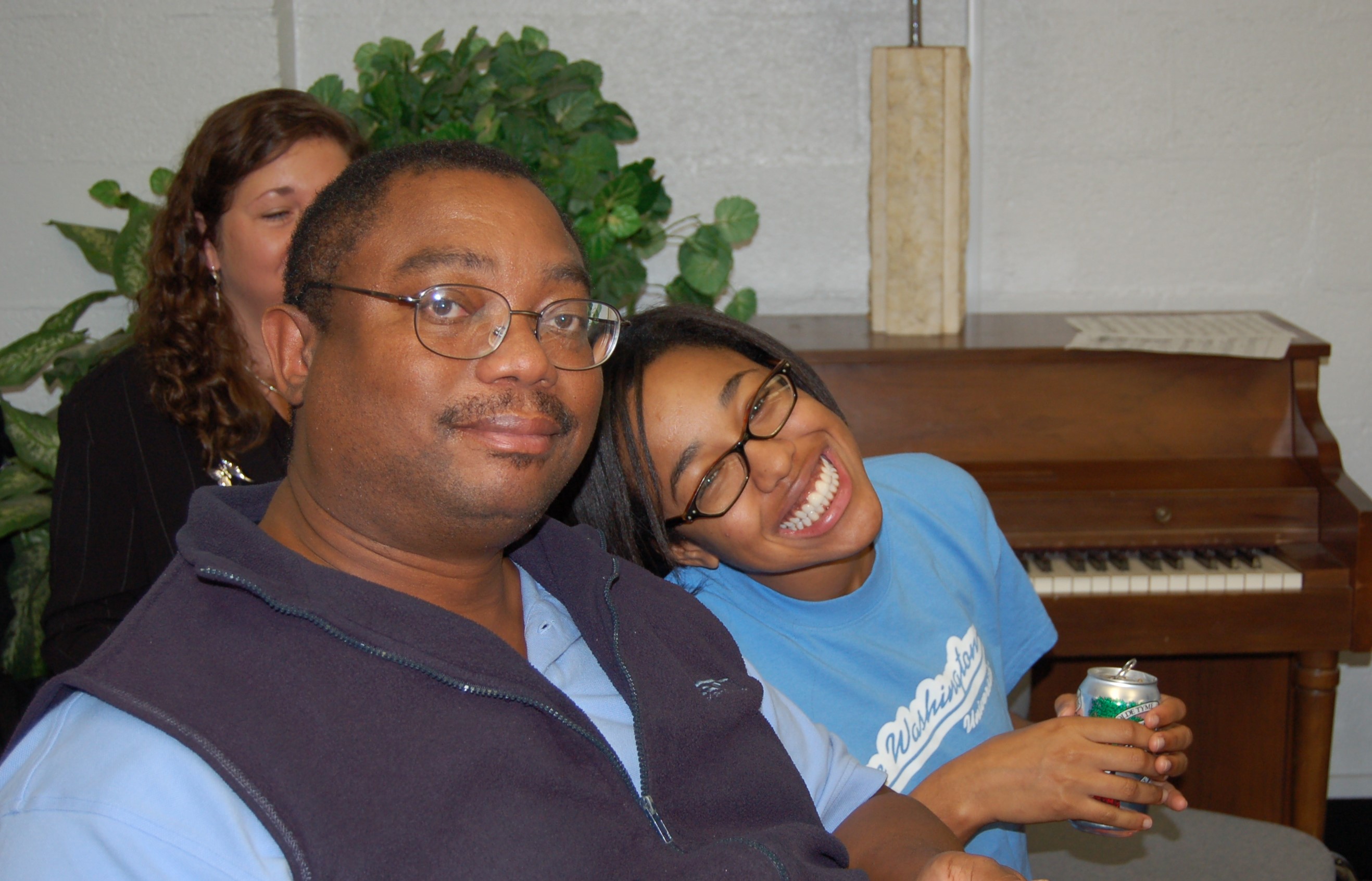
Retirement is still a new sensation. Anderson finds the absence of a morning onslaught of anxious emails odd.  But he savored not having to face an icy I-95 when snow fell this winter. He enjoys seeing more of his daughter Jessica, who will soon finish her graduate degree in clinical psychology and already works as a social worker, doing home visits to assess children and to assist their parents. He is starting to digitize his vinyl record collection, and will soon enjoy a vacation with Danna to New Orleans. Also planned are trips to see family in Georgia, California and New York.Jesse Anderson and student employee Angela Madden at the 2005 staff awards.Jesse Anderson and student employee Angela Madden at the 2005 staff awards.
Throughout his 34 years in the department, Anderson was deeply appreciated for his even keel and reassuring demeanor. “We miss Jesse, because he was always such a tremendous person and colleague,” said Rolston. “I can’t recall ever seeing him frazzled or irritated in the least. But he richly deserves an excellent retirement. He did whatever was needed in the department, from filling dewars on the Toll loading dock to hand-delivering important mail. We can’t thank him enough.”

At a staff luncheon in December, Anderson’s colleagues recognized him with a Department of Physics purchase order for a happy and healthy retirement. Anderson expressed his gratitude and drew a laugh when noting, “I’ve spent more time with you than I have with anyone else in my life.” Anderson affirmed that he truly regards the physics department as family, meaning that at UMD he gained two: One begun in a momentous elevator ride, and one established through 34 years of camaraderie.   
Creating an Inclusive Physics Community

When University of Maryland senior physics majors Ela Rockafellow and Kate Sturge entered the lecture hall of their honors math course freshman year, they quickly realized they were two of three women in a room of about 25 people.
All through high school, Rockafellow noticed how the number of women, gender minorities and students of color diminished in her advanced STEM classes, especially physics and math. When she asked her friends why their passion for science had faded, they told her they didn’t feel smart enough for the coursework—and often mentioned specific experiences or interactions that had discouraged them.

Studies show that since the ’90s, young women and men have earned about the same number of math and science high school credits, with women performing slightly better than men in these classes. But men are more likely to take the advanced placement exams to receive college credit. Seeing this themselves, Rockafellow and Sturge wondered how the dynamic could be changed so young members of underrepresented groups would feel empowered to pursue their goals in STEM.

“I think everyone in physics has felt like they’re not smart enough at one point or another,” said Rockafellow, a 2021 Goldwater Scholar. “But the compounded effect of society’s assumption that certain people aren’t as intelligent as others, especially in STEM spaces, can make it significantly more difficult to stay in the field.” 

Crafting a Curriculum

Rockafellow and Sturge, now co-presidents of the Society of Physics Students (SPS), decided to develop a class that would provide undergraduate students with the tools to counter society's assumptions about students in STEM. The idea for the course had initially been raised by attendees in an SPS town hall meeting in fall 2020. As SPS co-presidents, Rockafellow and Sturge decided to push the concept forward and create the course themselves in close collaboration with the director of education for the Department of Physics, Donna Hammer.

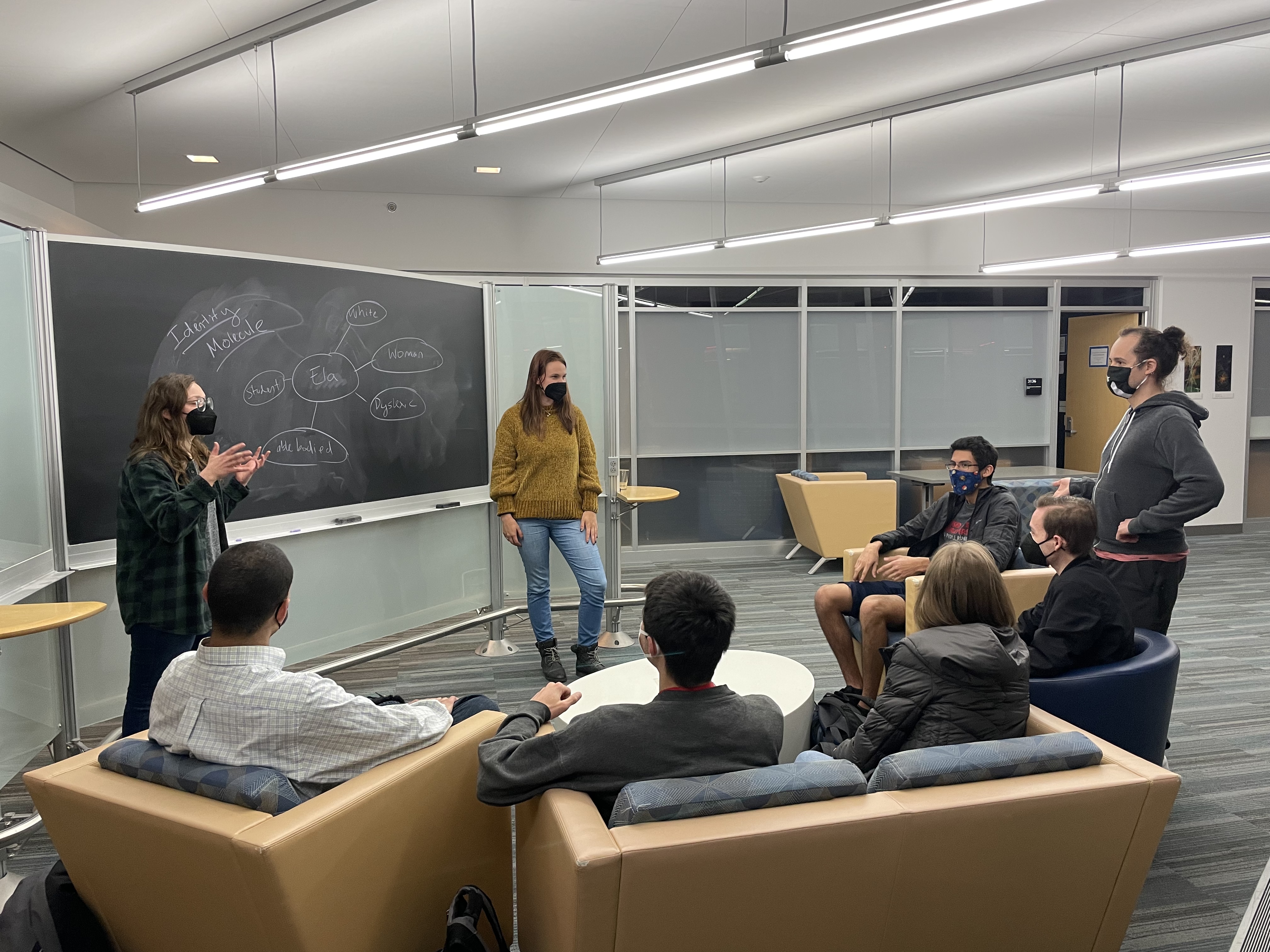
For months, Rockafellow and Sturge brainstormed the right course structure with Hammer, determining the necessary elements to make the course a reality. Together, they landed on a one-credit speaker series seminar to pilot the class, which became PHYS 298D: Diversity, Equity and Inclusion in Physics. 

“The idea was that from listening to a variety of speakers, students would gain a broader perspective, both validating the experience of minority students and increasing empathy and understanding of what minority members of the physics community go through,” Rockafellow explained. “Once we put together a rough outline for a curriculum, we sent it to everybody we knew who knew had experience in DEI work, and we got tons of feedback on how to make the course most effective.” 

To host this seminar, Rockafellow and Sturge first needed to find speakers. Starting with the American Physical Society’s climate report author list, they emailed hundreds of DEI experts to find the right mix of perspectives.

“We ended up getting a lot of really well-known people in the field to come speak just from asking,” Sturge said.

Speakers they chose ranged from Sandy Springs Friends School Head of School Rodney Glasgow to Harvard University Department of the History of Science Chair Evelynn Hammonds to UMD Counseling Center Research Director Yu-Wei Wang. Rockafellow and Sturge publicized the speaker series to SPS and physics department faculty and staff, expanding the reach of each lecture to the greater UMD physics community.

“The seminar format was a natural fit and an exciting student-driven curriculum endeavor,” Hammer said. “Ela and Kate have excellent leadership skills and true dedication to addressing and solving DEI issues.”

When freshman physics major Alejandro Escoto registered for PHYS 298D, he already had some understanding of the challenges underrepresented minorities have faced in physics. But he didn’t realize just how extensive those challenges were. 

“In this class, we explored in-depth why women and people of color have been excluded in physics, how it continues to happen and what each individual can do on a small scale to change that narrative,” Escoto said. “I left the class with a better understanding of how my own privileges play into my navigating of the field and how the things I say will end up affecting other people.”

Plotting the Future Course

For the course’s final project, students proposed projects to advance DEI efforts in their academic communities. For example, Escoto proposed a follow-up course to PHYS 298D on the history of science, focusing on the achievements of a wide range of scientists rather than just white men. 

“There’s a culture of there being one type of physicist,” Sturge said. “Usually, that physicist is white, male, cisgender, straight. That’s the box that you have to fit in. It’s our responsibility to use our privilege as white women to speak up and work toward a goal of dismantling that ideology in physics.” 

With the successful pilot behind them, Rockafellow and Sturge are looking for ways to grow the size of the course the next time it’s taught and they’re revising the PHYS 298D curriculum to meet the Understanding Plural Societies general education requirements. They also hope to continue their outreach work toward building a more diverse, inclusive physics community as they apply to graduate school.

“When you have a bunch of diverse minds together, science really flourishes,” Sturge said. “That’s why this work is important. We’re all working toward a better physics community.”

 Written by Katie Bemb

Thomas Ferbel, 1937- 2022

Thomas Ferbel, a UMD visiting professor since 2013, died at his home on Saturday, March 12. He was 84.

Ferbel was born in 1937 in Radom, Poland. During the tumult of World War II, he and his family endured exile in a Russian gulag and later, a camp for displaced persons in Stuttgart. Eventually, Ferbel arrived in New York and received a B.A. in Chemistry from Queens College, CUNY, and his and Ph.D. in Physics from Yale University (where his favorite professor was Bob Gluckstern, later the chancellor of this campus and a professor of physics).Thomas FerbelThomas Ferbel

After a postdoctoral appointment at Yale, Ferbel accepted a faculty position at the University of Rochester in 1965.  While there, he received an Alfred P. Sloan Fellowship, a John S. Guggenheim Fellowship and an Alexander von Humboldt Prize.

He was elected a Fellow of the American Physical Society in 1984, and served as the U.S. program manager for the Large Hadron Collider from 2004-08.

In 2020, Ferbel described both his early years and his life as a physicist as part of the American Institute of Physics Oral History project. The transcript is available here: https://www.aip.org/history-programs/niels-bohr-library/oral-histories/46304

New Perspective Blends Quantum and Classical to Understand Quantum Rates of Change

There is nothing permanent except change. This is perhaps never truer than in the fickle and fluctuating world of quantum mechanics.

The quantum world is in constant flux. The properties of quantum particles flit between discrete, quantized states without any possibility of ever being found in an intermediate state. How quantum states change defies normal intuition and remains the topic of active debate—for both scientists and philosophers.

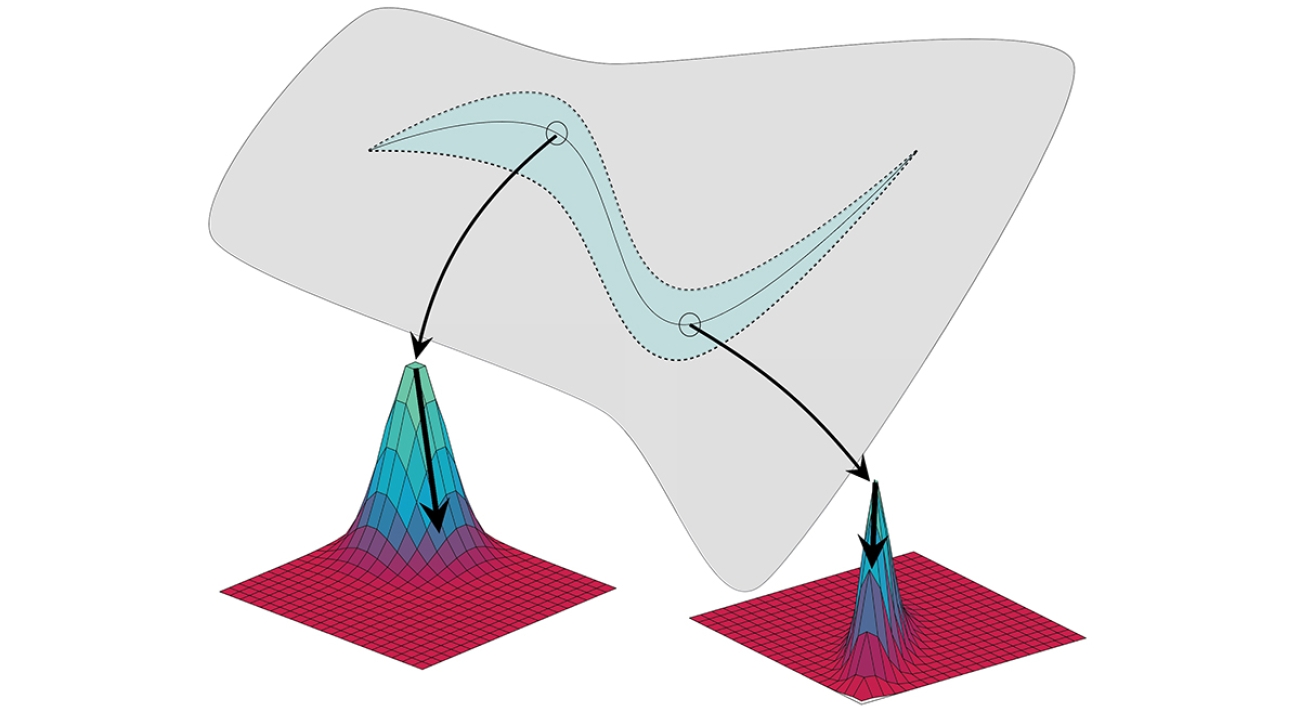
For instance, scientists can design a quantum experiment where they find a particle’s spin—a quantum property that behaves like a magnet—pointing either up or down. No matter how often they perform the experiment they never find the spin pointing in a direction in between. Quantum mechanics is good at describing the probability of finding one or the other state and describing the state as a mix of the two when not being observed, but what actually happens between observations is ambiguous.In the figure, a path winds through an abstract landscape of possible quantum states (gray sheet). At each point along the journey, a quantum measurement could yield many different outcomes (colorful distributions below the sheet). A new theory places strict limits on how quickly (and how slowly) the result of a quantum measurement can change over time depending on the various circumstances of the experiment. For instance, how precisely researchers initially know the value of a measurement affects how quickly the value can change—a less precise value (the wider distribution on the left) can change more quickly (represented by the longer arrow pointing away from its peak) than a more certain value (the narrower peak on the right). Credit: Schuyler NicholsonIn the figure, a path winds through an abstract landscape of possible quantum states (gray sheet). At each point along the journey, a quantum measurement could yield many different outcomes (colorful distributions below the sheet). A new theory places strict limits on how quickly (and how slowly) the result of a quantum measurement can change over time depending on the various circumstances of the experiment. For instance, how precisely researchers initially know the value of a measurement affects how quickly the value can change—a less precise value (the wider distribution on the left) can change more quickly (represented by the longer arrow pointing away from its peak) than a more certain value (the narrower peak on the right). Credit: Schuyler Nicholson

This ambiguity extends to looking at interacting quantum particles as a group and even to explaining how our everyday world can result from these microscopic quantum foundations. The rules governing things like billiards balls and the temperature of a gas look very different from the quantum rules governing things like electron collisions and the energy absorbed or released by a single atom. And there is no known sharp, defining line between these two radically different domains of physical laws. Quantum changes are foundational to our universe and understanding them is becoming increasingly important for practical applications of quantum technologies.

In a paper(link is external) published Feb. 28, 2022 in the journal Physical Review X, Adjunct Assistant Professor Alexey Gorshkov, Assistant Research Scientist Luis Pedro García-Pintos and their colleagues provide a new perspective for investigating quantum changes. They developed a mathematical description that sorts quantum behaviors in a system into two distinct parts. One piece of their description looks like the behavior of a quantum system that isn’t interacting with anything, and the second piece looks like the familiar behavior of a classical system. Using this perspective, the researchers identified limits on how quickly quantum systems can evolve based on their general features, and they better describe how those changes relate to changes in non-quantum situations.

“Large quantum systems cannot in general be simulated on classical computers,” says Gorshkov, who is a Fellow of the Joint Quantum Institute (JQI)  and the Joint Center for Quantum Information and Computer Science (QuICS). “Therefore, understanding something important about how these systems behave—such as our insights into the speed of quantum changes—is always exciting and bound to have applications in quantum technologies.”

There is a long history of researchers investigating quantum changes, with most of the research focused on transitions between quantum states. These states contain all the information about a given quantum system. But two distinct states can be as different as can be mathematically despite being extremely similar in practice. This means the state approach often offers a perspective that's too granular to generate useful experimental insights.

In this new research, the team instead focused on an approach that is more widely applicable in experiments. They didn’t focus on changes of quantum states themselves but rather on observables—the results of quantum measurements, which are what scientists and quantum computer users can actually observe. Observables can be any number of things, such as the momentum of a particle, the total magnetization of a collection of particles or the charge of a quantum battery(link is external) (a promising but still theoretical quantum technology). The researchers also chose to investigate quantum behaviors that are influenced by the outside world—a practical inevitability.

The team looked at general features of a possible quantum system, like how well known its energy is and how precisely the value they want to look at is known beforehand. They used these features to derive mathematical rules about how fast an observable can change for the given conditions.

“The spirit of the whole approach is not to go into the details of what the system may be,” says García-Pintos, who is also a QuICS postdoctoral researcher and is the lead author on the paper. “The approach is completely general. So once you have it, you can ask about a quantum battery, or anything you want, like how fast you're able to flip a qubit.”

This approach is possible because in quantum mechanics, two quantities can be intricately connected with strict mathematical rules about what you can know about them simultaneously (the most famous of these rules is the Heisenberg uncertainty principle for a quantum particle’s location and speed).

In addition to their new limits, they were able to reverse the process to show how to make a system that achieves a desired change quickly.

These new results build upon a previous work(link is external) from García-Pintos and colleagues. They studied classical changes such as how quickly energy and entropy can be exchanged between non-quantum systems. This previous result allowed the researchers to break up different behaviors into quantum-like and non-quantum-like descriptions. With this approach, they have a single theory that spans the extremes of possible outside influence—from enough interaction to allow no quantum behavior to the purely theoretical realms of quantum situations without any external influence.

“It's nice; it's elegant that we have this framework where you can include both of these extremes,” García-Pintos says. “One interesting thing is that when you combine these two bounds, we get something that is tighter, meaning better than the established bound.”

Having the two terms also allowed the researchers to describe the slowest speed at which a particular observable will change based on the details of the relevant situation. In essence, to find the slowest possible change they look at what happens when the two types of effects are completely working against each other. This is the first time that a lower bound has been put on observables in this way.

In the future, these results might provide insights into how to best design quantum computer programs or serve as a starting point for creating even more stringent limits on how quickly specific quantum situations can change.

Original story by Bailey Bedford: https://jqi.umd.edu/news/new-perspective-blends-quantum-and-classical-understand-quantum-rates-change

In addition to Gorshkov and García-Pintos, authors on the paper include Schuyler Nicholson, a postdoctoral fellow at Northwestern University; Jason R. Green, a professor of chemistry at the University of Massachusetts Boston; and Adolfo del Campo, a professor of physics at the University of Luxembourg.