• Home
  • About Us
    • Physics Administration
    • Directions
    • Awards
    • Student Awards
    • Make a Donation
    • News
      • Research News
      • Department News
      • Newsletters
    • PTK Policy
  • People
    • All
    • Faculty
      • Current
      • Emeritus
      • Adjunct
      • Affiliate
      • Research Professors
    • Research Scientists
    • Postdocs
    • Staff
    • Lecturers
    • Visitors
    • Graduate Students
  • Research
    • Research Areas
      • AI and Physical Sciences
      • Astro Metrology
      • Atomic, Molecular & Optical
      • Biophysics
      • Chemical Physics
      • Condensed Matter Experiment
      • Condensed Matter Theory
      • Cosmic Ray Physics
      • Elementary Particles
      • Gravitation Experiment
      • Gravitational Theory
      • High Energy Physics
      • Nonlinear Dynamics, Chaos and Complex Systems
      • Nuclear Physics
      • Particle Astrophysics
      • Physics Education Research
      • Plasma Physics
      • Plasma Theory
      • Quantum Science and Technology
      • Quarks, Hadrons and Nuclei
      • Space Physics
    • Centers & Institutes
  • Academics
    • OSES Home (Student Services)
    • OSES News
    • Undergraduate Program
      • Prospective Students
      • Apply Now
      • Degree Requirements and Policies
      • Scholarships
      • Undergraduate Research
      • Advising
      • Undergraduate Forms
      • Undergraduate Events
      • Departmental Honors
      • Society of Physics Students
      • FAQ
      • Undergraduate Student Committee
    • Graduate Program
      • Prospective Students
      • Open House
      • Degree Requirements
      • Graduate Resources
      • Deadlines and Forms
      • PhD Defenses
        • PhD Defenses 2026
        • PhD Defenses 2025
        • PhD Defenses 2024
        • PhD Defenses 2023
        • PhD Defenses 2022
        • PhD Defenses 2021
        • PhD Defenses 2020
        • PhD Defenses 2019
        • PhD Defenses 2018
        • PhD Defenses 2017
        • PhD Defenses 2016
      • Events
      • Scholarships & Awards
      • Qualifier
      • Graduate Student Organizations
      • FAQ
    • Student Opportunities
      • GRAD-MAP
      • Graduate Student Organizations
      • Outreach Volunteering
      • Society of Physics Students
      • NSF S-STEM Program
      • Undergraduate Research
      • The Noether Physics Society
      • Undergraduate Quantum Association
    • Courses
    • Academic Support
    • NSF S-STEM Program
    • Teaching Assistants
  • Events
    • Calendar
    • Physics Colloquia
    • W.J. Carr Lecture
    • Research Interaction Team (RIT) Math/Physics
    • Mechanick Quantum Biology Lecture
    • Irving and Renee Milchberg Endowed Lectureship
    • Charles W. Misner Endowed Lectureship in Gravitational Physics
    • John S. Toll Endowed Lecture
    • Prange Prize Lecture
    • Maryland Day
    • Outreach
      • Outreach Home
      • Physics is Phun
      • Discovery Days
    • Summer Programs
      • Physics Makers Camp
      • Physics of Quidditch
      • Science Discovery Camp
      • Advanced Physics Summer Program
      • Toolkit for Success
    • CUWiP
    • Vortex Makerspace
    • QURiSE Conference
  • Services
    • Building Access Requests
    • Computing Services
    • Conference Room Reservations
    • Department Operations Directory
    • Electronic and Mechanical Development
    • Hiring Procedures
    • Lecture Demo
    • Mental Health Resources
    • Parking
    • Physics Ombudspersons
    • Printing Services
      • Poster Print Request
    • Proposal Submissions
    • Purchase Order
    • Suggestion Box
    • Textbook Information
  • Give
  1. Home
  2. About Us
  3. News
  4. Department News

Written on 04 February 2026.

Faculty, Staff, Student and Alumni Awards & Notes

Faculty and Staff 

  • Maissam Barkeshli received a Frontiers of Science Award.
  • Jim Drake's work was featured in Space Daily. 
  • Jay Sau was quoted in Physics World
  • Raman Sundrum was quoted in Popular Mechanics.
  • Erik Blaufuss was quoted in The New York Times.
  • Hassan Jawahery spoke to Science Friday.
  • Frank Zhao’s work was highlighted in phys.org.
  • Ian Spielman was named a Fellow of the American Association for the Advancement of Science. 
  • Roald Sagdeev was quoted in Physics Today.
  • Eun-Suk Seo was awarded the Korean Deputy Prime Minister and Minister of Science and ICT Award for contributions to the advancement of science and technology.
  • Nicole Yunger Halpern was interviewed about quantum thermodynamics.

Students

  • Greg Babić was quoted in The Diamondback.
  • Christopher Zapata received the CMNS Dean’s Outstanding Teaching Assistant Award.

Alumni

  • Jeet Shah was a finalist in the campus 3 Minute Thesis competition.
  • Lynn Kistler (Ph.D, ’87) is a professor of Physics at the University of New Hampshire and recipient of the American Geophysical Union James Van Allen Lecture Award.
  • Sonja Hakala, Yash Anand and Nathan Constantinides received  National Science Foundation Graduate Research Fellowships.

Department

  • UMD Physics was ranked #14 by US News and World Report.
  • GRAD-MAP received a grant from the Do Good Campus Fund.
  • Mohammad Hafezi, Wolfgang Losert, Min Ouyang, Jaron Shrock, Scott Hancock, Nishchal Tripathi, Ari Sloss, Bo Miao, Howard Milchberg and Ela Rockafellow all received UMD Invention of the Year recognition.
  • Nicholas Butch, Michael Gullans and William Phillips have been cited for exceptional federal service. 

Written on 04 February 2026.

How Pokémon and Anime Inspired a Career in Physics

For some people, numbers just make sense. That’s always been the case for Samuel Márquez González (B.S. ’25, physics).

Márquez remembers his quantitative curiosity first sparking while he was playing Pokémon video games in elementary school. Inspired by his favorite character, Pancham, a pubescent dark- and fighting-type panda, Márquez wanted to come up with a formula that could calculate how much damage an attack would do based on each Pokémon’s level and type.

“I was never able to do it, if I’m being honest,” Márquez said, laughing.

Photo of Samuel MárquezSamuel Márquez

Nonetheless, that quantitative penchant grew to new heights at the University of Maryland. Márquez spent his undergraduate career researching materials science and quantum physics. Now, he seeks Ph.D. opportunities in quantum information, where he hopes to forge new and surprising interdisciplinary connections—as he once did playing Pokémon.

“I challenge myself to think of creative ideas where I take two different topics and try to unify them,” Márquez said. “That’s what motivates my science.”

An anime, a new country and a devastating blackout

Márquez grew up in Venezuela. His family was familiar with ambitious, quantitative endeavors: His father was a computer scientist, his mother studied law and his sister became a civil engineer.

It was Márquez’s father who first got him interested in physics through an anime called “Evangelion.”

“My dad—he introduced me to the world of anime. In ‘Evangelion’, there's a governmental institution called NERV,” Márquez said. “I wanted to study physics because I wanted to work for NERV.”

When Márquez was in high school, his family moved to Brazil, where his dad found contract work. There, navigating academics through a new language in Portuguese, he developed his physics intuition. He remembers walking through town, using kinematic laws and trigonometry to estimate how fast an airplane was moving from the size of its shadow.

Márquez’s family returned to Venezuela once his dad’s contract ended and he finished high school. But shortly after, the country suffered a devastating blackout that led to dozens of deaths. The Guri Dam—the primary electricity source for more than 70% of the country—failed. The Márquez family was without power for a week.

“It was a crazy time I had to live through,” Márquez said.

Even after power was restored, intermittent blackouts persisted. His dad, who was employed by Nokia at the time, couldn’t work consistently, so the family traveled to Florida to live with an aunt in what they thought would be a temporary arrangement.

“I remember my bag was only five pounds. My plan was to come here, buy stuff, and then bring it back with me to Venezuela,” Márquez said. “But then, we ended up staying here.”

A circuitous path to UMD

With little English knowledge, Márquez moved to Bethesda, Maryland, to be near his sister, who was enrolled in a civil engineering master’s program nearby. His family eventually to Rockville, where he lives to this day. He wanted to study physics in college, but first, he had to learn the language.

“I only knew very basic English, like the ‘to be’ verbs,” Márquez said. “Six years ago, I wouldn't have been able to have a conversation.”

So, he enrolled in a one-year program for non-native English speakers called English Language for Academic Purposes at Montgomery College , where he developed a working fluency before continuing to earn an associate’s degree in physics and computer science.

It was during community college that Márquez began his physics research. He worked for a year at the National Institute of Standards and Technology, where he researched organic semiconductors that could improve solar cells and quantum technologies. He continued doing physics research at UMD’s Quantum Materials Center at UMD after transferring to College Park in spring 2024.

At UMD, Márquez worked with Physics Adjunct Professor Nicholas Butch and graduate student Gicela Saucedo Salas to study the material properties of crystals made of nickel and varying amounts of scandium and yttrium.

Altering the chemical composition of these crystals changes the magnetic and physical properties. Because these materials are used in superconductors, MRIs, and quantum computers, this research could help technology developers select the best composition for their specific needs.

“There are so many applications,” Márquez said.

Now, Márquez is applying for Ph.D. programs in quantum information science. He’s interested in quantum decoherence—a phenomenon where quantum particles begin to lose their “quantumness” and behave more like classical systems.

Meanwhile, he is independently writing a paper on how decoherence affects quantum entanglement, a property describing how the states of quantum particles are linked, which he will soon submit for peer review.

Márquez believes his captivation with numbers will always drive his work. But he doesn’t do scientific research just to satisfy a curiosity. He pursues discoveries that can improve the world—and sees quantum physics as potentially transformational.

“Technology can't advance without advancements in science,” he said. “I want to make a change in society by discovering something big.”

Written by Jason P. Dinh

Written on 04 February 2026.

Remembering and Giving Back

It’s been more than 30 years, but Jeff Saul (M.S. ’91, Ph.D. ’98, physics) still remembers the week that changed his life.

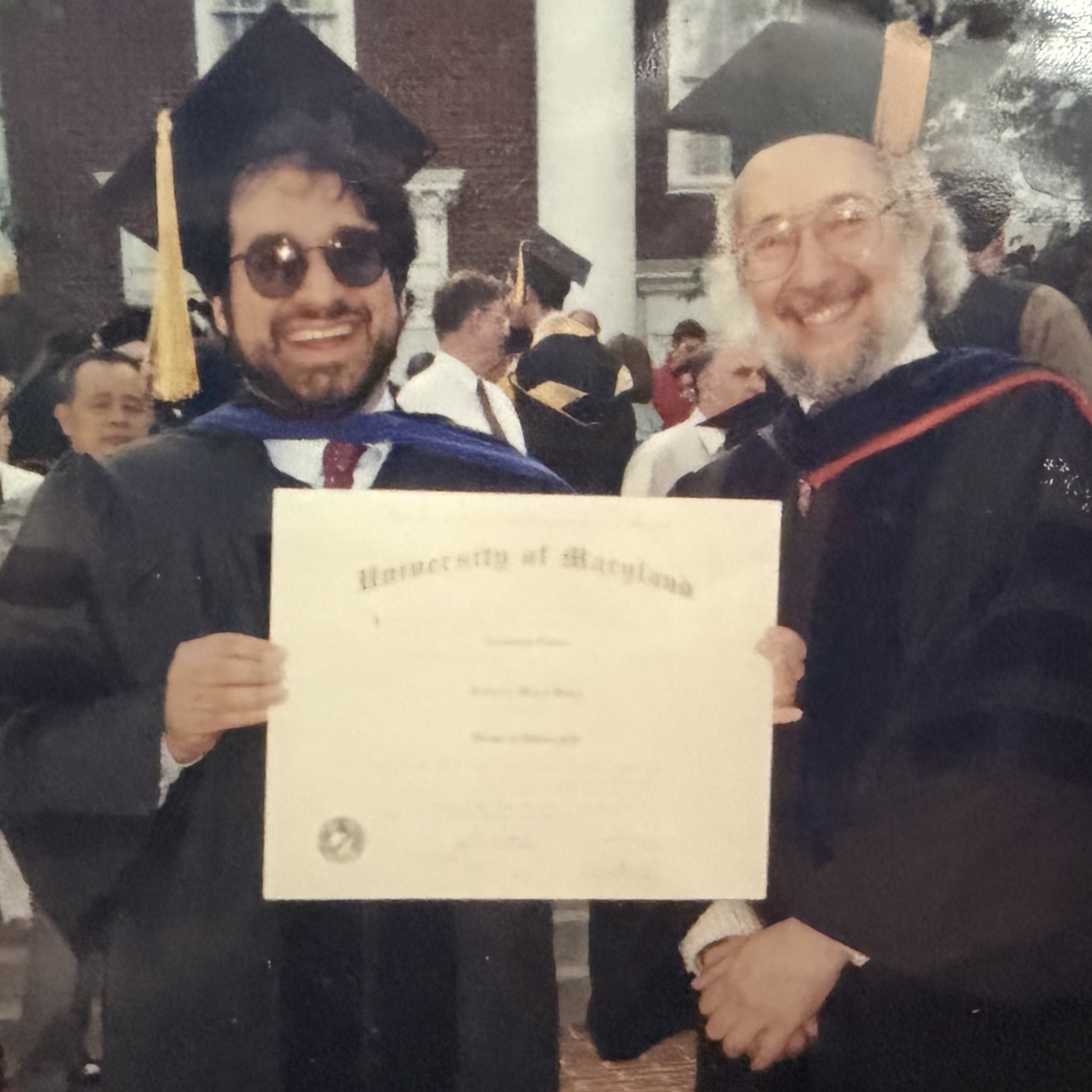
“I guess I must have been in the right place at the right time, because that week started with Joe Redish becoming my advisor, then, the same week, I had my first date with Joy—who’s now my wife—and I got my first teaching job,” Saul recalled. “That week changed everything.”Jeff Saul and Joe Redish in cap and gown at Saul's PhD ceremony.Jeff Saul and Joe Redish

At the time, Saul was a physics graduate student at the University of Maryland, looking forward to a career teaching college-level physics. The late Physics Professor Joe Redish, a nuclear theorist who became an internationally recognized expert in physics education research, became Saul’s mentor and friend and made him part of the new Maryland Physics Education Research Group (PERG).

“It was great to work for Joe. It was exciting and fun,” Saul recalled. “For me, it was the first time I was working in a physics lab where everything just sort of clicked.”

In their work, Saul and Redish and the rest of the founding Maryland PERG group members (Richard Steinberg, Michael Wittmann, Mel Sabella, and Bao Lei) conducted research on students’ physics learning, developed new assessment strategies, and explored innovative, activity-based approaches to teaching college-level physics. As they developed strategies to make physics education less lecture-driven and more interactive, Saul and Redish operated on the same wavelength—in more ways than one.

“If you saw the two of them together, you could see the connection,” recalled Saul’s wife, Joy Watnik-Saul. “They both had the beards, and they both had the round glasses. And they both wore that same kind of fedora-type hat. So, people would sometimes call Jeff a ‘Mini Joe.’ Joe was just a really important part of Jeff’s life and his whole career.”

For Saul, Redish’s mentorship and their work in physics education research became the inspiration for a decades-long career as a teacher, advocate, innovator in physics and STEM education, and physics faculty member at the University of Central Florida, Florida International University and the University of New Mexico. Now retired, Saul is committed to paying that life-changing UMD physics experience forward.

“I knew I wanted to make a contribution that would last longer than me,” Saul explained. “I want physics education research to continue at Maryland, and I want Maryland to continue working at making physics more fun and more accessible and helping students get more out of it.”

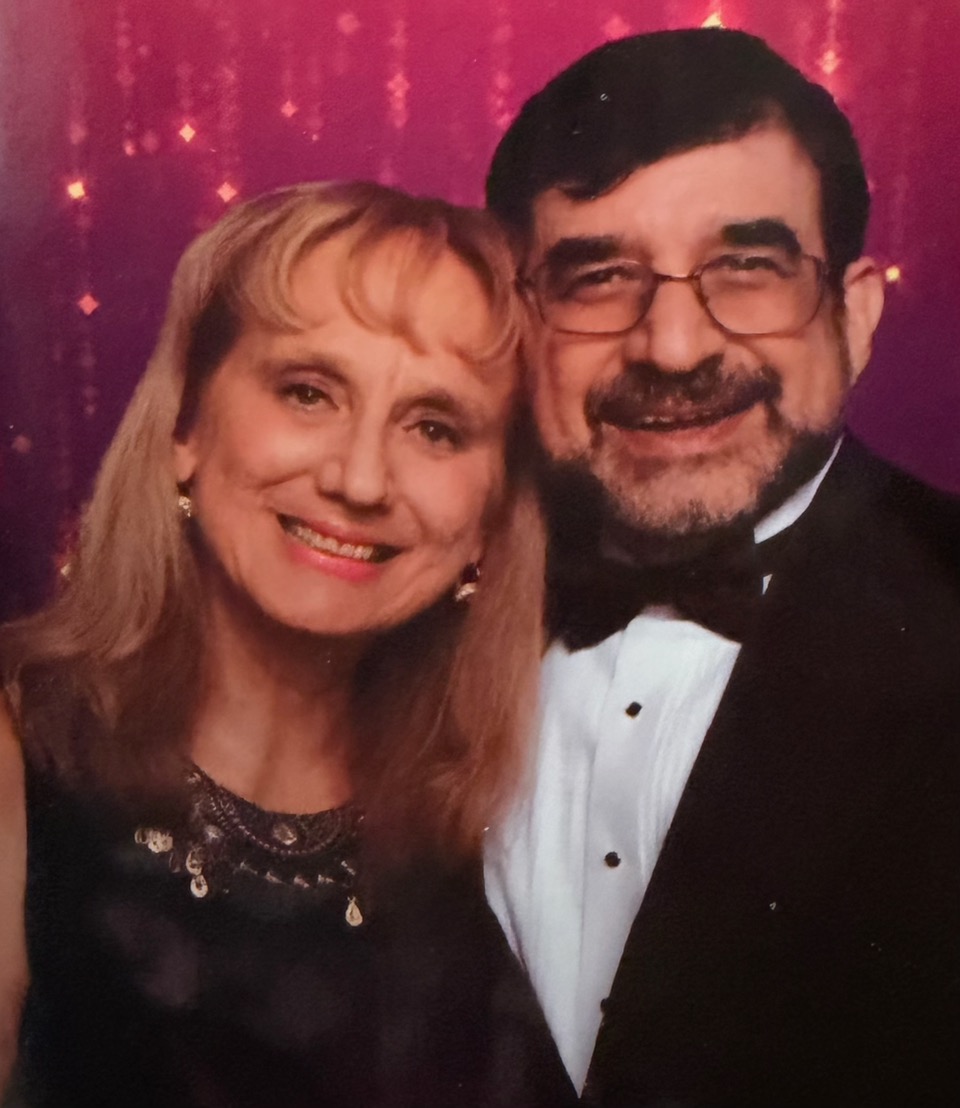
Now, Saul and his wife are doing their part by making a planned gift to Forward: The University of Maryland Campaign for the Fearless, a $2.5 billion initiative that officially launched in November 2025 to accelerate advances in research, education and science.Joy Watnik-Saul and Jeff SaulJoy Watnik-Saul and Jeff Saul

“Joe Redish was one of the pioneers of physics education research – the recognition that if we want to improve the teaching of physics, it needs to be done by physicists, treating it as a science.  This has since broadened throughout the sciences as discipline-based science education research,” Physics Chair Steven Rolston explained.  “This gift from Jeff and Joy emphasizes the outsized impact of Joe’s work and helps continue the tradition here at UMD.”

The Sauls’ generous gift will establish the Dr. Jeff Saul and Joy Watnik-Saul Endowed Distinguished Graduate Fellowship in Physics.

“It’s a fellowship for graduate students doing physics education research,” Saul explained, “and the fact that there's a fellowship for that helps increase the prestige of the field, and it helps attract good graduate students to continue to work in the field.”

To support physics undergraduates interested in physics education, they will also establish the Dr. Jeff Saul and Joy Watnik-Saul Endowed Undergraduate Student Support Fund in Physics.

“The undergraduate scholarship is for a student doing physics education research,” Saul said. “The idea is to get students interested in this field and keep them going forward.”

The Sauls’ gift also includes a contribution to name a collaboration room in the Physical Sciences Complex in memory of Redish.

“A research group really should have its own space and its own conference room where they can get together and talk, and I remember that being part of an active group was a big part of being at Maryland, working on a lot of different things, sharing ideas and really being a team,” Saul said. “And I thought, what a great way to memorialize Joe as well.”

The Sauls’ commitment is also part of the Bequest Legacy Challenge, an incentive program that provides an immediate cash match for donors who document new or increased planned giving commitments to the College of Computer, Mathematical, and Natural Sciences. The Sauls hope their gift can inspire others to do the same thing.

“I'm happy we’re able to make a lasting difference for another generation of students,” Saul said.

Saul says he’ll never forget the many ways that UMD changed his life. Now, it’s all about giving back.

“I owe my career to the University of Maryland, and the people who mentored me and worked with me,” he reflected. “This is a way that I can continue to make a difference and give something back.”

Written by Leslie Miller

Written on 03 February 2026.

Conducting Quantum Experiments in the ‘Coolest’ Lab on Campus

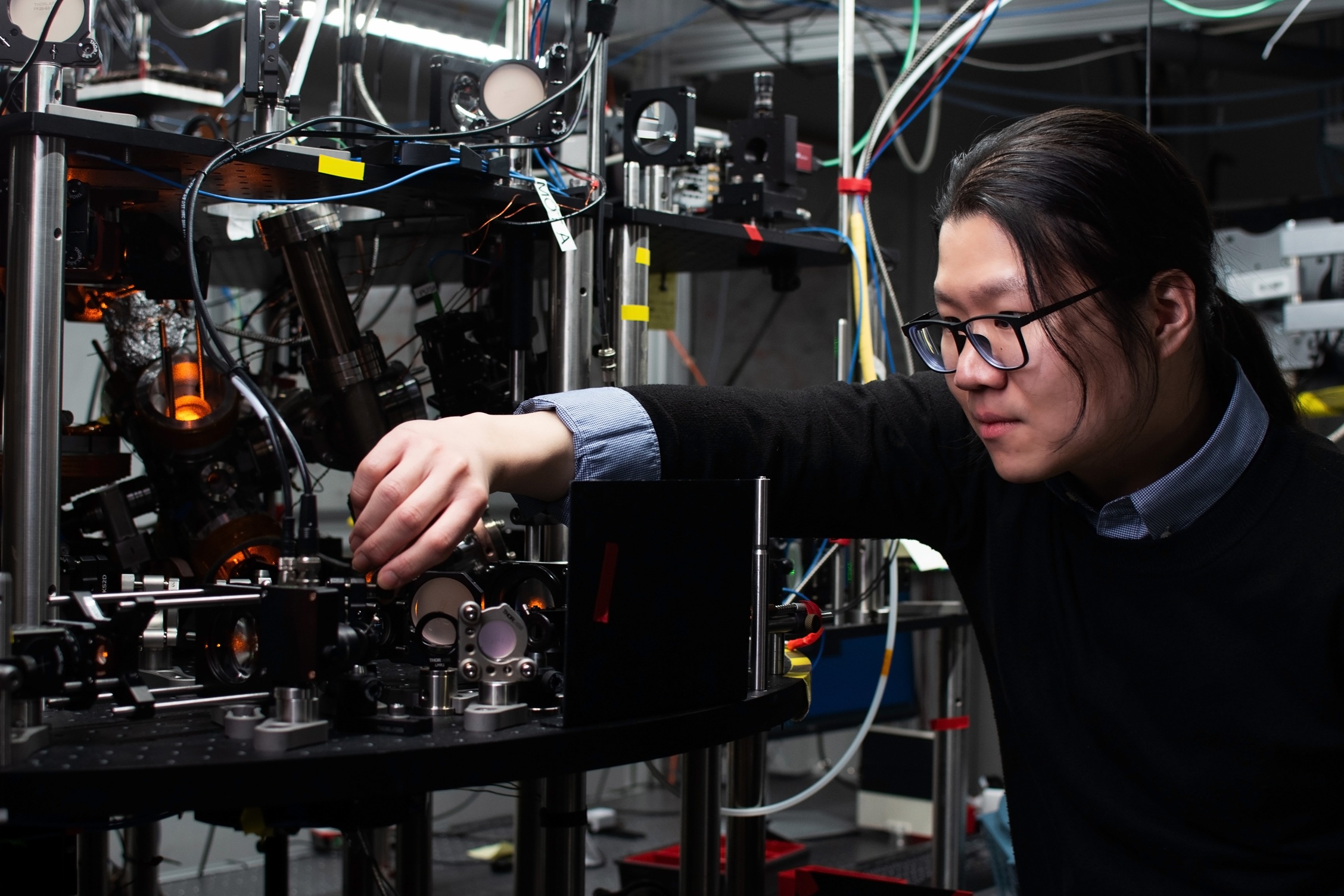
When University of Maryland physics Ph.D. candidate Yanda Geng tells people he works at the ‘coolest’ lab on campus, he’s not exaggerating. In his laboratory at the Joint Quantum Institute (JQI), atoms are cooled to 100 nanokelvin—about one billionth of a degree above absolute zero and roughly 1,000 times colder than the quantum systems used in superconducting quantum computers.Yanda Geng at work in the lab. Credit: Rahul ShresthaYanda Geng at work in the lab. Credit: Rahul Shrestha

In these extreme conditions, something bizarre happens. Atoms stop acting like individual particles and instead merge into a single quantum blob called a Bose-Einstein condensate (BEC). BECs contain millions of atoms that behave according to quantum mechanics rather than classical physics, and they reveal quantum dynamics on a scale large enough to observe without the extreme difficulty of studying single atoms or photons. 

“Simply put, we use laser cooling and trapping techniques to cool atoms down to a very cold temperature, changing the atoms into a different type of matter,” Geng said. 

Advised by Adjunct Professor of Physics Ian Spielman and Associate Vice President for Quantum Research and Education Gretchen Campbell, Geng used microwaves to split the BEC into two different superfluids—liquids that flow without friction. 

“Unlike regular fluids that eventually stop moving because of friction, superfluids can flow forever,” Geng explained. “For example, if you have superfluid in a bucket and rotate that bucket, the superfluid inside won’t follow the bucket because it doesn’t really ‘feel’ the motion of the wall.” 

Like oil and water, these two superfluids cannot mix. But Geng and postdoctoral researcher Junheng Tao discovered interesting swirling patterns as they pushed the superfluids together—the distinctive mushroom-shaped plumes were eerily similar to what happens when galaxies collide, volcanoes erupt or nuclear fusion occurs. Called the Rayleigh-Taylor instability (RTI), this phenomenon had been observed in classical fluids before, but never in superfluids.

“I remember quite distinctly when this data was presented at group meeting: it was a surprise,” noted Spielman. “Several of the cold atom students had been talking with me about measuring fluid dynamical instabilities for some time, but the first RTI data was taken in secret on a weekend, and neither Gretchen nor I knew it was coming!”

For Geng, the findings confirm something profound about the universe: some laws of physics are so fundamental that they work the same everywhere, from cosmic scales to the quantum realm. Finding the same patterns in the quantum world and the everyday world helps scientists understand where the rules of classical physics end and where unique quantum behaviors begin. Geng and the team published the discovery in the journal Sciences Advances in August 2025. 

“It’s kind of amazing to see that this [Rayleigh-Taylor instability] is everywhere, and that the ingredients you need to make it happen aren’t that difficult to put together,” Geng noted. “It’s a pattern with extremely simple origins, something you can find in countless other systems under countless different conditions.”

The journey to cold atom physics

Growing up, Geng was inspired by his uncle, a high-energy physicist, to pursue fundamental questions about how the universe works. After earning his undergraduate degree in physics at Nanjing University in 2020, Geng began looking for graduate schools with atomic physics programs. UMD quickly became a top choice.

“UMD was really a dream school because of its collaboration with [the U.S. National Institute of Standards and Technology] through JQI,” Geng recalled. “I was happy to accept an offer from UMD. Even when a Berkeley professor during my search warned that what I was interested in—ultracold neutral atoms—was ‘really difficult physics,’ I was more confident than ever that this is what I want to do.”

When he began working with Spielman and Campbell in his second year, Geng inherited an experiment from previous students that quickly needed major repairs and upgrades. The experiment itself was a marvel of complexity: four laser tables spanning a 20-foot-by-30-foot lab, requiring expertise in optics, vacuum systems, electronics and even plumbing for the water-cooling system. Everything was controlled by Python programs and code largely written by Geng himself, drawing on the programming skills he learned in high school.

“You have to make sure all subsystems work, and they have to all work at the same time. For the first two years, I worked to optimize each component to achieve the reliability needed for publishable research,” Geng said.

Advocacy in academia

Over the years, Geng has also embraced a leadership role, serving on the department’s Graduate Student Committee, where he organized outreach and social events to help bridge communication gaps between students and faculty members. Geng is particularly committed to supporting new graduate students studying cold atomic physics, emphasizing both the immense challenges and rewards in the field. 

“I remember how I was when I first started here,” Geng explained. “Having some guidance about what to expect as a graduate researcher in cold atomic physics would have really helped me, so I try to pass along my experiences about things like how to interact with a PI and how to be patient with projects. It’s my goal to be transparent and give everyone a realistic picture of what academic research environments can look like.” 

As he approaches his graduation, Geng plans to continue doing research that makes an impact beyond the lab.

“I want to see my work directly connected to people’s lives,” Geng said. “Even though my research is very fundamental, what I’ve found is actually very universal in some ways. I like fundamental research that explores the secrets of the universe, but I’m also interested in photonics applications like with biosensors or precision measurement work like atomic clocks—research that can potentially change people’s lives.”

Written by Georgia Jiang

Written on 08 December 2025.

Young Suh Kim, 1935 - 2025

Professor Emeritus Young Suh Kim died on October 25, 2025 at age 90.  Prof. Kim's research was dedicated to elucidating the connections between relativity, quantum mechanics, and the symmetries that underlie the laws of nature.

Born in Korea in 1935, Prof. Kim earned his Bachelor of Science degree from the Carnegie Institute of Technology (now Carnegie Mellon University) and his Ph.D. in Physics from Princeton University in 1961. He stayed at Princeton to complete his postdoctoral research. At the invitation of Department Chair John S. Toll, Kim joined the University of Maryland faculty in 1962. At the time, he was the youngest person to become assistant professor at the university. He retired in 2007.

While at Princeton as a graduate student, he studied Eugene Wigner’s influential 1939 paper on the inhomogeneous Lorentz group, and had the privilege of asking questions directly to Wigner. At the start of Prof. Kim’s career at Maryland, Paul A. M. Dirac visited for one week, and Prof. Kim was assigned to serve as Dirac’s personal assistant. During this time, Dirac suggested to Kim that more physicists should study the relationship of Lorentz covariance to the internal symmetries of particles.

Prof. Kim’s early research centered on the representations of the Lorentz and Poincaré groups, the fundamental symmetries of special relativity. Together with Marilyn E. Noz, he developed the covariant harmonic oscillator model, providing a relativistically consistent description of the internal structure of bound systems. Their 1977 paper, “Covariant Harmonic Oscillators and the Parton Picture” (Physical Review D, 15, 335), offered an innovative framework linking the quark model of hadrons with Feynman’s parton picture of high-energy processes. This work sought to reconcile the static quark view with the dynamic, frame-dependent parton model through Lorentz-covariant formalism.

Professor Kim’s numerous papers appeared in leading journals including Physical Review, Physical Review Letters, and Journal of Mathematical Physics. His 1989 paper, “Observable Gauge Transformations in the Parton Picture,” offered an important contribution to the study of relativistic symmetries in hadron structure by showing that the parton picture of fast-moving hadrons can be understood as a Lorentz covariant effect with the use of Wigner’s little group formalism, an insightful complement to the dynamical consequence of QCD interactions.

He had a long collaboration with Wigner, co-authoring the 1990 paper “Space-time Geometry of Relativistic Particles” in the Journal of Mathematical Physics. In it he uses Wigner’s little group formalism to unify the space-time geometry of relativistic particles — from massive quarks to massless photons — within a single Lorentz-covariant framework. Again complementing QCD, it is a deep symmetry-based reinterpretation of how internal quantum states (spin, helicity) are tied to external Lorentz transformations. His influential book “Theory and Applications of the Poincare Group” is a key resource for understanding how symmetries underpin modern physics, with discussions of how Poincaré symmetries explain conservation laws via Noether’s theorem.

Prof. Kim is survived by his wife, son, daughter-in-law, two grandchildren, and a global community of former students, collaborators, and admirers. 

  • camara 137
  • Sultangazin with others
  • PC110118   Copy
  • Kim holiday
  • yspgh58d
  • kimy
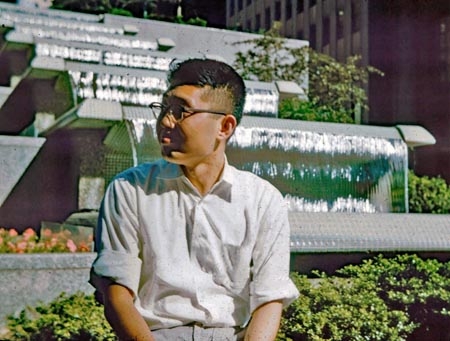
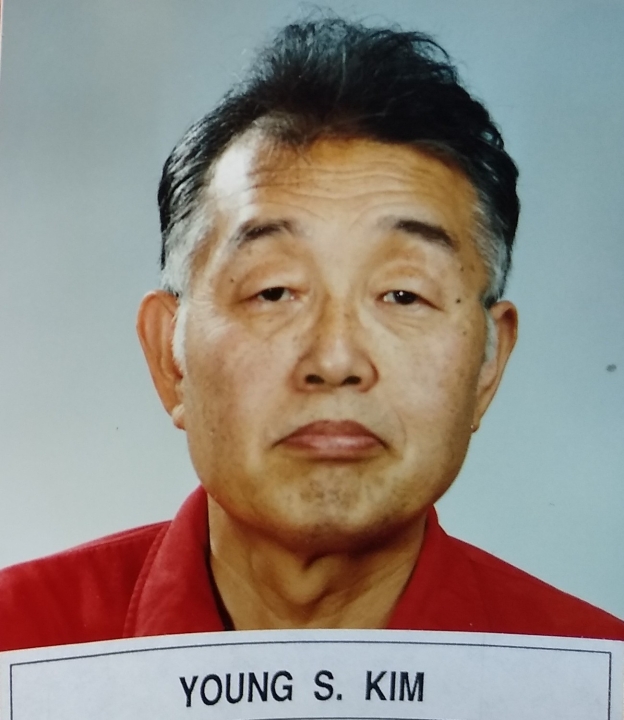
  • Young Suh Kim

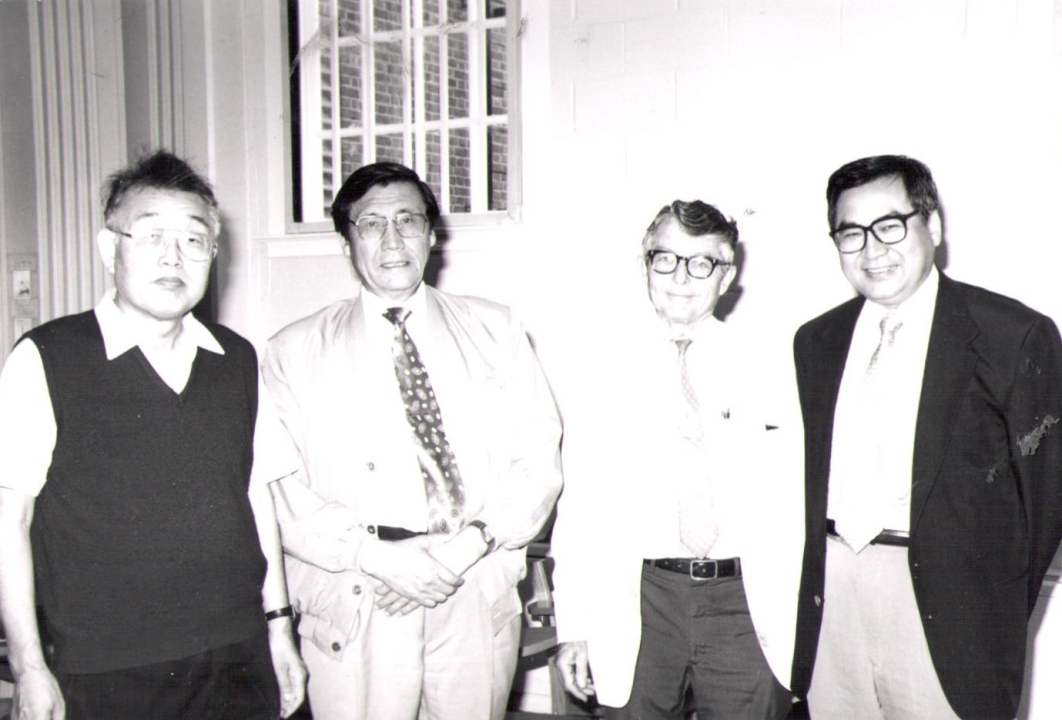
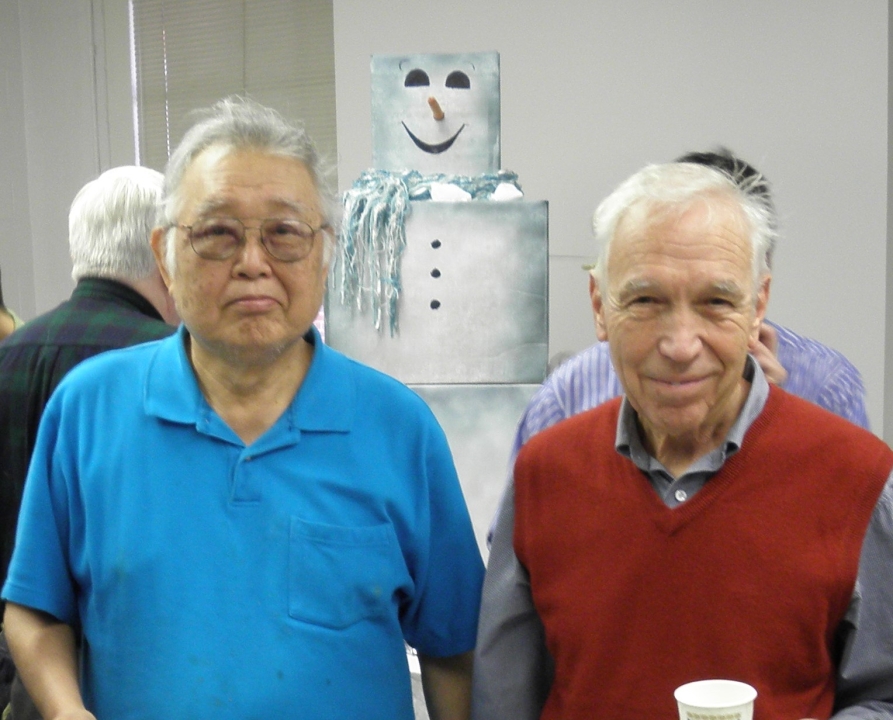
Y.S. Kim, Umirzak Makhmutovich Sultangazin, Richard Ferrell and Chuan S. Liu.

Y.S. Kim and Dieter Brill.

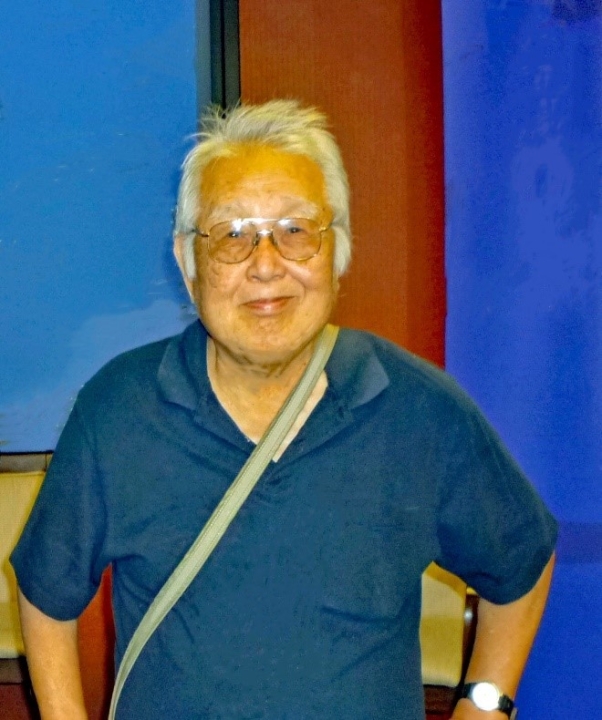
Y.S. Kim at a departmental holiday party. 

More Articles …

  1. Gates Receives 2025 Barry Prize, Named Fellow of the American Mathematical Society and African Academy of Sciences
  2. Barkeshli Selected for Prestigious Simons Collaboration to Study Inner Workings of Artificial Intelligence
  3. Chung Yun Chang, 1929 - 2025
  4. Jaron E. Shrock Cited for Outstanding Thesis
  5. When Physics and Math Go Viral

Page 7 of 154

  • 2
  • 3
  • 4
  • 5
  • 6
  • 7
  • 8
  • 9
  • 10
  • 11
  • Physics Administration
  • Directions
  • Awards
  • Student Awards
  • Make a Donation
  • News
    • Research News
    • Department News
    • Newsletters
  • PTK Policy

College and Department Links

Department of Physics

Physical Sciences Complex
4296 Stadium Dr
College Park, MD 20742
Phone: 301.405.3401

Information

  • Campus Directory
  • Undergraduate Research
  • Scholarships
  • Prospective Undergraduates
  • Directions & Transit
  • Web Accessibility
© 2026 University of Maryland - Department of Physics
Top
  • Home
  • About Us
    • Physics Administration
    • Directions
    • Awards
    • Student Awards
    • Make a Donation
    • News
      • Research News
      • Department News
      • Newsletters
    • PTK Policy
  • People
    • All
    • Faculty
      • Current
      • Emeritus
      • Adjunct
      • Affiliate
      • Research Professors
    • Research Scientists
    • Postdocs
    • Staff
    • Lecturers
    • Visitors
    • Graduate Students
  • Research
    • Research Areas
      • AI and Physical Sciences
      • Astro Metrology
      • Atomic, Molecular & Optical
      • Biophysics
      • Chemical Physics
      • Condensed Matter Experiment
      • Condensed Matter Theory
      • Cosmic Ray Physics
      • Elementary Particles
      • Gravitation Experiment
      • Gravitational Theory
      • High Energy Physics
      • Nonlinear Dynamics, Chaos and Complex Systems
      • Nuclear Physics
      • Particle Astrophysics
      • Physics Education Research
      • Plasma Physics
      • Plasma Theory
      • Quantum Science and Technology
      • Quarks, Hadrons and Nuclei
      • Space Physics
    • Centers & Institutes
  • Academics
    • OSES Home (Student Services)
    • OSES News
    • Undergraduate Program
      • Prospective Students
      • Apply Now
      • Degree Requirements and Policies
      • Scholarships
      • Undergraduate Research
      • Advising
      • Undergraduate Forms
      • Undergraduate Events
      • Departmental Honors
      • Society of Physics Students
      • FAQ
      • Undergraduate Student Committee
    • Graduate Program
      • Prospective Students
      • Open House
      • Degree Requirements
      • Graduate Resources
      • Deadlines and Forms
      • PhD Defenses
        • PhD Defenses 2026
        • PhD Defenses 2025
        • PhD Defenses 2024
        • PhD Defenses 2023
        • PhD Defenses 2022
        • PhD Defenses 2021
        • PhD Defenses 2020
        • PhD Defenses 2019
        • PhD Defenses 2018
        • PhD Defenses 2017
        • PhD Defenses 2016
      • Events
      • Scholarships & Awards
      • Qualifier
      • Graduate Student Organizations
      • FAQ
    • Student Opportunities
      • GRAD-MAP
      • Graduate Student Organizations
      • Outreach Volunteering
      • Society of Physics Students
      • NSF S-STEM Program
      • Undergraduate Research
      • The Noether Physics Society
      • Undergraduate Quantum Association
    • Courses
    • Academic Support
    • NSF S-STEM Program
    • Teaching Assistants
  • Events
    • Calendar
    • Physics Colloquia
    • W.J. Carr Lecture
    • Research Interaction Team (RIT) Math/Physics
    • Mechanick Quantum Biology Lecture
    • Irving and Renee Milchberg Endowed Lectureship
    • Charles W. Misner Endowed Lectureship in Gravitational Physics
    • John S. Toll Endowed Lecture
    • Prange Prize Lecture
    • Maryland Day
    • Outreach
      • Outreach Home
      • Physics is Phun
      • Discovery Days
    • Summer Programs
      • Physics Makers Camp
      • Physics of Quidditch
      • Science Discovery Camp
      • Advanced Physics Summer Program
      • Toolkit for Success
    • CUWiP
    • Vortex Makerspace
    • QURiSE Conference
  • Services
    • Building Access Requests
    • Computing Services
    • Conference Room Reservations
    • Department Operations Directory
    • Electronic and Mechanical Development
    • Hiring Procedures
    • Lecture Demo
    • Mental Health Resources
    • Parking
    • Physics Ombudspersons
    • Printing Services
      • Poster Print Request
    • Proposal Submissions
    • Purchase Order
    • Suggestion Box
    • Textbook Information
  • Give