
Particle accelerators are among the largest and most complex scientific projects ever built. The Large Hadron Collider spans 16 miles deep beneath Switzerland. Stanford’s linear accelerator stretches more than two miles. These massive, billion-dollar machines can probe the fundamental nature of reality—but their size and cost put them out of reach for most.
University of Maryland physics postdoctoral researcher Jaron Shrock (Ph.D. ’23, physics) is helping to change that.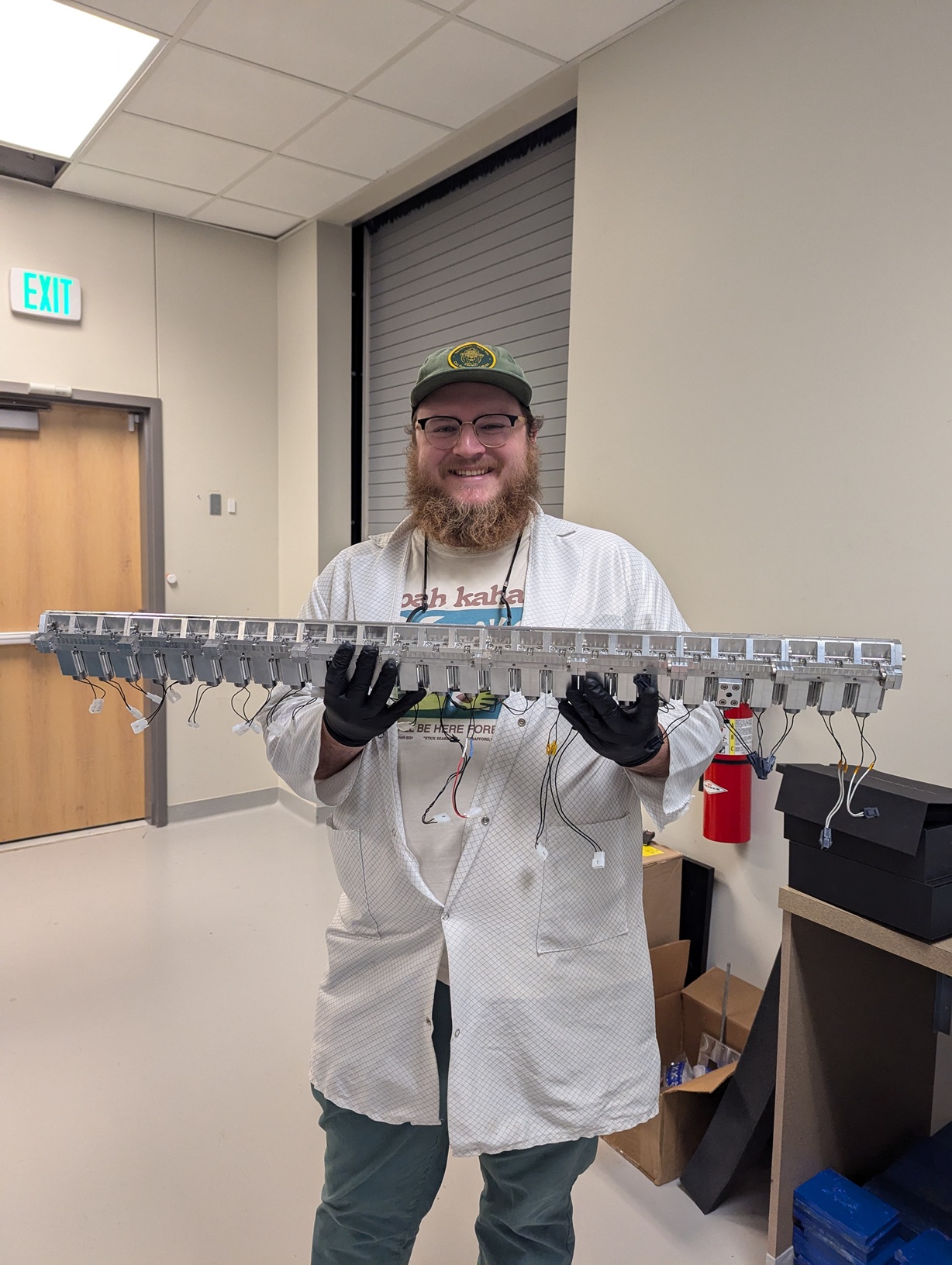 Jaron Shrock holds newly-developed equipment.
In 2025, Shrock won the American Physical Society's Marshall N. Rosenbluth Outstanding Doctoral Thesis Award for demonstrating the first multi-GeV laser wakefield acceleration using optically generated plasma waveguides. In simpler terms, he figured out how to shrink a kilometers-long accelerator down to the size of a conference table.
“Getting a kilometers-long machine to fit inside a university lab, a manufacturing facility or a hospital room has enormous potential to bring advanced light and radiation sources to a variety of applications,” explained Shrock, who works with Distinguished University Professor of Physics Howard Milchberg in the Intense Laser Matter Interactions lab at UMD.
Traditional particle accelerators are already mainstays in research: scientists use them to study the universe’s origins, discover new particles, produce isotopes for medical imaging, manufacture computer chips and much more. Shrock says that overcoming the limitations that come with their massive size could open doors for other applications and users, allowing more people to access the benefits of accelerators on a more portable and more cost and energy-efficient level.
“This is a major step to really democratizing the capabilities of this kind of tech,” Shrock explained. “Our findings help make this more accessible to a whole variety of people, including researchers, hospitals and industries.”
From musical harmonics to plasma physics
Shrock’s current success is a long way from where his journey began in a high school physics classroom when a music project about harmonics suddenly made the universe click into place.
“I saw the connection between the musical training I had and physics,” Shrock recalled. “There are really fascinating, deep relationships that govern all these things around us, and I realized I wanted to learn more.”
Always a tactile person, Shrock excelled at working with his hands. After graduating from high school, he attended Swarthmore College in Pennsylvania to play baseball and study physics.
“I got to work in a plasma physics lab there, and I discovered that I wanted to be in a lab where I get to touch stuff, make things, have physical connections to the experiment,” Shrock said. “My then-advisor told me to go and meet Howard Milchberg at UMD, see what they do with intense lasers. I did and got hooked on it immediately.”
Since that initial visit to College Park in 2018, Shrock never looked back. He became fascinated by the idea of using lasers to accelerate electrons through plasma, a special state of matter found in lightning and the sun.
“Traditional particle accelerators face fundamental limits: they push particles using electromagnetic fields inside vacuum chambers, but those fields can only be so strong before destroying the machine’s walls,” Shrock explained. “The only solution was to just build longer and longer, which is why conventional accelerators span kilometers.”
Shrock’s laser-driven approach sidesteps this entirely. Ultrapowerful laser pulses—lasting just femtoseconds (a millionth of a billionth of a second)—can rip through plasma like a snowplow, separating electrons from ions. This creates a wave that accelerates trapped electrons with forces a thousand times stronger than conventional accelerators.
“We could push particles a thousand times harder with this laser method, so it meant that we only need to push them a thousand times shorter distance,” Shrock said. “All of a sudden, a kilometer-size machine becomes a meter-scale machine.”
The key innovation is a plasma waveguide—essentially a fiber optic cable made of plasma that keeps ultra-intense lasers focused over meter-long distances. Although Milchberg pioneered these waveguides at UMD in the 1990s, the laser tech wasn’t ready to test at that time. But when Shrock joined Milchberg’s lab in 2018 as a physics Ph.D. student, they finally made it happen.
After spending months in Colorado running experiments, Shrock and Milchberg’s team produced the breakthrough that would anchor Shrock’s award-winning thesis—the first single-shot muon radiography using a laser-driven source.
“Muons are subatomic particles that can penetrate dense materials, but while they’ve been used to successfully discover hidden chambers in Egyptian pyramids, those applications relied on cosmic rays and took weeks,” Shrock explained. “We rolled a rental truck loaded with detectors into the beam path and were able to see, on single shots, shadows of the material we were scanning. If the accelerator fits on a truck, then you can take it directly to the feature that you want to image, quick and easy.”
Small team, massive impact
Shrock says these breakthroughs would’ve been impossible without a uniquely supportive research environment.
“The culture here at UMD, I think, makes a big difference,” Shrock said. “Students don’t just run experiments—they design equipment, fabricate optics, engineer gas jets and intimately understand every component.”
Shrock believes that the deep technical expertise, combined with Milchberg’s mentorship style, allowed him and his groupmates to thrive. The team’s success in Colorado wasn’t a massive national laboratory or industry effort but simply a handful of dedicated graduate students—now postdocs—working closely together. Despite the limited personnel, their work completely transformed the trajectory of particle accelerator technology around the world, including research at Lawrence Berkeley National Laboratory, the birthplace of particle accelerator technology.
In 2021, Shrock led a multi-institutional collaboration with the Defense Advanced Research Projects Agency (DARPA) as a graduate student. He directed a team of senior scientists—an unusual level of responsibility that reflected Milchberg’s commitment to developing the next generation of physicists.
“Howard really empowers young scientists,” Shrock noted. “Whenever our lab receives invitations to give talks, he always passes it to graduate students. He’s never stingy about opportunities, and it’s led to our work being widely recognized. I’m the fourth person from his group to receive the Rosenbluth Award, which reflects his efforts to support us.”
This year, as UMD’s upgraded 100-terawatt laser system comes online, the campus will have its very own compact particle accelerator, thanks to foundational work from Milchberg’s group. Faculty members are already designing experiments to take advantage of its unprecedented capabilities.
“There's a whole lot that will come out of reconsidering the economic calculation for what you can do with a high-energy particle beam,” Shrock said. “It saves a lot of time, money and effort if you can just walk across campus to use an accelerator rather than needing to go someplace far away.”
Looking ahead, Shrock envisions compact accelerators taking on research and production to the next level, beyond what conventional accelerators have provided in fields such as medical isotope production, advanced manufacturing and fusion research diagnostics.
“It's been both incredibly thrilling and exhausting to see this platform grow from ideas developed by our small team to the centerpiece of international research efforts,” Shrock reflected. “I believe we're only scratching the surface of what these accelerators can do.”
Written by Georgia Jiang