Long-Distance Teleportation Between Atoms

For the first time, scientists have successfully teleported information between two separate atoms in unconnected enclosures a meter apart – a significant milestone in the global quest for practical quantum information processing.

Teleportation may be nature’s most mysterious form of transport: Quantum information, such as the spin of a particle or the polarization of a photon, is transferred from one place to another, but without traveling through any physical medium. It has previously been achieved between photons over very large distances, between photons and ensembles of atoms, and between two nearby atoms through the intermediary action of a third. None of those, however, provides a feasible means of holding and managing quantum information over long distances. 

Read More

UMD Physicists Play Major Roles in Four of AIP's Top Ten Physics Discoveries of 2008

Editors and science writers at the American Institute of Physics and the American Physical Society selected a list of Top Ten Physics Stories in 2008. The selections were released on December 22, 2008 and included four discoveries in which UMD Physicists had major roles (Large Hadron Collider, Quarks , Ultracold Molecules and Cosmic Rays).

To view the full article, visit: http://www.aip.org/pnu/2008/split/879-1.html

Heavy electrons: new ways to break old rules

By: Johnpierre Paglione


In 1853, well before the discovery of the electron by J. J. Thomson in 1897, two German physicists named Gustav Wiedemann and Rudolf Franz made the peculiar observation that the ratio of electrical to thermal conductivities is the same in several different metals. Although not as famous as the discovery of superconductivity in mercury by Kamerlingh Onnes over fifty years afterward in 1911, this experiment marked one of the first quantitative studies of the inner nature of metals and would turn out to play a pivotal role in guiding the development of the quantum theory of solids. Much effort went into explaining “the law of Wiedemann and Franz”, with the first successful (although fortuitousi) theoretical explanation given by Drude in 1900 in terms of a classical gas of electrons. The advent of quantum mechanics played a crucial role in advancing this interpretation, leading to corrections by Sommerfeld and Bloch in 1928 employing the concept of a Fermi gas of particles that obey quantum mechanical statistics.

While the non-interacting quantum gas picture was quite successful, it was still not obvious how the interactions between ~1023 electrons confined within a small chunk of metal could be completely negligible. This remained a mystery for some time, but the last piece of the puzzle, called Fermi liquid theory, was provided by L. D. Landau in 1957. This theory presented a new way of thinking about the strong interactions present in a system, introducing the notion of “dressed” electrons, or so-called “quasiparticles,” that can be treated as non-interacting particles with the same quantum variables as bare electrons, but with the effects of their interactions buried within renormalized quantities such as their mass. This finally explained the law of Wiedemann and Franz as a simple consequence of having spin ½, charge ‘e’ fermionic particle excitations that transport a set ratio of heat and charge quantities given only by fundamental constants.

In 1975, Fermi liquid theory was put to the test with the discovery of a new class of metals which pushed the quasiparticle idea to the extreme: CeAl3, the first reported “heavy-fermion” system, is one of several metals which harbor quasiparticles with effective masses approaching 1000 times that of the bare electron mass. And yet, these are well described by Landau’s theory; considering this means electrons in these materials are slowed down to the speed of sound, this is truly amazing!  However, the world is not so simple – many other materials exhibit strange metallic properties that do not fit Landau’s picture, and for lack of a better term are often branded as “non-Fermi liquids.” For example, some heavy-fermion systems on the verge of magnetism can be experimentally tuned by applying external pressures or strong magnetic fields to traverse through a zero-temperature phase transition between two stable ground states. Because it occurs at absolute zero temperature, the character of such a “quantum critical point” is dictated by quantum effects rather than the thermal fluctuations that dominate normal phase transitions. More important, the influence of these quantum fluctuations can disrupt the formation of long-lived quasiparticles down to the lowest measured temperatures, some 10,000 degrees below where that occurs (i.e. the Fermi energy) in normal metals, causing electronic masses to appear to diverge toward infinity.

The question is, are these quantum fluctuations simply altering the behavior of quasiparticles in an as-yet misunderstood manner, or have we finally gone well beyond the limits of Landau’s theory? Cut to the law of Wiedemann and Franz: this nice, simple description of spin ½ charge e particles carrying a fixed ratio of heat and charge actually has profound implications. It turns out to be very difficult, so far impossibly soii, to break this relation if you start with Landau’s quasiparticles as an ingredient; being individual entities, they simply carry heat as well as charge. In this light, an experimentally observed violation of this law is considered “smoking gun” evidence for the failure of Fermi liquid theory. Recently, studies of the low-temperature heat and charge conductivities of the heavy-fermion material CeCoIn5 [Tanatar et al., Science 316, 1320 (2007)] have unearthed a violation of the Wiedemann-Franz law as the temperature of the system approaches absolute zero and the ground state is tuned to a quantum critical point. By turning a knob on the magnet power supply, this system can be tuned back and forth between a Fermi liquid ground state, where quasiparticles are well behaved and the Wiedemann-Franz law is obeyed, and a strange metallic state where the WF law does not hold, suggesting that the quasiparticle description has met its match.

Does this behavior mark the death of the quasiparticle and the demise of the Fermi liquid? Oddly, yes and no. It appears that Nature simply refuses to completely abandon Landau’s picture: even when tuned directly to the critical magnetic field, the observed violation in CeCoIn5 only thrives when heat and charge currents are applied along one particular direction of the tetragonal crystalline lattice, and not the other. In other words, it is only under the most stringent conditions that the Wiedemann-Franz law can be forced to break down, making it no surprise that this law has stood for so long. While Gustav and Rudolf may be dismayed to know their law has finally been broken, they would surely be impressed to know that it has been the law of the land for over 150 years. Now that’s an experiment to remember.


i Drude’s published calculation, which treated electrons using classical statistics, was fortuitously wrong by a factor of two.

iiThe WF law remains valid in several extreme theoretical limits, including that of strong disorder and up to the insulator transition.

MILAGRO Detects Cosmic Ray Hot Spots

The University of Maryland-led Milagro collaboration, comprised of scientists from 16 institutions across the United States, has discovered two nearby regions with an unexpected excess of cosmic rays. 

This is the second finding of a source of galactic cosmic rays relatively near Earth announced in the past week. In the November 20 issue of the journal Nature, ATIC an international experiment lead by LSU scientists and conceived by a University of Maryland physicist announced finding an unexpected surplus of cosmic-ray electrons from an unidentified, but relatively close source.

“These two results may be due to the same, or different, astrophysical phenomenon, said Jordan Goodman, a University of Maryland professor of physics and principal investigator for Milagro. However, they both suggest the presence of high-energy particle acceleration in the vicinity of the earth. Our new findings [published in the November 24 issue of Physical Review Letters] point to general locations for the localized excesses of cosmic-ray protons observed with the Milagro observatory.

Cosmic rays are actually charged particles, including protons and electrons, that are accelerated to high energies from sources both outside and inside our galaxy. It’s unknown exactly what these sources are, but scientists theorize they may include supernovae -- massive stars that explode -- quasars or perhaps from other even more exotic, less-understood sources within the universe. Until recently, it was widely held that cosmic-ray particles came toward Earth uniformly from all directions. These new findings are the strongest indications yet that the distribution of cosmic rays is not so uniform.

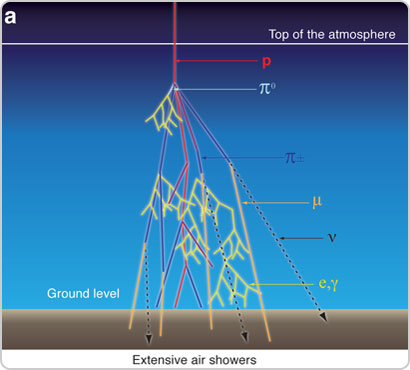
When these high energy cosmic ray particles strike the Earth's atmosphere, a large cascade of secondary particles are created in an extensive “air shower.” The Milagro observatory, located near the Los Alamos National Lab in New Mexico, 'sees' cosmic rays by observing the energetic secondary particles that make it to the surface.

Jordan and his Milagro colleagues used the cosmic-ray observatory to peer into the sky above the northern hemisphere for nearly seven years starting in July 2000. The Milagro observatory is unique in that it monitors the entire sky above the northern hemisphere. Its design and field of view, made it possible for the observatory to record over 200 billion cosmic-ray collisions with the Earth’s atmosphere.

This allowed researchers for the first time to see statistical peaks in the number of cosmic-ray events originating from relatively small regions of the sky. Milagro observed an excess of cosmic ray protons in an area above and to the right of Orion, near the constellation Taurus. The other hot spot is a comma-shaped region in the sky near the constellation Gemini.

“Whatever the source of the protons we observed with Milagro, their path to Earth is deflected by the magnetic field of the Milky Way so that we cannot directly tell exactly where they originate,” said Goodman. “And whether the regions of excess seen by Milagro actually point to a source of cosmic rays, or are the result of some other unknown nearby effect is an important question raised by our observations.”

Even more revelatory observations of cosmic rays and further help solving the mystery of the origin of cosmic rays may come in the form of a new observatory that Jordan and his fellow U.S. Milagro scientists have partnered with colleagues in Mexico to propose to the National Science Foundation. This second-generation experiment named the High Altitude Water Cherenkov experiment (HAWC) would be built at a high-altitude site in Mexico.

The National Science Foundation (NSF) funded construction of the Milagro through the University of Maryland. The observatory’s work was funded by NSF, the US Department of Energy, Los Alamos National Laboratory, and the University of California. For more information on Milagro and HAWC, visit the University of Maryland HAWC website: http://hawc.umd.edu or contact Jordan Goodman (This email address is being protected from spambots. You need JavaScript enabled to view it.) or Brenda Dingus (This email address is being protected from spambots. You need JavaScript enabled to view it.).

"Spooky Action-at-a-Distance" with Individual Atoms

By: Christopher Monroe

Albert Einstein never liked Quantum Mechanics, with its fuzzy superpositions and confused states of reality. In 1935, he and colleagues Boris Podolsky and Nathan Rosen proposed a thought experiment that they believed would finally show cracks in the new quantum theory. The essentials of their famed proposal can be seen by cconsidering two “quantum coins,” that are prepared in a strange superposition of being both heads-up and both tails-up at the same time. When such coins are brought far apart from each other and then measured, quantum mechanics predicts that the only possible results can be HH and TT – the orientation of the coins always matches in perfect correlation. But when either individual coin is observed, its value is expected to be totally random (H or T). What’s interesting here is that while an individual coin is in an indeterminate state until observed, the observer immediately knows that orientation of the other coin, and this knowledge happens faster than the speed of light can traverse the distance between the coins.

Einstein called this quantum behavior “spooky action-at-a-distance,” and concluded that either quantum mechanics is incomplete, or it is just very weird. We now know, thanks to John Bell in 1964, that if quantum mechanics is indeed incomplete, than any more complete theory must be just as weird, so we might as well stick with quantum mechanics. Bell devised a measure of this weirdness: an inequality involving measured pair-correlations that is violated for situations like the one considered by Einstein, Podolsky and Rosen.

This weird type of quantum state the Einstein introduced is now known as an “entangled state,” and the spooky action-at-a-distance that he bemoaned is now the central resource in the field of Quantum Information Science. Replace the coins by quantum bits that can be in the state 0 and 1 simultaneously, and these qubits can be used for superfast computing applications, or fundamentally secure communication. Qubits are now being investigated in a variety of physical systems, from individual atoms and photons, to superconducting circuits and semiconductor quantum dots.

Recently, a team of researchers from the University of Maryland Department of Physics and Joint Quantum Institute have observed for the first time, quantum entanglement of individual atoms separated by a large distance [Moehring, et al., Nature 449, 68, (2007)]. Two atoms, held in electromagnetic traps one meter apart, were synchronized with a laser pulse, and the resulting emitted light was interfered on a beamsplitter and detected. This detection produced an entangled state of the two atoms, where qubits were stored in the magnetic orientation of each atom. This entanglement (the correlations of the atomic-scale magnets and the randomness of each one individually) was directly verified by measuring the magnetic orientation with a separate laser, resulting in a clear violation of Bell inequalities. This type of quantum linking between atomic qubits may ultimately lead to the fabrication of a large-scale quantum computer, where atomic memories will be able to store exponentially-rich amounts of data and be connected through optical interconnects as demonstrated here. In the nearer term, this is among the most promising roads to a “quantum repeater,” where qubits can be propagated over very large (or even geographic) distances with the use of optical fibers.