On World Quantum Day, April 14, 2023, Jade LeSchack was featured in a video narrated by LeVar Burton:
In 2021, when Jade LeSchack was a high school senior imagining herself at potential colleges, she was already entranced by physics—quantum physics in particular. After taking high school physics classes and an online course on quantum computing, she wanted to explore the world of physics more fully.
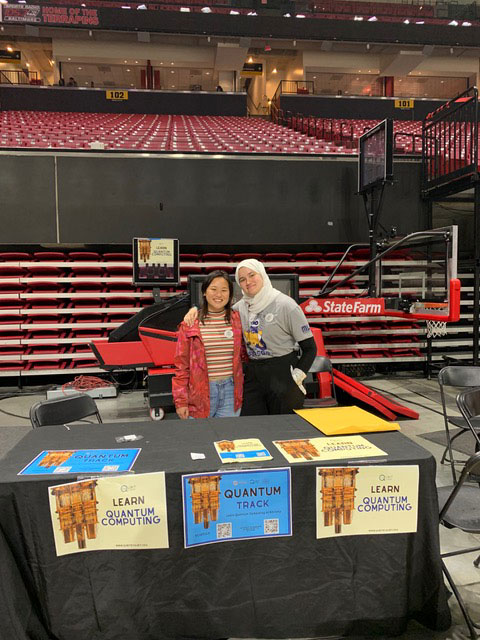
“I loved that in class we talked about a lot of different topics that were not just mechanics related,” LeSchack said. “We were talking about waves, quantum mechanics a little bit here and there, about sound and things like that. That's where I really found a love for physics. And then taking the Qubit by Qubit online Introduction to Quantum Computing course, that solidified it for me, because I realized you need physics for quantum computing. And I really wanted to dive deeper into physics.”Jade LeSchack and Sondos Quqandi, the UQA Vice President and a UMD physics major, at an informational table for the quantum track of Bitcamp 2021. Image credit: Dhruv Srinivasan
That desire attracted her to the University of Maryland’s flourishing and top-rated physics program, where an ambitious student can engage in basic research and learn how quantum physics is being harnessed in cutting-edge quantum technologies. UMD encompasses eight centers and institutes dedicated to quantum research, is part of the Mid-Atlantic Quantum Alliance, and is home to the Quantum Startup Foundry. Last year, as a freshman physics major at UMD, LeSchack wasted no time before connecting with faculty, embracing the resources offered by the university and even creating new opportunities for herself and her fellow undergrads in the form of a quantum club.
While LeSchack was still investigating prospective colleges, she noticed Nicole Yunger Halpern, a quantum theorist who is now an adjunct assistant professor of physics at UMD, on the QuICS website. Yunger Halpern was moving to UMD and a position at NIST in the fall of 2021, the same time LeSchack would be starting if she decided to become a UMD student.
“I wanted to reach out to her to see what her experience has been like,” LeSchack said. “And what has her path been? I wanted to connect with another woman in STEM. And it was great to just talk with her. I had looked at all of her research pages and some of the titles of the papers she published, and I was like, wow, I don't understand any of that. And she said, ‘But you will; you will soon.’ That was nice to hear.”
Yunger Halpern invited LeSchack to sit in on a group meeting to see what her research group was like, which developed into an ongoing arrangement throughout the year. Yunger Halpern provided additional mentorship as the year went on, like walking LeSchack through how she approaches reading an academic paper.
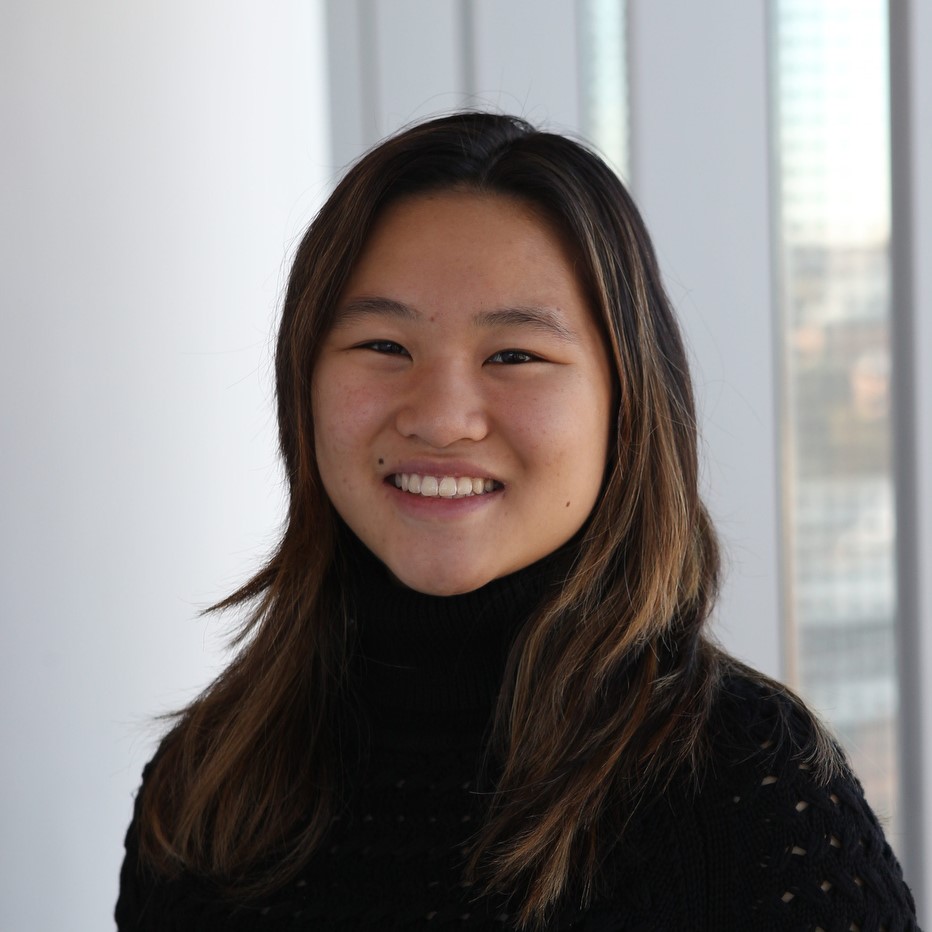
Jade LeSchack "I can best illustrate how self-driven Jade is by sharing that, before she even enrolled at UMD, she decided that she was going to specialize in quantum computing and I was going to be her advisor,” Yunger Halpern said. “One can scarcely stand in the way of such determination! Her passion for physics and leadership have been a delight to engage with throughout the past year."
Once LeSchack decided that UMD was where she wanted to go and before her first semester had even started, she was looking for a way to contribute to the community. As a high school student, she had learned about undergraduate quantum clubs at universities like Stanford and MIT through hackathons—events where people gather to develop computer coding skills through workshops and challenges.
“I enjoy starting things, and then also using those things to teach people about the things that I'm interested in,” LeSchack said. “Since there were models that existed before, I wanted to take up the mantle of starting something at UMD because I thought a quantum club belongs here for the students and that there might be interest.”
She reached out to various people at UMD about her idea for an undergraduate quantum club. She eventually connected with Donna Hammer, the director of Student and Education Services in the Department of Physics, who suggested LeSchack present her vision for a club at the meeting for all the department’s students that happened on the first Wednesday of the semester.
“She said we need to start recruiting people, we need to see the interest and we should get started right away,” LeSchack said. “Donna has been really instrumental in helping sponsor the club and helping me get it off the ground.”
The result was the formation of the Undergraduate Quantum Association (UQA), which helps students learn about and engage with quantum science and technology by hosting events—including quantum hackathons, speaker events and lab tours. LeSchack’s goal is for the club to aid students from a variety of majors.
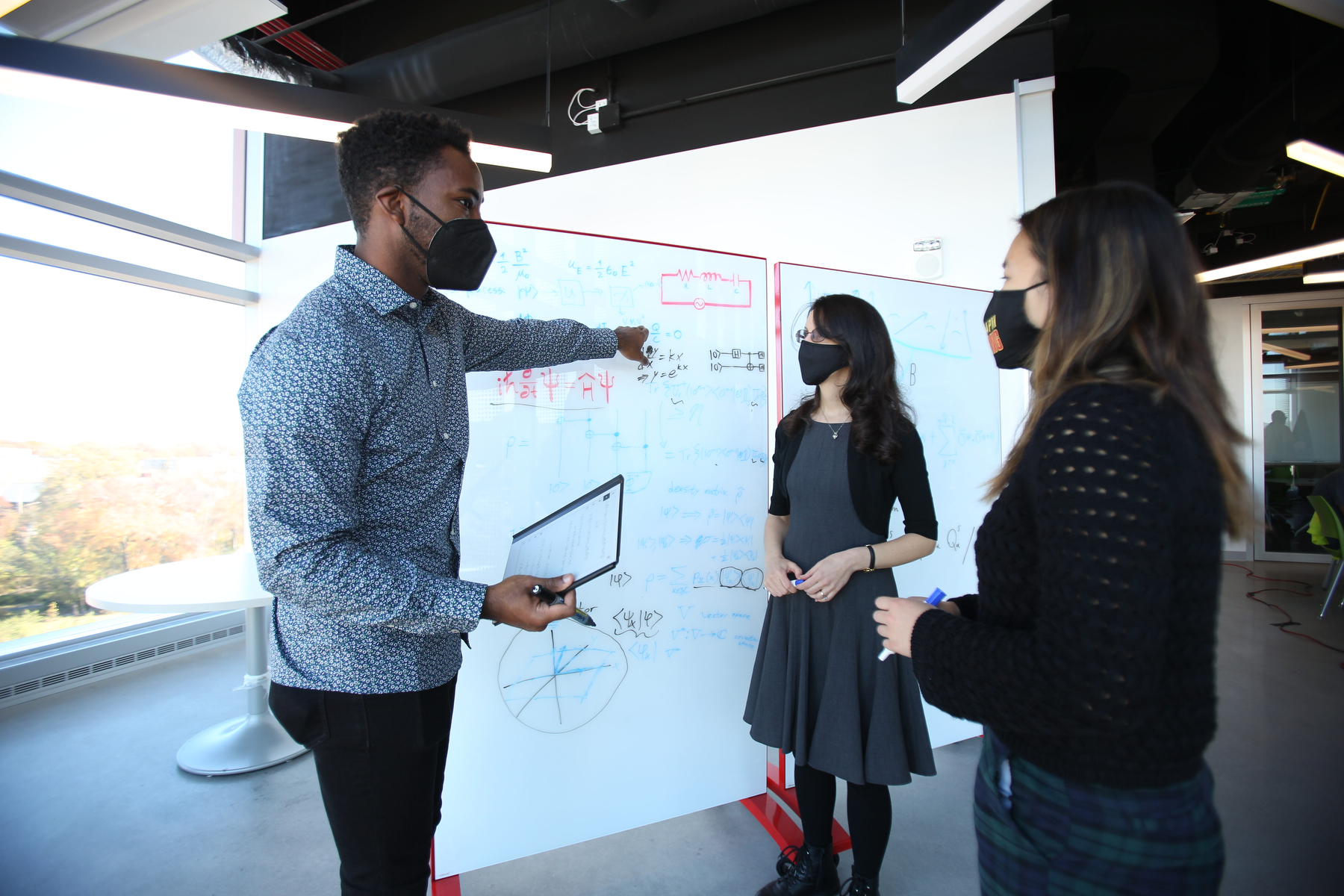
“I think that what's cool about what UQA can do is that it can pull people from all majors—not just physics—because quantum computing is an intersection between physics and computer science as well as math, and it has applications to even more than that, like bioengineering, chemistry and finance,” LeSchack said. “So those places where the applications are, are where UQA wants to help bring students that are not just physics majors in and say this new field is going to have applications to what you are already interested in, how can you incorporate quantum into what you're doing?”Anthony Munson, Nicole Yunger Halpern and Jade LeSchack
In UQA’s first year, one of its main events was giving its members a firsthand look at quantum industry by touring IonQ. IonQ is the first publicly traded quantum computing company, and it grew out of UMD research projects and is based in the UMD Discovery District. The members of UQA got to see the company’s labs and quantum computer and meet with some of the staff.
UQA also participated in organizing the quantum track of the 36-hour Bitcamp hackathon put on by the university. The quantum track covered a broad range of quantum topics, including introducing qubits, the most fundamental pieces of quantum computers; using Qiskit, an open-source software development kit for working with quantum computers; and solving a programming challenge by using simulations to determine the ground state bond length of hydrogen molecules.
While getting UQA started, LeSchack also made time to get firsthand experience working in a lab. During the annual department research fair in October 2021, LeSchack met Patrick Banner, a UMD physics graduate student. Over the winter break she reached out to him about getting hands-on lab experience. She wanted to try lab work early so she could figure out what type of research she enjoyed and to ensure that she really understood what academic research is in practice.
She asked Banner about opportunities to contribute to research, and he helped arrange for her to work in the lab run by UMD Physics Adjunct Professor Trey Porto and UMD Physics Professor Steve Rolston, who is also chair of the Department of Physics. Under the guidance of Banner and Deniz Kurdak, another UMD physics graduate student, she worked on an electronics project. Besides developing practical skills working in the lab, she got to see how Porto’s experimental group had a different dynamic from Yunger Halpern’s theoretical group.
After a year of classes, research and lab work, LeSchack is still eager to learn more about physics and quantum computing. She said that UQA plans to arrange more events in the upcoming semesters and do additional lab tours, including possibly returning to IonQ. She also hopes the group will be able to collaborate with the Quantum Coalition—an intercollegiate group of undergraduate quantum computing clubs from several universities.
“I want to make UQA something that lasts longer than just the four years that I'm here,” LeSchack said. “So that starts with engaging all the incoming classes and building a structure that will last a long time.”
Two recent physics graduates are among 18 current students and recent alums of the University of Maryland’s College of Computer, Mathematical, and Natural Sciences (CMNS) to receive prestigious National Science Foundation (NSF) Graduate Research Fellowships, which recognize outstanding graduate students in science, technology, engineering, and mathematics.
Ariana Bussio and Eliot Kienzle both graduated in 2022. Bussio is continuing her research at UMD, and Kienzle is pursuing a doctorate at the University of California, Berkeley.
Across the university, 34 current students and recent alums were among the 2023 fellowship winners announced by the NSF. The college’s 18 awardees include seven current graduate students, three current undergraduates and eight recent alums.
NSF fellows receive three years of support, including a $37,000 annual stipend, a $12,000 cost-of-education allowance for tuition and fees, and access to opportunities for professional development.
The NSF Graduate Research Fellowship Program helps ensure the vitality of the human resource base of science and engineering in the United States and reinforces its diversity. The program recognizes and supports outstanding graduate students in NSF-supported science, technology, engineering, and mathematics disciplines who are pursuing research-based master’s and doctoral degrees at accredited U.S. institutions.
Since 1952, NSF has funded more than 60,000 Graduate Research Fellowships out of more than 500,000 applicants. At least 42 fellows have gone on to become Nobel laureates and more than 450 have become members of the National Academy of Sciences.
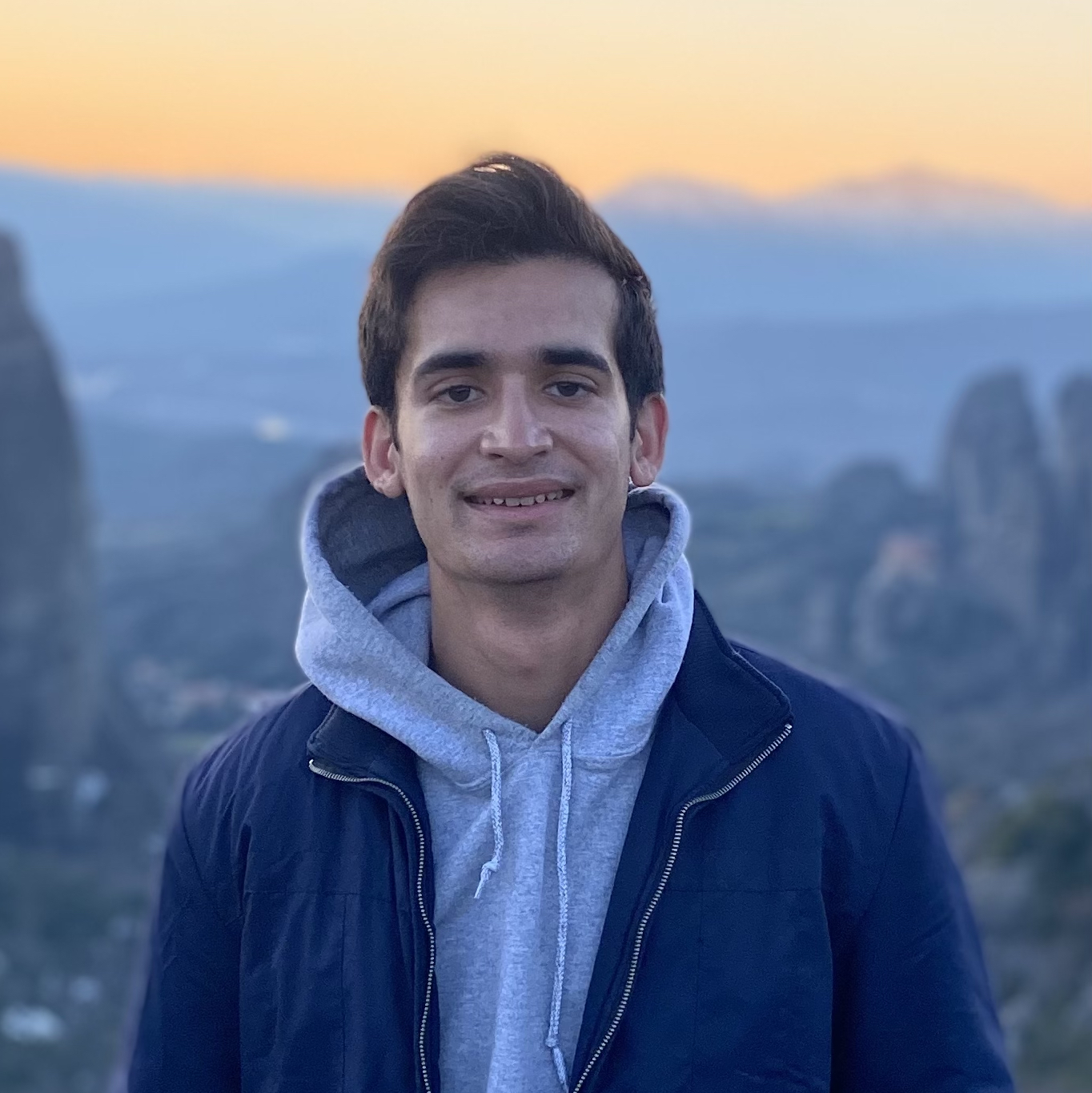
Deven Bowman. Courtesy of same.Bowman and UMD bioengineering majors Corinne Martin and Neel Panchwagh are among 413 Goldwater Scholars selected from 1,267 nominees nationally. Goldwater Scholars receive one- or two-year scholarships that cover the cost of tuition, fees, books, and room and board up to $7,500 per year.
Over the last 15 years, UMD’s nominations yielded 49 scholarships—the most in the nation. The Goldwater Foundation has honored 79 UMD winners and five honorable mentions since the program’s first award was given in 1989. In the last decade, 16 physics students have received Goldwater recognition: Bowman, Patrick Kim, Ela Rockafellow, Scott Moroch, John Martyn, Nicholas Poniatowski, Mark Zic, Paul Neves, Christopher Bambic, Eliot Fenton, Prayaag Venkat, Nathan Ng, Geoffrey Ji, Stephen Randall and Noah Roth Mandell.
“We are immensely proud of all that Deven, Corinne and Neel have accomplished to this point and the bright futures ahead of them. Their success is a win for everyone at the University of Maryland and highlights the commitment of the university to provide opportunities for our students to advance knowledge in their research disciplines and address grand challenges that impact people and communities, both locally and globally,” said Robert Infantino, associate dean of undergraduate education in the College of Computer, Mathematical, and Natural Sciences. Infantino has led UMD’s Goldwater Scholarship nominating process since 2001.
Bowman started working remotely in a UMD research group the summer before his freshman year—during the height of the COVID-19 pandemic. He spent the next two years in that group led by Eun-Suk Seo, a professor of physics with a joint appointment in the Institute for Physical Science and Technology, studying the cosmic ray spectrum by fitting physically motivated models to data and investigating the connections to atmospheric neutrinos.
This research resulted in a first-author paper published in the journal Advances in Space Research, as well as a co-authored paper and a conference proceeding.
In summer 2021, Bowman joined the lab of physics chair and Joint Quantum Institute Fellow Steve Rolston, where he continues to work today on long-distance quantum communication.
Taking advantage of an eight-mile-long fiber optic cable buried on campus, the researchers in Rolston’s lab want to send polarization-encoded quantum information through the fiber for long distances. However, optical fibers can perturb and scramble the polarization signals due to stresses and temperature variations along the path, especially for long fibers like this one.
To address this challenge, Bowman first measured the amount of variation in the signal and then devised a feedback system to correct for the perturbations of the fiber and the environment. Then, he designed two unique, complex polarimeters to compensate for signal drift and allow for continuous calibration. He presented this work at the Frontiers in Optics+Laser Science conference in 2022.
“Over my career, I have interacted with many undergraduates and graduate students—and it is clear Deven has an exceptionally bright future,” Rolston said. “He is highly motivated and very self-sufficient in both understanding the science and figuring out technical solutions.”
Outside the lab, Bowman spent time tutoring two high school students in math, science and English and advised them on preparing for college for the past three years. He also competed in the William Lowell Putnam Mathematical Competition in 2021.
Bowman spent the spring 2022 semester studying abroad in Italy through the Maryland-in-Florence (PHYS) program. There, he took three classes taught by UMD Physics Professor Emeritus Luis Orozco, who has since become a key physics mentor for Bowman.
“Studying in Florence, Italy, was a great opportunity to delve into advanced physics coursework, form enduring professional relationships and benefit from the unique experience of touring the gravitational wave detector Virgo,” Bowman said.
During his time at UMD, Bowman received the President’s Scholarship and the Angelo Bardasis Scholarship from the Department of Physics.
After graduation, Bowman plans to pursue a Ph.D. in physics, following in his father’s footsteps. Bowman’s father Steven received his M.S. and Ph.D. in physics from UMD in 1980 and 1986, respectively. His mother Anuradha is also a Terp, receiving her B.S. in physics in 1986 and M.A. in geography in 1997 from UMD.
“Their unwavering support for my education has been paramount to my success thus far,” Bowman said of his parents. “Their support played a vital role when I first sought out research opportunities. Their encouragement helped me take myself seriously as a researcher and gave me the confidence to speak up in meetings, ask questions and seek help when confused. I hope that my parents will continue to be active in my academic life and we can continue to connect over our shared passion for physics.”