Solving a Decades-long Solar Flare Mystery

For almost half a century, scientists have been scratching their heads over one of the strangest and most inexplicable phenomena to occur on the sun. During certain explosive events like solar flares, helium-3 (an extremely rare isotope normally found in tiny quantities) suddenly becomes dramatically more abundant than usual as it gets blasted toward Earth. Sometimes, it even outnumbers helium-4, the most common variant of the element—a complete reversal of expectations. 

Now, Anna Fitzmaurice, a physics Ph.D. student at the University of Maryland, may have brought scientists a step closer to solving this cosmic puzzle. Working with Distinguished University Professor of Physics James Drake, Fitzmaurice narrowed down potential culprits for the abnormally high amount of helium-3 during solar flares by focusing on a fundamental process called magnetic reconnection. Anna FitzmauriceAnna Fitzmaurice

“Magnetic reconnection is a driving force behind solar flares and their interactions with Earth's magnetic field, such as what we see as the northern and southern lights,” Fitzmaurice explained. “Although the sun’s magnetic reconnection and the helium being released toward Earth usually isn’t harmful to us, it influences space weather and potentially impacts our satellites, power grids and even astronauts we send up to space. Studying this phenomenon can help us predict and maybe even prepare for when things get rough.”

A new approach to an old problem

Previous scientific theories focused on high-energy electrons (negatively charged particles) somehow creating the right conditions to accelerate helium-3. But based on previous magnetic reconnection research,  Drake’s group thought that the real drivers might be just the opposite:  they believed that protons (positively charged particles) were more likely to be able to transfer energy into helium-3, superheating the rare isotope and pushing it past helium-4 toward Earth. 

To test this theory, Fitzmaurice developed a detailed simulation of solar environments by modeling a uniform magnetic field containing cold background protons and hot, energetic particles streaming through them like jets.

“Imagine if you had a pond full of water. If you shoot a hose through this pond, you’d get all these ripples and waves in the water,” Fitzmaurice explained. “Something similar happens when you shoot high-energy protons through a background of still, non-moving protons.” 3He acceleration. Credit: Anna Fitzmaurice.3He acceleration. Credit: Anna Fitzmaurice.

Fitzmaurice found that magnetic reconnection on the sun created beams of fast-moving particles, and these particles generated two types of plasma waves that heated helium-3 to extremely high temperatures—nearly 20 times hotter than its original temperature. The  temperatures were so intense that superheated helium-3 could move into regions of the sun where particles get accelerated and eventually shot toward Earth. However, helium-4 experienced less heating, so it stayed behind this speed threshold and was unable to reach the acceleration zones. Fitzmaurice’s research resulted in two recent papers, one published in The Astrophysical Journal and the other in the journal Physics of Plasmas. 

“My  simulations indicate that helium-3 enhancement events are probably much more common than we previously thought,” Fitzmaurice said. “This suggests that there’s some underlying physical process that’s a fundamental feature of solar flare physics rather than a rare anomaly. Learning more about these fundamental processes can help us better understand how the universe works. We can apply this to many different contexts, including learning about environments around black holes and neutron stars, or how the sun’s activity influences life on Earth and humans.”

From family stargazer to solar flare detective

Fitzmaurice feels like she’s come a long way in her journey as an astrophysicist. Growing up in a family where “no one was very science-minded,” she often reflects on how her serendipitous path to astrophysics began—with her father, who often took her to watch rocket launches from NASA’s Wallops Visitor Center in Virginia when she was growing up. 

“I feel pretty lucky to have someone who really fed my curiosity about space as a kid,” Fitzmaurice explained. “We would go as a family to watch meteor showers and rocket launches. He pointed out stars and planets in the night sky. It was because of those experiences that I ‘accidentally’ ended up studying the sun during my undergrad at Catholic University, even though it really wasn’t my original plan in college.”  

Looking back, Fitzmaurice believes she couldn’t have picked a better time to study the sun and its fiery storms. She initially began her research around the 2017 total solar eclipse, which captured the attention of millions of Americans, and has observed many unique solar events since. Now in her final year of her Ph.D. program, Fitzmaurice hopes to connect her theoretical breakthrough about helium-3 to real satellite measurements and essentially prove that her computer models match what actually happens deep in space. She hopes her work will help scientists understand the fundamental physics behind solar flares and bring researchers closer to predicting when and how violently the sun might act up.

“It’s honestly been a very exciting time for me and other solar scientists,” Fitzmaurice said. “We’re now nearing the end of the solar maximum, the peak of the sun’s 11-year activity cycle and when there are more frequent and violent solar flares. With satellites like the Parker Solar Probe and Solar Orbiter, we’re getting closer to the sun than ever before and learning things we would never have expected.” 

Summer at Summit Station

For most graduate students, research trips primarily mean conferences. For Aishwarya Vijai, it meant a month at Summit Station, Greenland, deep inside the Arctic Circle. Summit Station is located near the apex of the Greenland ice sheet at an elevation of ~10,000 feet above sea level. The station hosts scientists from collaborations around the world to conduct experiments on and with the Greenland ice sheet. One such collaboration is the Radio Neutrino Observatory in Greenland (RNO-G), a next-generation, ultra-high energy (UHE) neutrino detector. RNO-G sends teams of 4-5 people to help build the detector, and this year, these teams included a student from UMD: Aishwarya, a fourth-year graduate student in the physics department. Aishwarya works with Assistant Professor Brian Clark. The team flew to Summit Station via miltary aircrafts called LC-130s from Kangerlussuaq, a small town in Western Greenland. They stayed at Summit Station for a month to do maintenance work and collect data for calibration purposes. 

From Summit Station, the RNO-G detector, which is spread out over multiple locations (“stations”) on the ice sheet, is accessed via snow machines. Primary work done by this year included raising structures like solar panels and wind turbines which are used to power the detector. This involved a lot of shoveling to remove the drifting snow and attaching extensions to the bases of these structures to raise their heights. In addition, the team collected critical data to better understand the detector’s performance. This was achieved by campaigns where antennas were lowered hundreds of feet into the ice sheet. 

Summit Station has a maximum capacity of 40 people and operates 6 days a week with Sundays off. The biggest building on station is the aptly named Big House, a common area for meals, bathrooms, showers and entertainment in the form of books and board games. Food is prepared on station by a chef 6 days a week with leftovers on Sundays. Additional amenities include a gym, a recreational tent with a projector for watching movies, and a sauna. Sleeping accommodations are in the form of fish huts (small hard-sided structures for 1 person), the Flarm and the Caboose (hard-sided structures for 6-8 people). 

Temperatures at Summit Station typically fluctuate around -10 degrees Fahrenheit with wind chill, with occasional storms generating wind gusts of up to 50 mph. All people on Summit Station are equipped with winter gear to handle extreme weather. The station is located within the Arctic Circle so the sun doesn’t set in the summer until the beginning of August. The constant sunlight reflecting off the ice sheet leads to a high albedo. Sunglasses are worn outside at almost all times. 

Summit Station and the surrounding ice sheet was an incredible place to visit. The ice sheet is extremely beautiful and vast, appearing almost infinite in size. There are also several cool phenomena that can be observed on the ice sheet, like sun dogs and halos, which are produced when sunlight refracts through the ice crystals in the atmosphere. Sunsets at Summit Station saturate the sky in shades of red and yellow that appear even brighter in contrast to the white surroundings. The community at Summit Station also made the experience incredible, turning a nearly inhospitable place into the place to be for an experience of a lifetime. 

The Greenland ice sheet is one of the only places in the world where a UHE neutrino observatory like RNO-G can be built. The collaboration as a whole looks forward to returning next year and continuing work building the detector and hopefully using it to elevate our understanding of the universe at the highest of energies. 

More About RNO-G

The Radio Neutrino Observatory in Greenland (RNO-G) is a UHE neutrino telescope located at Summit Station, Greenland. The detector aims to find UHE neutrinos potentially emitted from energetic phenomena in the universe like black hole mergers and supernovas (explosions of stars). The detector is currently under construction and the University of Maryland (UMD) is a major construction site. Currently, the RNO-G group at UMD has built nearly 250 antennas. These antennas are the primary detection unit of RNO-G and aim to find the broadband radio pulse that is produced when UHE neutrinos interact with ice.

The fully completed detector will have 35 stations spaced 1 km apart to create an array. Each station will be equipped with 24 antennas buried in the Greenland Ice Sheet in drilled holes ~100 meters in depth. 8 stations have been built so far.


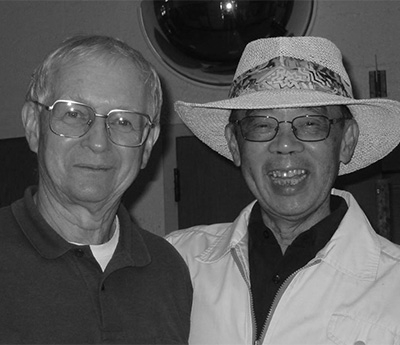
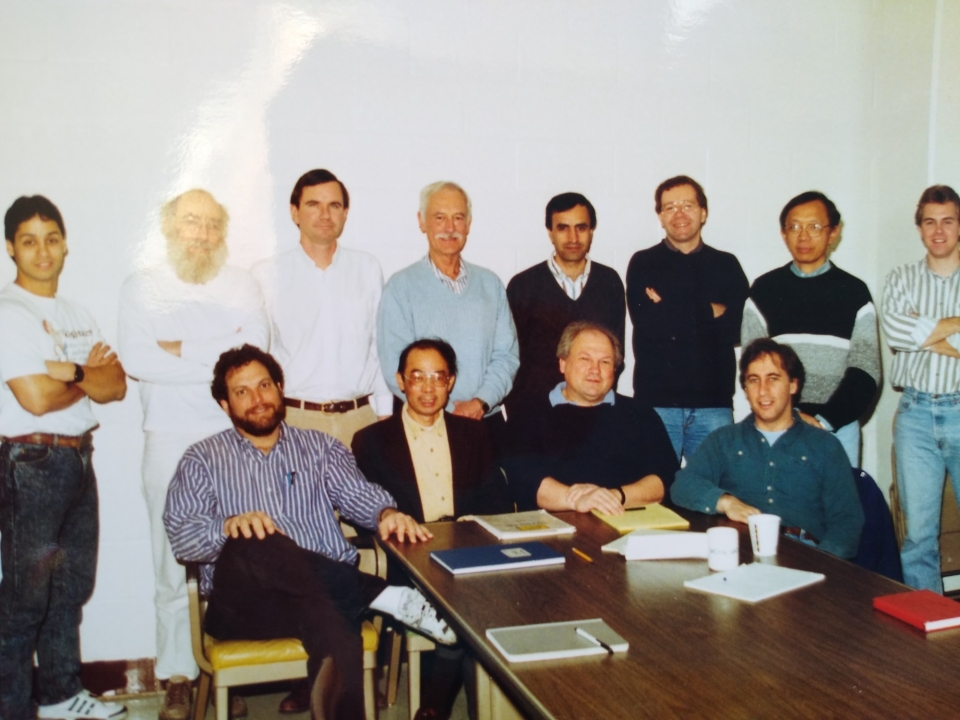
Jacob "Bob" Dorfman, 1937-2025

Professor Emeritus Jacob Robert Dorfman died on August 27, 2025. A native of Pittsburgh, Dorfman grew up in Baltimore and received his bachelor’s degree and doctorate at Johns Hopkins University. After three years of post-doctoral research at the Rockefeller University, he was appointed a UMD assistant professor in physics. During his time in College Park, he served as the Director of the Institute for Physical Science and Technology, Dean of the College of Computer, Mathematical and Physical Sciences, and Vice President for Academic Affairs and Provost, returning to teaching and research in 1992. He retired as an emeritus professor in 2005.

"The entire University of Maryland community extends its deepest condolences to Dr. Dorfman's family, friends and colleagues,” said UMD President Darryll J. Pines. "Dr. Dorfman's contributions to the university were substantial and wide-ranging, from serving as a dean and as provost to chairing a committee focused on improving student academic outcomes. He played a critical role in laying the foundation for our institution to achieve excellence, and we are grateful for all he did to advance the university.”

Dorfman enjoyed visiting professor appointments at the University of Utrecht, Rockefeller University and The Technion in Haifa, Israel.  He is the author of over one hundred scientific papers and books on statistical thermodynamic and chaos theory. His most recent book, Contemporary Kinetic Theory of Matter, written with Henk van Beijeren and T. R. Kirkpatrick, was published in 2021.

In addition to his scientific work, Dorfman studied art history, specializing in 17th century Dutch art, and continued to serve on thesis committees in recent years.

A memorial service is planned for Sunday, Aug. 31 at 10 a.m. at Temple Micah, 2829 Wisconsin Ave. NW: https://umdphysics.umd.edu/administrator/index.php?option=com_content&view=article&layout=edit&id=2057

A memorial was posted in Physica A: https://www.sciencedirect.com/science/article/pii/S0378437125008994?via%3Dihub


Faculty, Staff, Student and Alumni Awards & Notes

Follow us on LinkedIn: https://www.linkedin.com/company/umdphysics 


Faculty and Staff 
Students
Alumni
 Department news

Faculty, Staff, Student and Alumni Awards & Notes

Follow us on LinkedIn: https://www.linkedin.com/company/umdphysics 


Faculty and Staff 
Students
  • Dhruv Agarwal and Hannah McCright received CMNS Alumni Network Endowed undergraduate awards.
  • Isabella Giovannelli was quoted in Physics.
  • Rodrigo Andrade e Silva and Saketh Muddu received the Charles W. Misner Award in Gravitational Physics.
  • Rajrupa Mondal and Zhaohui Xu received the Joseph and Dorothy Sucher Graduate Prize in Physics.
  • Iman Ahmadabadi and Jeffery Yu received the Thomas Mason Interdisciplinary Physics Award.
  • Sagnik Mondal, Kushan Panchal, Alexandra Behne and Greeshma Oruganti received the Charles T. Husar Fellowship in Physics.
  • Shuzhe Zeng received the Leon A. Herreid Science Fellowship.
  • Aishwarya Vijai spent the summer at Summit Station in Greenland.
Alumni
  • Susan Holcomb (B.S., '10) won the 2023 Cupboard Pamphlet Contest for her book Wolfbaby.