• Home
  • About Us
    • Physics Administration
    • Directions
    • Awards
    • Student Awards
    • Make a Donation
    • News
      • Research News
      • Department News
      • Newsletters
    • PTK Policy
  • People
    • All
    • Faculty
      • Current
      • Emeritus
      • Adjunct
      • Affiliate
      • Research Professors
    • Research Scientists
    • Postdocs
    • Staff
    • Lecturers
    • Visitors
    • Graduate Students
  • Research
    • Research Areas
      • AI and Physical Sciences
      • Astro Metrology
      • Atomic, Molecular & Optical
      • Biophysics
      • Chemical Physics
      • Condensed Matter Experiment
      • Condensed Matter Theory
      • Cosmic Ray Physics
      • Elementary Particles
      • Gravitation Experiment
      • Gravitational Theory
      • High Energy Physics
      • Nonlinear Dynamics, Chaos and Complex Systems
      • Nuclear Physics
      • Particle Astrophysics
      • Physics Education Research
      • Plasma Physics
      • Plasma Theory
      • Quantum Science and Technology
      • Quarks, Hadrons and Nuclei
      • Space Physics
    • Centers & Institutes
  • Academics
    • OSES Home (Student Services)
    • OSES News
    • Undergraduate Program
      • Prospective Students
      • Apply Now
      • Degree Requirements and Policies
      • Scholarships
      • Undergraduate Research
      • Advising
      • Undergraduate Forms
      • Undergraduate Events
      • Departmental Honors
      • Society of Physics Students
      • FAQ
      • Undergraduate Student Committee
    • Graduate Program
      • Prospective Students
      • Open House
      • Degree Requirements
      • Graduate Resources
      • Deadlines and Forms
      • PhD Defenses
        • PhD Defenses 2026
        • PhD Defenses 2025
        • PhD Defenses 2024
        • PhD Defenses 2023
        • PhD Defenses 2022
        • PhD Defenses 2021
        • PhD Defenses 2020
        • PhD Defenses 2019
        • PhD Defenses 2018
        • PhD Defenses 2017
        • PhD Defenses 2016
      • Events
      • Scholarships & Awards
      • Qualifier
      • Graduate Student Organizations
      • FAQ
    • Student Opportunities
      • GRAD-MAP
      • Graduate Student Organizations
      • Outreach Volunteering
      • Society of Physics Students
      • NSF S-STEM Program
      • Undergraduate Research
      • Women in Physics
      • Undergraduate Quantum Association
    • Courses
    • Academic Support
    • NSF S-STEM Program
    • Teaching Assistants
  • Events
    • Calendar
    • Physics Colloquia
    • W.J. Carr Lecture
    • Research Interaction Team (RIT) Math/Physics
    • Mechanick Quantum Biology Lecture
    • Irving and Renee Milchberg Endowed Lectureship
    • Charles W. Misner Endowed Lectureship in Gravitational Physics
    • John S. Toll Endowed Lecture
    • Prange Prize Lecture
    • Maryland Day
    • Outreach
      • Outreach Home
      • Physics is Phun
      • Discovery Days
    • Summer Programs
      • Physics Makers Camp
      • Physics of Quidditch
      • Science Discovery Camp
      • Advanced Physics Summer Program
      • Toolkit for Success
    • CUWiP
    • Vortex Makerspace
    • QURiSE Conference
  • Services
    • Building Access Requests
    • Computing Services
    • Conference Room Reservations
    • Department Operations Directory
    • Electronic and Mechanical Development
    • Hiring Procedures
    • Lecture Demo
    • Mental Health Resources
    • Parking
    • Physics Ombudspersons
    • Printing Services
      • Poster Print Request
    • Proposal Submissions
    • Purchase Order
    • Suggestion Box
    • Textbook Information
  • Give
  1. Home
  2. About Us
  3. News

Written on 25 July 2023. Posted in Department News.

Charles W. Misner, 1932 - 2023

Charles W. Misner, an eminent theorist and co-author of the classic textbook Gravitation, died on July 24, 2023. He was 91.

Misner received a bachelor’s degree at the University of Notre Dame before his doctoral studies at Princeton University with John Archibald Wheeler.  Following conferral of his Ph.D. in 1957, he remained at Princeton. A Sloan Fellowship enabled him to study at Niels Bohr’s Institute for Theoretical Physics in Copenhagen, and while there, he met and fell in love with Susanne Kemp, a friend of the Bohr family.  John S. Toll, also in Denmark that spring, greeted the couple as they emerged from their wedding at the Copenhagen cathedral to convince them to move to UMD. Toll's powers of persuasion prevailed, and Misner served on the Maryland faculty from 1963 until his 2000 retirement. 

Prof. Misner's many contributions were celebrated Nov. 10-11 with a special lecture by Kip Thorne and a day-long symposium. Please click here for information. 

Misner enjoyed a distinguished career in general relativity, devising with Richard Arnowitt and Stanley Deser the ADM formalism, which earned them the American Physical Society Dannie Heineman Prize for Mathematical Physics in 1994, and was commended by the Albert Einstein Society with its Einstein Medal in 2015. Misner was an elected Fellowand was an elected Fellow of the American Academy of Arts and Sciences, the American Physical Society, the American Association for the Advancement of Science and the Royal Astronomical Society. 

He is also well-known as the co-author, with Wheeler and Nobel laureate Kip Thorne, of the acclaimed 1973 textbook, Gravitation. The authoritative opus, known universally as MTW, was so comprehensive and unique in its vivid pedagogical style that it has remained a valued resource despite subsequent developments, and was republished in 2017. Earlier this year, the International Society on General Relativity and Gravitation (ISGRG) celebrated the book’s 50th anniversary with an online forum; the milestone was also marked in Physics Today.

Following LIGO’s confirmation of Einstein’s theory of relativity, Misner contributed to UMD's popular Nov. 1, 2016 symposium, A Celebration of Gravitational Waves.  When Rainer Weiss, Kip Thorne and Barry Barish received the 2017 Nobel Prize for LIGO, Misner was quoted in Nature 's writeup.  His student Richard Isaacson (Ph.D., 1967), was noted as an "unsung hero" of LIGO, along with former UMD physicist Joe Weber and Alessandra Buonanno, in a separate article in Nature. 

The American Institute of Physics interviewed Misner for its oral history collection in 1989, 2001 and in 2020.

In 2018, Susanne Misner spotted a New York Times story announcing that a signed copy of Stephen Hawking's doctoral thesis had sold for $760,000. The Misners authorized the sale of their Hawking correspondence, yielding $260,000 to benefit the Joseph Weber Fund for Gravitational Physics.

More recently, the Misner family established the Charles W. Misner Endowed Lectureship in Gravitational Physics, which debuted in Fall 2022. 

The Charles W. Misner Award, recognizing outstanding Ph.D. thesis work in gravitation and cosmology by a UMD graduate student, was established in his honor.

Susanne Misner died in 2019; the couple is survived by four children and five grandchildren.  Please see this link for further information from the Misner family.  

  • Wheeler Thorne Misner  1
  • MTW Gravitiation Cover Page
  • gravity theory group
  • SusanneKempCharlieMisner
  • NeilsBohratMisnerWedding ws
  • Misners
  • DSC00073  2
  • Building w Misner and Wheeler
  • misner by vishveshwara
  • Misner with Vishu and pic
  • Penrose Process
  • Jadwin Hall 19706
  • IMG 20190311 140208
  • Retirement Misner
  • MisnerBrillHuWheeleratUMD  2
  • youthfulADM
  • MTW at 25 maybe
  • LakeAtemnesia
  • CinStudy
  • WheelerTakesCharlieToEurope
  • PXL 20231109 225741666.PORTRAIT.ORIGINAL
  • grgroup
  • w Claudio
  • CECS lecture
  • hike
  •    CWMLF1973.   1
  • CharlieAtBlackboard wider
  • panel screenshot
  • CWMatGWcelebUMD2c
  • misner weber ded

John Wheeler, Kip Thorne and Charlie Misner.

Front row: Dieter Brill, Bei-Lok Hu, Charlie Misner, Ted Jacobson. Behind them (left to right) are postdoc Jonathan Simon (now a UMD ECE/Biology Professor) and graduate students Tom Shiokawa, Alpan Raval, Greg Stevens, Stephen Ramsey, Nicholas Phillips, Steven Corley, and Gungwon Kang.

Susanne Kemp and Charles Misner at their Copenhagen wedding, June 13, 1959.

Margrethe and Niels Bohr at the Kemp-Misner wedding.

Charlie and Susanne Misner at the physics memorial for John S. Toll.


Charlie Misner, John Wheeler, John Toll and Mary Ridgell at the 2001 renaming of the physics building for John Toll. 

David Fiske, Misner and Wheeler at the the 2001 renaming of the physics building for John Toll. 

Misner as rendered by his graduate student, C. V. Vishveshwara. 

Misner with his graduate student, C. V. Vishveshwara. 

One of many physics cartoons produced by “Vishu” Vishveshwara

In 1970, John Wheeler organized a conference in honor of mathematician W.K. Clifford--who first posited that matter is a form of spatial curvature---at the new Jadwin Hall at Princeton U.

Participants included Wheeler, Robert Dicke, Eugene Wigner, Stephen Hawking, Brandon Carter, Cecile DeWitt, Charles Misner, Freeman Dyson, Bryce DeWitt, James York, Arthur Wightman. John Klauder, Tulio Regge, Kip Thorne, James Peebles, Bei-Lok Hu, Dieter Brill, Bill Unruh, Karel Kuchař, Jeffrey Cohen, Brandon Godfrey, Claudio (Teitelboim) Bunster, Remo Ruffini, David Sharp and Nicola Cabibbo.

At the International Symposium on Directions in General Relativity, May, 1993, John Wheeler and Cécile DeWitt-Morette, in front, surround a photo of mathematician W.K. Clifford. Second row: Bei-Lok Hu, Kip Thorne, Dieter Brill, Karel Kuchař, Charles Misner, Bryce DeWitt and James W. York.  (The people and their relative positions in this photo form a subset of those in the previous photo of the 1970 Clifford Conference.)

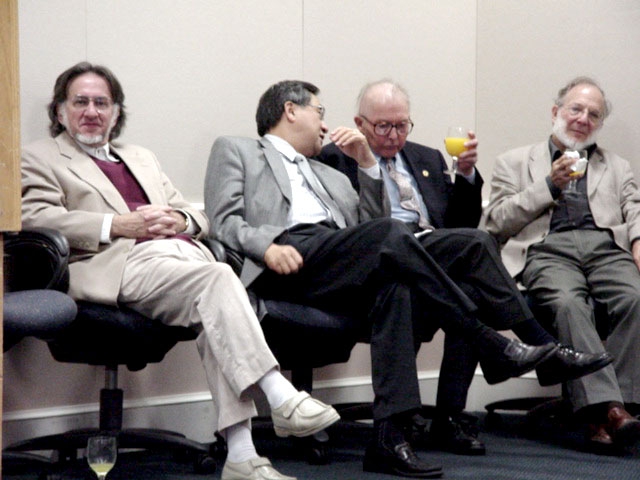
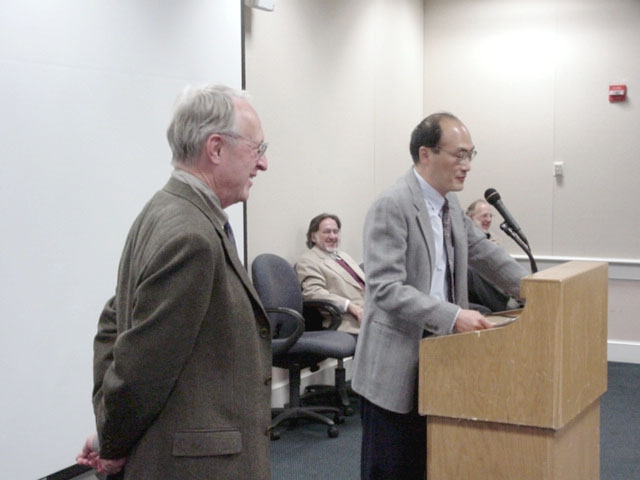
At his retirement celebration, Misner enjoys remarks by Bei-Lok Hu. Also visible are Jean-Paul Richard and Michael Fisher.

 Front row: Tsvi Piran, Murray Cantor, Deiter Brill, Vince Moncrief
Second row: John Wheeler, Doug Eardley, Charlie Misner, Bei-Lok Hu
Third row: ?, Jeeva Anandan, Jimmy York, Frank Tipler 
Back row: ?, Nick Tsamis, Richard Woodard

Richard Arnowitt, Charlie Misner, Stanley Deser

C.W. Misner, J.A. Wheeler, K.S. Thorne

Dieter Brill, Charlie Misner, Birgit Brill, Francis Misner

Detail from group portrait at the 60th Birthday Symposium honoring Dieter Brill and Charlie Misner. Second row, center: Dennis Sciama, Charles Misner, Dieter Brill, Stanley Deser, ?, John Toll

Dieter Brill, Ted Jacobson, Betty Alexander, Bei-Lok Hu, Charlie Misner, Jonathan Simon

Charles Misner, Claudio Teitelboim (Bunster)

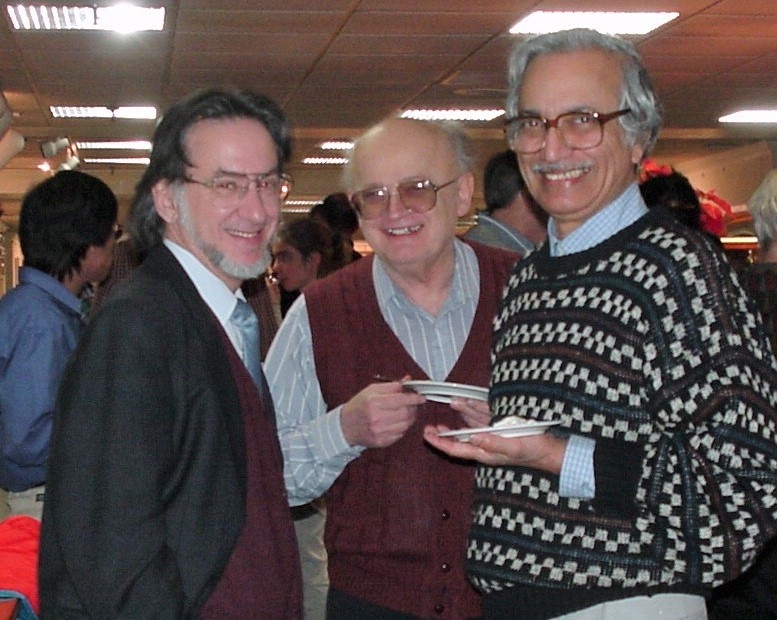
Bei-Lok Hu, Susanne Misner, Charlie Misner, Phil Johnson, Veronika Hubeny, ?, Jorma Louko

Charles Misner, ?, Leslie Fishbone

At the 2016  Celebration of Gravitational Waves: Jim Gates, Kip Thorne, Alessandra Buonanno, Charlie Misner, Peter Shawhan and Rai Weiss.

Charlie Misner at the March 2019 dedication of the Weber Garden outside the PSC. 

Written on 14 July 2023. Posted in Research News.

Crystal Imperfections Reveal Rich New Phases of Familiar Matter

Matter—all the stuff we see around us—can be classified into familiar phases: our chairs are solid, our coffee is liquid, and the oxygen we breathe is a gas. This grouping obscures the nitty gritty details of what each molecule or atom is up to and reduces all that complexity down to a few main features that are most salient in our everyday lives.

But those are not the only properties of matter that matter. Focusing on solids, physicists have found that they can group things according to symmetries. For example, atoms in solids arrange themselves into repeating patterns, forming crystals that can be grouped according to whether they look the same left and right, up and down, rotated about, and more. In the 1980s, physicists discovered a new paradigm: In addition to symmetries, solids can be classified using topology—a field of math that does for geometrical shapes the same kind of thing that symmetries do for crystalline solids. All the shapes without holes (a ball, a pizza) are in the same topological “phase,” while those with one hole (a donut, a coffee mug) are in a different “phase,” and so on with each new hole.

Within physics, topology doesn’t usually refer to the shape a piece of metal is cut into. Rather, the topology of how electrons are arranged inside a crystal provides information about the material’s electrical conductance and other properties. Now, theorists at the Joint Quantum Institute have found that these same crystals hide a richer set of topological phases than previously thought. In two separate works, they revealed a host of possible topological phases that become apparent when two different kinds of defects develop in crystals, or when they study the twirling properties of the electronic arrangement. They published their findings in the journal Physical Review X on July 14, 2023 and in the journal Physical Review Letters in Dec. 2022.

“Condensed matter physics is about understanding all the properties of phases of matter,” says Naren Manjunath, a graduate student at JQI and an author on both results. “I think that our work is really expanding our understanding of how to define new topological properties and how to characterize phases of matter better.”

Topology was first recognized as an important matter-classification tool after the discovery of the quantum Hall effect in the 1980s. When thin sheets of certain materials are pierced by a strong magnetic field, the electrons inside the materials spin around in circles—the larger the magnetic field the tighter their turns. Once the circles get small enough, quantum mechanics kicks in and dictates that the size of the circles can only have certain discrete values (the “quantum” in the quantum Hall effect). As the magnetic field is increased, nothing changes for a while—there is a plateau. Then, when the field gets large enough, electrons suddenly hop into a tighter orbit—an abrupt, step-wise change.

This jump from one radius of a spinning orbit to another can be thought of as a change in the topological phase—the geometry of the electron motion in the material switches. This sudden hopping is extremely precise, and it results in abrupt jumps in the electrical conductivity of the metal sheet, making the topological phase easy to measure experimentally.

Hofstadter butterfly (Adapted from Osadchy and Avron, J. Math. Phys. 42, 5665–5671 (2001) https://doi.org/10.1063/1.1412464 )Hofstadter butterfly (Adapted from Osadchy and Avron, J. Math. Phys. 42, 5665–5671 (2001) https://doi.org/10.1063/1.1412464 )

Even more interesting things would happen if the magnetic field in the quantum Hall effect was cranked up so high that the electron orbitals became about as small as the atomic spacing in the crystal. There, electrons arrange themselves into different topological phases that depend on how many electrons were around in the first place and the magnetic field piercing each little bit of the crystal. A color-coded plot of conductivity as it depends on the electron density and the magnetic field appears as a winged butterfly, called the Hofstadter butterfly after the theoretical physicist that first studied this model.

“We're furthering this program of trying to find all possible quantized numbers that could be associated with phases of matter,” says JQI Fellow and Associate Professor Maissam Barkeshli, a principal investigator on the work. “And this is a long-term program and we made a lot of progress on it recently.”

Manjunath, Barkeshli, and their collaborators found that there may be more intricate details hiding in the Hofstadter butterfly’s wings than previously thought. Some spots on the butterfly might have the same color, and therefore the same topological phase in the original treatment, and yet behave differently from each other in important ways.

These extra distinguishing features are always present, but they become most obvious when the crystal develops defects—little mistakes in its otherwise perfectly regular pattern. The way electrons behave around this defect would differ depending on the underlying topological phase. And different defects can help uncover different kinds of phases.

The team first studied an imperfection called a disclination, which occurs when a piece of the crystal is taken out and the remaining atoms are stitched back together, as seen in the diagram below. The researchers found that electric charge tends to cluster around this defect. And how much charge pops up at the defect depends on a new quantity, which the team called the shift. Much like the size of electron orbits in the quantum Hall effect, the shift is quantized: It can only be an integer or a half-integer. A different value of the shift corresponds to a different phase of matter. The electric charge appearing at a disclination would be a multiple of this shift, which, weirdly enough, could even be a fraction of a single electron’s charge. They published the results of their theoretical investigation in the journal Physical Review Letters in December 2022.

After disclinations, the team focused their attention on another kind of imperfection called a dislocation. Unlike a disclination, no atoms are missing in a dislocation. Instead, the connections between atoms in a crystal are rewired in a different order. Instead of being connected to its closest neighbor, one or more of the atoms bonds with the next atom over, creating a skewed ladder of links.

Dislocations turned out to have another quantized quantity associated with them, this time named a quantized polarization. Inside a perfectly regular crystal, every tiny square of the lattice may hide a bit of charge polarization—one side becomes somewhat positively charged while the other side becomes a bit negatively charged. This polarization is hard to spot. If a dislocation is introduced, however, the researchers found that one side of this polarized charge gets trapped in the defect, revealing the extent of the polarization. Exactly how polarized they would become depended directly on the underlying quantized polarization. The team published this result in the journal Physical Review X.

Each of these quantities—the shift and the quantized polarization—has consequences even without any defects. These consequences have to do with the way the electrons tend to twist around different points inside the crystal lattice. But these twists are tricky to find experimentally, while crystal defects offer a tangible way of measuring and observing these new quantities by trapping charges in their vicinity.

New butterflies, cousins of the original Hofstadter butterfly, pop up thanks to the shift and quantized polarization. Both can be plotted as a function of electron density and magnetic field and exhibit the same winged, fractal butterfly-like structure. The researchers believe more such quantities and their associated phases remain to be uncovered, associated with yet more defects. “Eventually we expect we will have a large number of beautiful colored butterfly figures,” Barkeshli says, “one for each of these topological properties.”

For now, testing these predictions experimentally seems just out of reach. The Hofstadter model requires such large magnetic fields that it cannot be realized in regular materials. Instead, people have resorted to simulating this model with synthetic lattices of atoms or photons, or in layered graphene structures. These synthetic lattices are not quite large enough to measure the charge distributions required, but with some engineering advances, they might be up to the task in the coming years. It may also be possible to create these lattices using small, noisy quantum computers that have already been built, or topological photonic systems.

“We only considered the Hofstadter model,” says Manjunath, “but you could measure the same thing for more exotic phases of matter. And some of those phases might actually have some applications in the very distant future.”

Original story by Dina Genkina: https://jqi.umd.edu/news/crystal-imperfections-reveal-rich-new-phases-familiar-matter

In addition to Manjunath and Barkeshli, authors on the publications included UMD graduate students Yuxuan Zhang and Gautam Nambiar.

About the Research

Reference Publications

  • Fractional Disclination Charge and Discrete Shift in the Hofstadter Butterfly , Y. Zhang, N. Manjunath, G. Nambiar, and M. Barkeshli, Physical Review Letters, 129, (2022)
  • Quantized Charge Polarization as a Many-Body Invariant in (2+1)D Crystalline Topological States and Hofstadter Butterflies , Y. Zhang, N. Manjunath, G. Nambiar, and M. Barkeshli, Phys. Rev. X, 13, 031005, (2023)

Related Articles

  • Tug-of-War Unlocks Menagerie of Quantum Phases of Matter
  • Quantum Computers Do the (Instantaneous) Twist


Written on 14 July 2023. Posted in Department News.

Yunger Halpern is US Nominee for ASPIRE Young Researcher Award

Adjunct Assistant Professor and Joint Quantum Institute affiliate Nicole Yunger Halpernis the 2023 U.S. nominee for the Asia-Pacific Economic Cooperation (APEC) Science Prize for Innovation, Research and Education (ASPIRE), an annual prize for young researchers that is awarded by the APEC trade organization. Yunger Halpern’s nomination by the State Department’s Office of Science and Technology Cooperation comes with its own $3,000 prize. Nicole Yunger Halpern  (Credit: John T. Consoli/UMD)Nicole Yunger Halpern (Credit: John T. Consoli/UMD)

“I'm extremely grateful to NIST and the University of Maryland for their support for my work,” says Yunger Halpern, who is also a Fellow of the Joint Center for Quantum Information and Computer Science, a physicist at the National Institute of Standards and Technology, an adjunct assistant professor of the Institute for Physical Sciences and Technology, a member of the NSF Quantum Leap Challenge Institute for Robust Quantum Simulation, and a founding member of the Maryland Quantum-Thermodynamics Hub.

Yunger Halpern leads a theoretical research group that is modernizing thermodynamics, which traditionally describes large things like steam engines. Her team uses the tools of quantum information theory to make a theory of quantum thermodynamics that describes small things like individual molecules and the qubits that are the basic building blocks of quantum computers. She applies her quantum thermodynamics perspectives to problems from a broad range of fields, including atomic, molecular, and optical physics; condensed matter physics; chemistry; high-energy physics; and biophysics.

In addition to the U.S., APEC comprises 20 other members, including Australia, Russia, Taiwan and Chile. Each member can nominate one individual under 40 years old for the award, and the ASPIRE winner will receive a prize of $25,000.

This year the U.S. is hosting the APEC meeting that will include the ASPIRE award ceremony. As host, the U.S. selected the ASPIRE Prize theme for this year’s competition to be “Inclusive Science, Technology, and Innovation for a Resilient and Sustainable Environment.” Nominees are selected based on criteria including how their work contributes to the annual theme, their history of scholarly publications and their commitment to inclusive and interdisciplinary collaborations with scientists from other APEC regions.

Story by Bailey Bedford


Written on 07 June 2023. Posted in Research News.

New Study Identifies Mechanism Driving the Sun’s Fast Wind

The fastest winds ever recorded on Earth reached more than 200 miles per hour, but even those gusts pale in comparison to the sun’s wind.

In a paper published June 7, 2023 in the journal Nature, a team of researchers used data from NASA’s Parker Solar Probe to explain how the solar wind is capable of surpassing speeds of 1 million miles per hour. They discovered that the energy released from the magnetic field near the sun’s surface is powerful enough to drive the fast solar wind, which is made up of ionized particles—called plasma—that flow outward from the sun.

This illustration shows NASA’s Parker Solar Probe near the sun. Credit: NASA/Johns Hopkins APL/Steve Gribben.This illustration shows NASA’s Parker Solar Probe near the sun. Credit: NASA/Johns Hopkins APL/Steve Gribben. This illustration shows NASA’s Parker Solar Probe near the sun. Credit: NASA/Johns Hopkins APL/Steve Gribben.

James Drake, a Distinguished University Professor in the University of Maryland’s Department of Physics and Institute for Physical Science and Technology (IPST), co-led this research alongside first author Stuart Bale of UC Berkeley. Drake said scientists have been trying to understand solar wind drivers since the 1950s—and with the world more interconnected than ever, the implications for Earth are significant.

The solar wind forms a giant magnetic bubble, known as the heliosphere, that protects planets in our solar system from a barrage of high-energy cosmic rays that whip around the galaxy. However, the solar wind also carries plasma and part of the sun’s magnetic field, which can crash into Earth’s magnetosphere and cause disturbances, including geomagnetic storms.

These storms occur when the sun experiences more turbulent activity, including solar flares and enormous expulsions of plasma into space, known as coronal mass ejections. Geomagnetic storms are responsible for spectacular aurora light shows that can be seen near the Earth’s poles, but at their most powerful, they can knock out a city’s power grid and potentially even disrupt global communications. Such events, while rare, can also be deadly to astronauts in space.

“Winds carry lots of information from the sun to Earth, so understanding the mechanism behind the sun’s wind is important for practical reasons on Earth,” Drake said. “That’s going to affect our ability to understand how the sun releases energy and drives geomagnetic storms, which are a threat to our communication networks.”

Previous studies revealed that the sun’s magnetic field was somehow driving the solar wind, but researchers didn’t know the underlying mechanism. Earlier this year, Drake co-authored a paper which argued that the heating and acceleration of the solar wind is driven by magnetic reconnection—a process that Drake has dedicated his scientific career to studying.

The authors explained that the entire surface of the sun is covered in small “jetlets” of hot plasma that are propelled upward by magnetic reconnection, which occurs when magnetic fields pointing in opposite directions cross-connect. In turn, this triggers the release of massive amounts of energy.

“Two things pointing in opposite directions often wind up annihilating each other, and in this case doing so releases magnetic energy,” Drake said. “These explosions that happen on the sun are all driven by that mechanism. It’s the annihilation of a magnetic field.”

To better understand these processes, the authors of the new Nature paper used data from the Parker Solar Probe to analyze the plasma flowing out of the corona—the outermost and hottest layer of the sun. In April 2021, Parker became the first spacecraft to enter the sun’s corona and has been nudging closer to the sun ever since. The data cited in this paper was taken at a distance of 13 solar radii, or roughly 5.6 million miles from the sun.

“When you get very close to the sun, you start seeing stuff that you just can’t see from Earth,” Drake said. “All the satellites that surround Earth are 210 solar radii from the sun, and now we’re down to 13. We’re about as close as we’re going to get.”

Using this new data, the Nature paper authors provided the first characterization of the bursts of magnetic energy that occur in coronal holes, which are openings in the sun’s magnetic field as well as the source of the solar wind.

The researchers demonstrated that magnetic reconnection between open and closed magnetic fields—known as interchange connection—is a continuous process, rather than a series of isolated events as previously thought. This led them to conclude that the rate of magnetic energy release, which drives the outward jet of heated plasma, was powerful enough to overcome gravity and produce the sun’s fast wind.

By understanding these smaller releases of energy that are constantly occurring on the sun, researchers hope to understand—and possibly even predict—the larger and more dangerous eruptions that launch plasma out into space. In addition to the implications for Earth, findings from this study can be applied to other areas of astronomy as well.

“Winds are produced by objects throughout the universe, so understanding what drives the wind from the sun has broad implications,” Drake said. “Winds from stars, for example, play a crucial role in shielding planetary systems from galactic cosmic rays, which can impact habitability.”

This would not only aid our understanding of the universe, but possibly also the search for life on other planets.

###

In addition to Drake, Marc Swisdak, a research scientist in UMD’s Institute for Research in Electronics and Applied Physics, co-authored this study.

Their paper, “Interchange reconnection as the source of the fast solar wind within coronal holes,” was published in Nature on June 7, 2023. 

This study was supported by NASA (Contract No. NNN06AA01C). This story does not necessarily reflect the views of this organization.


Original story by Emily C. Nunez: https://cmns.umd.edu/news-events/news/new-study-identifies-mechanism-driving-suns-fast-wind

Written on 12 May 2023. Posted in Research News.

Insight into How Cells Get Signals from Physical Senses Could Lead to New Disease Treatments

The body’s cells are constantly receiving and reacting to signals from their environment. A lot is known about how a cell senses and responds to chemical signals, or biomolecules, such as COVID-19. But little is known about how signals from the physical environment, like touch, temperature or light, direct a cell’s activity. Understanding that process could lead to new ways of treating cancer and other disease.mage showing how the red mechano-chemical waves (actin waves) guide the signaling molecules (green). Image courtesy of UMD MURI team.mage showing how the red mechano-chemical waves (actin waves) guide the signaling molecules (green). Image courtesy of UMD MURI team.

A new study published May 1, 2023 in the Proceedings of the National Academy of Sciences by a University of Maryland-led Multidisciplinary University Research Initiative (MURI) funded by the Air Force Office of Scientific Research has opened the door to seeing how cells react to physical signals.

“We elucidated a cell's sense of touch,” said Professor Wolfgang Losert, a team leader of the study. “We think how cells sense the physical environment may be quite distinct from how they sense the chemical environment. This may help us develop new treatment options for conditions that involve altered physical cellular environments, such as tumors, immune disease and wound healing.”

A major difference between chemical and physical signals is size. Chemical signals are 100,000 times smaller than the width of a human hair. Physical cues are the heavyweights in the ring.

“We looked at how cells sense crucial physical cues from their environment that are on the order of 100 times larger than chemical signaling molecules,” said Losert, who also has a joint appointment in UMD’s Institute for Physical Science and Technology (IPST).

“We’re really answering a kind of long-standing mystery of how cells react to cues in their environment that are on a physical rather than chemical-size scale,” said paper co-author and MURI team member John T. Fourkas, a professor in UMD’s Department of Chemistry and Biochemistry with a joint appointment in IPST.

The MURI team studied the major players in a cell’s interaction with its physical environment: the cytoskeleton, a network of proteins that surround a cell and acts as a direct sensor of the physical environment; actin, the protein that keeps cells connected; and the cell’s signaling pathways.

Qixin Yang (Ph.D. ’22, physics), who led the experiments and analysis for her Ph.D. research at UMD, said, “I think our work related to the cytoskeleton shows that it plays an important role in sensing physical cues, like pain.”

The MURI team found that the networks that guide cell migration are upstream for chemical sensing and downstream for physical, topographic sensing; and that actin is the direct sensor for both types of signals.

“I think this is the first real crucial confirmation that actin itself is the sensor and that the waves are really where they are in the sensing pathway, not way downstream, but up front and center,” Fourkas said.

“Our findings reveal that, in much the same way that patterns of waves in the ocean allow an expert surfer to understand the undersea topography, the so-called ‘mechano-chemical’ waves in cells are key in sensing signals from their physical environment that are much larger than single proteins,” Losert said. “That has implications for how you might design physical interventions to change the behavior of cells.”

For instance, previous research by a co-author of this study, Peter Devreotes of Johns Hopkins University, found that actin dynamics were different for cancer cells considered most invasive.

“Understanding how drugs impact waves is an important additional piece of information that may be used in making decisions on treatment options,” Losert said. “I see our study also providing pointers on how you can improve the ability of immune cells to be guided to their target.”

The MURI team is made up of researchers in physics, chemistry, biology, bioengineering and dermatology from the University of Maryland and several other institutions.

###

In addition to Losert, Fourkas and Yang, UMD chemistry graduate student Matt Hourwitz was a co-author of the paper.

The paper, “Nanotopography modulates intracellular excitable systems through cytoskeleton actuation," was published in PNAS on May 1, 2023.

This research was supported by the Air Force Office of Scientific Research (Award No. FA9550-16-1-0052). This story does not necessarily reflect the views of this organization.

Original story by Ellen Ternes: https://cmns.umd.edu/news-events/news/afosr-muri-insight-how-cells-get-signals-physical-senses-could-lead-new-disease-treatments


More Articles …

  1. New Research Sheds Light on How Mesothelioma Develops
  2. Alumna, Adjunct Elected to National Academy of Sciences
  3. Department Rated Highly by US News
  4. Hill Elected to the American Academy of Arts and Sciences

Page 36 of 203

  • 31
  • 32
  • 33
  • 34
  • 35
  • 36
  • 37
  • 38
  • 39
  • 40
  • Physics Administration
  • Directions
  • Awards
  • Student Awards
  • Make a Donation
  • News
    • Research News
    • Department News
    • Newsletters
  • PTK Policy

College and Department Links

Department of Physics

Physical Sciences Complex
4296 Stadium Dr
College Park, MD 20742
Phone: 301.405.3401

Information

  • Campus Directory
  • Undergraduate Research
  • Scholarships
  • Prospective Undergraduates
  • Directions & Transit
  • Web Accessibility
© 2026 University of Maryland - Department of Physics
Top
  • Home
  • About Us
    • Physics Administration
    • Directions
    • Awards
    • Student Awards
    • Make a Donation
    • News
      • Research News
      • Department News
      • Newsletters
    • PTK Policy
  • People
    • All
    • Faculty
      • Current
      • Emeritus
      • Adjunct
      • Affiliate
      • Research Professors
    • Research Scientists
    • Postdocs
    • Staff
    • Lecturers
    • Visitors
    • Graduate Students
  • Research
    • Research Areas
      • AI and Physical Sciences
      • Astro Metrology
      • Atomic, Molecular & Optical
      • Biophysics
      • Chemical Physics
      • Condensed Matter Experiment
      • Condensed Matter Theory
      • Cosmic Ray Physics
      • Elementary Particles
      • Gravitation Experiment
      • Gravitational Theory
      • High Energy Physics
      • Nonlinear Dynamics, Chaos and Complex Systems
      • Nuclear Physics
      • Particle Astrophysics
      • Physics Education Research
      • Plasma Physics
      • Plasma Theory
      • Quantum Science and Technology
      • Quarks, Hadrons and Nuclei
      • Space Physics
    • Centers & Institutes
  • Academics
    • OSES Home (Student Services)
    • OSES News
    • Undergraduate Program
      • Prospective Students
      • Apply Now
      • Degree Requirements and Policies
      • Scholarships
      • Undergraduate Research
      • Advising
      • Undergraduate Forms
      • Undergraduate Events
      • Departmental Honors
      • Society of Physics Students
      • FAQ
      • Undergraduate Student Committee
    • Graduate Program
      • Prospective Students
      • Open House
      • Degree Requirements
      • Graduate Resources
      • Deadlines and Forms
      • PhD Defenses
        • PhD Defenses 2026
        • PhD Defenses 2025
        • PhD Defenses 2024
        • PhD Defenses 2023
        • PhD Defenses 2022
        • PhD Defenses 2021
        • PhD Defenses 2020
        • PhD Defenses 2019
        • PhD Defenses 2018
        • PhD Defenses 2017
        • PhD Defenses 2016
      • Events
      • Scholarships & Awards
      • Qualifier
      • Graduate Student Organizations
      • FAQ
    • Student Opportunities
      • GRAD-MAP
      • Graduate Student Organizations
      • Outreach Volunteering
      • Society of Physics Students
      • NSF S-STEM Program
      • Undergraduate Research
      • Women in Physics
      • Undergraduate Quantum Association
    • Courses
    • Academic Support
    • NSF S-STEM Program
    • Teaching Assistants
  • Events
    • Calendar
    • Physics Colloquia
    • W.J. Carr Lecture
    • Research Interaction Team (RIT) Math/Physics
    • Mechanick Quantum Biology Lecture
    • Irving and Renee Milchberg Endowed Lectureship
    • Charles W. Misner Endowed Lectureship in Gravitational Physics
    • John S. Toll Endowed Lecture
    • Prange Prize Lecture
    • Maryland Day
    • Outreach
      • Outreach Home
      • Physics is Phun
      • Discovery Days
    • Summer Programs
      • Physics Makers Camp
      • Physics of Quidditch
      • Science Discovery Camp
      • Advanced Physics Summer Program
      • Toolkit for Success
    • CUWiP
    • Vortex Makerspace
    • QURiSE Conference
  • Services
    • Building Access Requests
    • Computing Services
    • Conference Room Reservations
    • Department Operations Directory
    • Electronic and Mechanical Development
    • Hiring Procedures
    • Lecture Demo
    • Mental Health Resources
    • Parking
    • Physics Ombudspersons
    • Printing Services
      • Poster Print Request
    • Proposal Submissions
    • Purchase Order
    • Suggestion Box
    • Textbook Information
  • Give