Chasing Neutrinos at the ‘End of the World’

It took one week, five flights and a slow ride on a six-wheeled bus for Rachel Procter-Murphy to arrive at her dream destination: the South Pole.

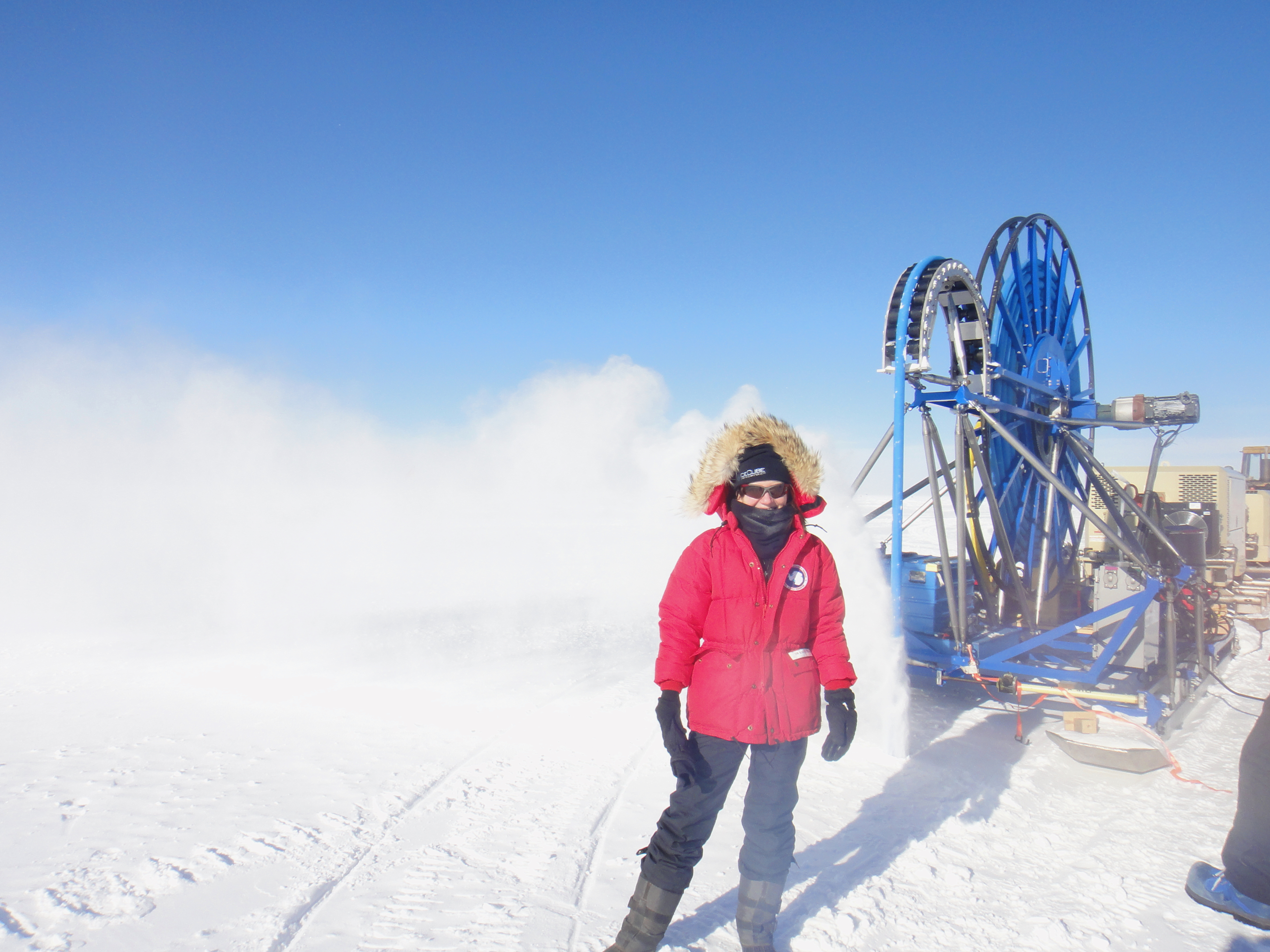
Rachel Procter-Murphy in Antarctica assisting with an installation at the IceCube observatory. Photo courtesy of same.

Last fall, the University of Maryland physics Ph.D. student went to Antarctica for two months in search of neutrinos—super-abundant but hard-to-detect subatomic particles created by violent events like exploding stars and radioactive decay. She was most excited to be in the presence of IceCube, a neutrino observatory outfitted with thousands of optical sensors suspended deep within the ice and spanning 35.3 billion cubic feet (about the volume of the Empire State Building 946 times over).

“It was an incredible opportunity to work with technology that very few people get to experience,” Procter-Murphy said. “I felt like I’d won the lottery.”

Pinpointing the invisible

Procter-Murphy’s Ph.D. research focuses not just on finding neutrinos in space but also figuring out where they’re coming from. 

“Trying to pinpoint things that are virtually invisible has its challenges,” she noted. 

Neutrinos have little mass, no electrical charge and don’t interact with much in the universe—they aren’t bent by magnetic fields or interruptedRachel Procter-Murphy in Antarctica assisting with an installation at the IceCube observatory. Photo courtesy of same.Rachel Procter-Murphy in Antarctica assisting with an installation at the IceCube observatory. Photo courtesy of same. by dust clouds—so they streak through the Earth (and our bodies) in a straight line, mostly unnoticed. Despite their abundance, scientists can only detect them on the rare occasion that they interact with something—like ice.
“The South Pole is a great place to detect neutrinos because the ice target is so big and the ice is so clear, dark and mostly stable,” Procter-Murphy explained. When a rare neutrino collides with an atom in the ice, “it creates charged particles that emit a faint blue glow known as Cherenkov radiation. That light is what IceCube’s sensors detect.”

But neutrinos aren’t the only bits from afar being blasted out of the sky.

“Cosmic rays interact with the atmosphere and produce a lot of particles that also interact with the detector,” Procter-Murphy said. “And they send thousands per second, while the astrophysical neutrinos only occur around once every two weeks. So, there’s a lot of background noise that we’re trying to mitigate.”

Parsing through those mixed signals, Procter-Murphy worked with IceCube data to search for the particles' origins by scouring  “catalogs of astrophysical sources,” enabling her to narrow down what might be producing these neutrinos—an effort that helps serve an even more ambitious aim. 

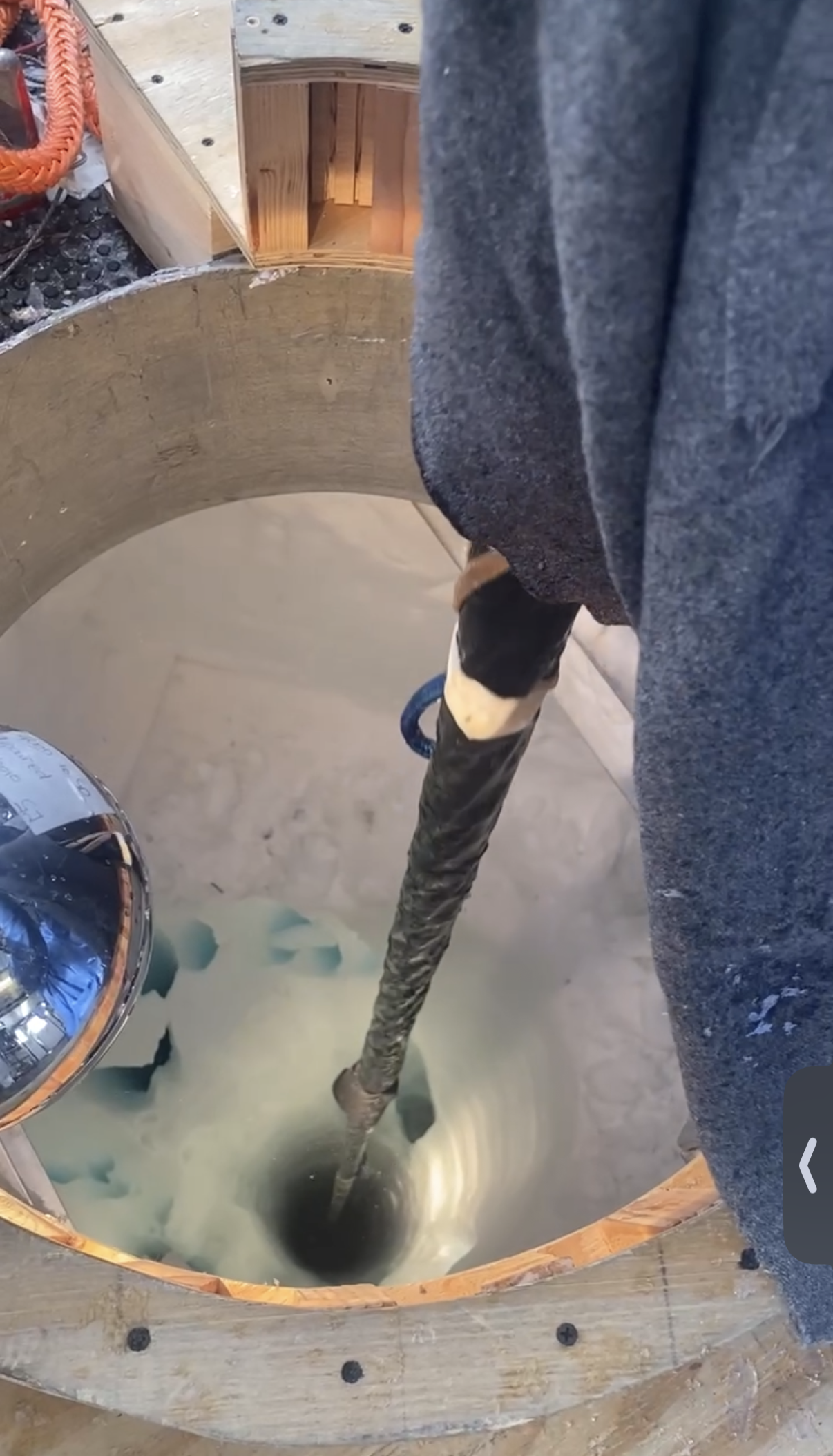
“Neutrinos aren’t going to cure cancer or solve hunger, but there’s value in adding detail to the big picture of how the universe works,” she said. “Understanding these major forces could help explain the existence of stars and planets and even the reason living things like us are made of matter.”Drilling into the ice to install a new string of neutrino sensors at the IceCube observatory. Photo courtesy of Rachel Procter-Murphy.Drilling into the ice to install a new string of neutrino sensors at the IceCube observatory. Photo courtesy of Rachel Procter-Murphy.
Hands-on education

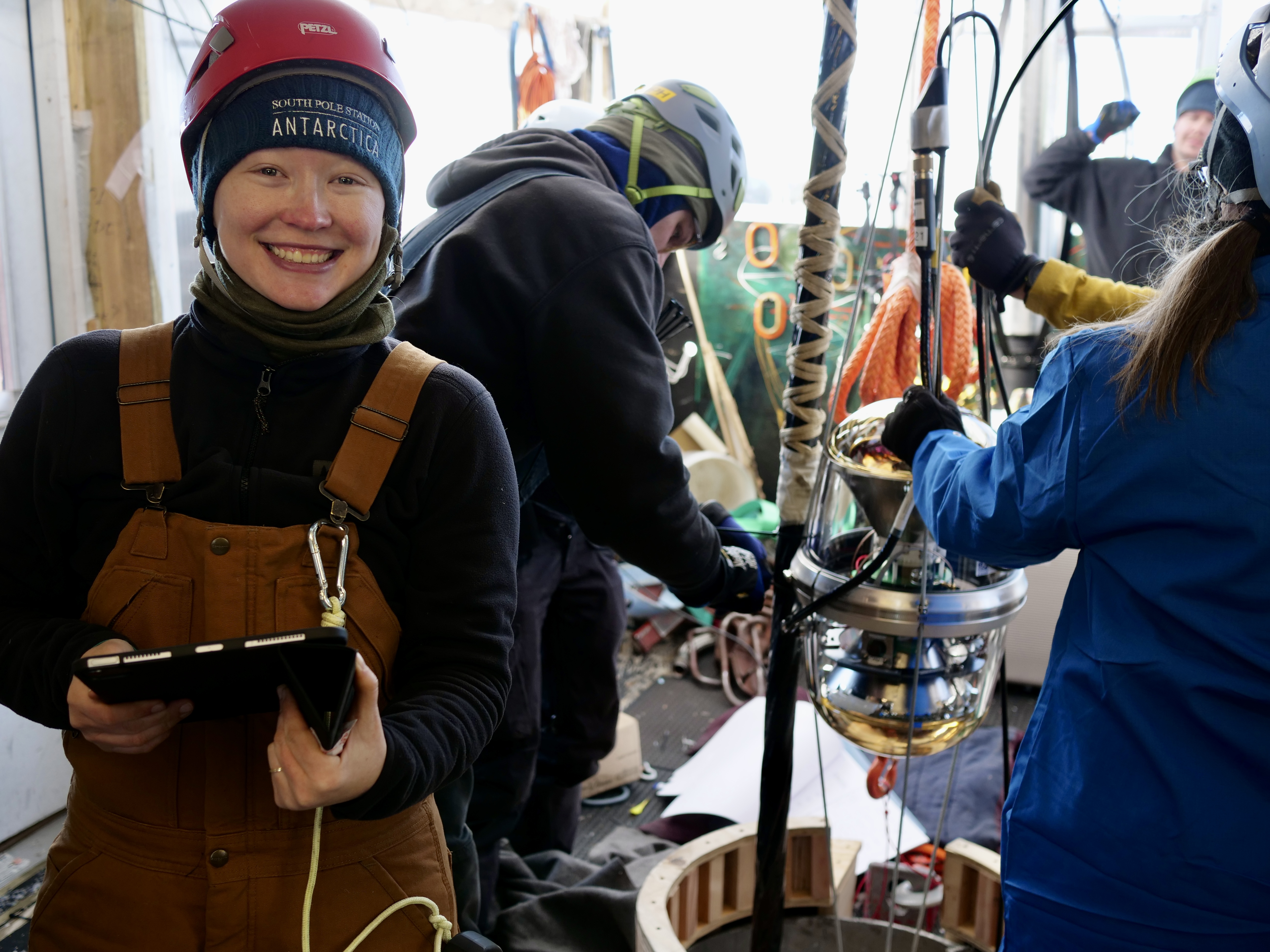
Procter-Murphy’s main goal while at the South Pole was to help install an upgrade to IceCube. The observatory is made up of a hexagonal lattice of more than 85 cables or “strings,” each equipped with 60 digital optical modules (DOMs) that are suspended in the ice at depths between 4,760 and 8,200 feet. A rush of water kept hot by massive car-wash heaters lets installers drill down into the ice and unspool the DOM-laden strings into place. The ice then refreezes around the instruments, becoming part of the observatory.

“We installed five new strings, which had me at times standing over a huge hole in a glacier, with space heaters around me and cold air constantly blowing in my face from the hole as I’m monitoring these giant cables and tapping away on an iPad—it was a bit surreal,” she recalled. “Not your typical graduate school experience.”

But as noted by her advisor, Physics Professor and Chair Kara Hoffman, Procter-Murphy is not your typical graduate student.

“Rachel isn’t afraid to pursue what she wants,” Hoffman said. “Beds at the Pole are limited, with many of them occupied by the essential personnel who keep the station running and operate the heavy construction machinery. There's a lot of competition for the slots designated for scientists."

To get one of those slots, "she was a great advocate for herself, did the training and rose to the necessary level to be a good colleague on the ice,” Hoffman said. "What that means is being willing and able to do everything from scrub toilets to survey, drill and do high-level data analysis. Rachel stepped up and people praised her for filling so many gaps. Not everyone could have done what she did.”

Eyes on the skies

Working on IceCube was something Procter-Murphy feels she was destined to do.

“As a kid, I wanted to be an astronaut,” she said. “I was obsessed with space. I wanted to know about black holes, how things behave deep in the universe, science-y things like that.”

So, she zeroed in on physics, with astrophysics as her dream career.

“When I first interviewed at UMD, I remember Professor Hoffman saying she felt that students did their best work on things they were passionate about,” Procter-Murphy said. “For me, that meant trying to get to the Pole.”

As that trip became a reality, Procter-Murphy faced a slew of medical tests to ensure she could handle the difficult conditions, then the grueling days of travel ending in a mild sense of panic as she struggled to carry her own bag in the thin air at 10,000 feet. 

But once she acclimated to the conditions, Procter-Murphy dove into her work and thrived. 

“The two-month experience made me a more confident, capable person,” she said. “And I was surprised how much I enjoyed the installation. Now I can see adding an engineering aspect to whatever I do next.”

Warm memories 

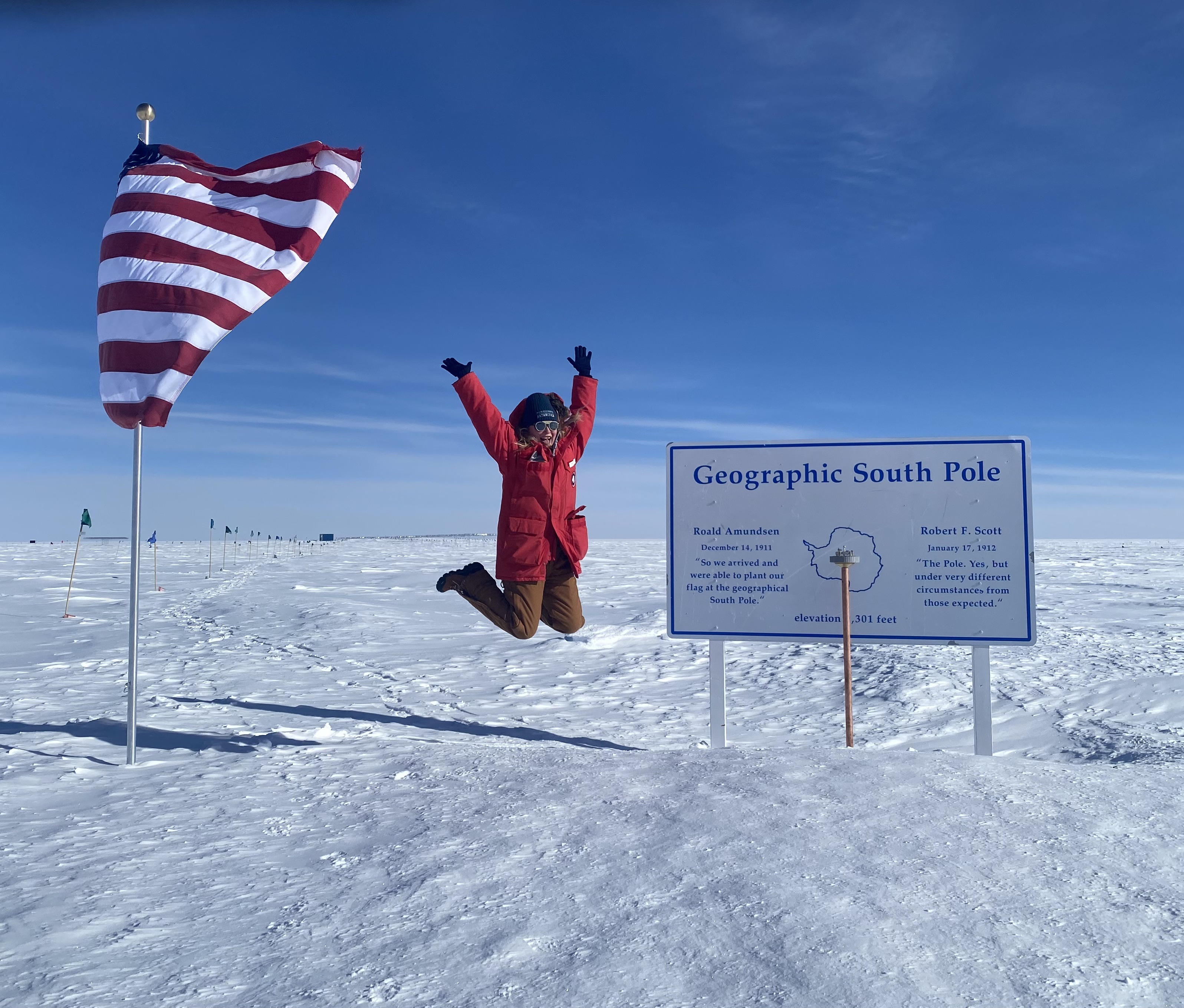
Rachel Procter-Murphy leaps for joy at the South Pole. Photo courtesy of same.
Rachel Procter-Murphy leaps for joy at the South Pole. Photo courtesy of same.Rachel Procter-Murphy leaps for joy at the South Pole. Photo courtesy of same.Procter-Murphy credits much of her Antarctic success to the people around her. 

“I was part of such a supportive group who thought I had good ideas and was worth listening to,” she said. “That helped me to grow and changed how I saw myself.” 

Among her most memorable moments: working with IceCube for the first time, scribbling her own name in the logbook signed by the original observatory installers and sledding down a giant glacier.

Oh, and standing at the end of the world.

“The end of the world is what people call the place beyond the research station and defunct buildings, where snow management ends,” she explained. “It feels like the edge of nothingness, just flat ice and open space under this eerie glow as far as you can see. It’s a view I’ll never forget.”
A ‘Groundbreaking, Earth-Shattering, Universe-Defining’ Mission

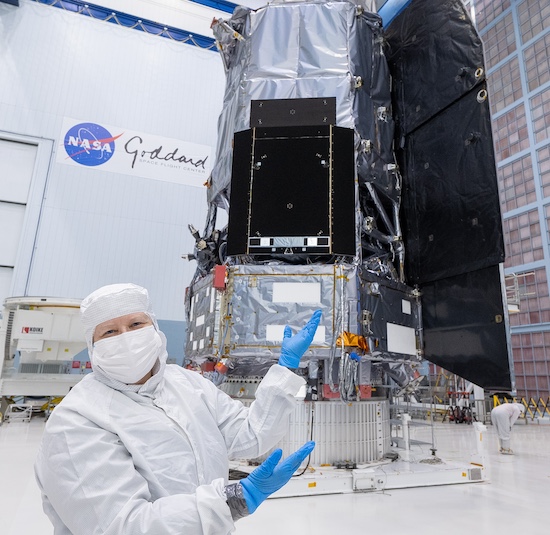
This fall, when all the final system checks are done and the countdown ticks to the final second, NASA’s Nancy Grace Roman Space Telescope will blast off the launchpad at Kennedy Space Center—and no one will be more geeked than Jackie Townsend (B.S. ’94, physics).

“Nothing matches the pride and terror of the moment of launch,” Townsend explained. “Even for me, who does science missions—it's like watching your kid graduate and worrying they're going to trip as they walk across the stage. I will be crying. It will be a magnificent moment.”

For Townsend, Roman is the latest milestone in a 30-plus-year NASA career that included groundbreaking Hubble missions, countless spaceship materials challenges, complex weather satellite collaborations and a host of discoveries. Recently named project manager for the Roman mission, after spending more than 15 years as deputy project manager, Townsend deliberated over every detail of one of NASA’s most ambitious efforts ever, a scientific adventure that will explore the universe in ways never possible before.

“What most excites me? We’re going to record or image more than 20 billion celestial objects over the life of this mission. And when you record 20 billion of something, you’ll capture 20 thousand, one-in-a-million events—phenomena we’ve never seen before,” Townsend said. “That’s what I love about Roman. We're going to do the science that we were designed to do spectacularly well—and we’re going to find untold new areas to explore.”

Wrong turn, right career

Space wasn’t part of Townsend’s original career plan. Jackie Townsend with the Roman Space Telescope at NASA Goddard Space Flight Center. Photo courtesy of Jackie Townsend.Jackie Townsend with the Roman Space Telescope at NASA Goddard Space Flight Center. Photo courtesy of Jackie Townsend.

“When I graduated from high school, I didn’t know that I was any good at math or science, and I first went to college to study psychology,” she said. “But I found I was really bored by psychology. It did not inspire me to try harder, so after my first year, I quit.”

Townsend spent the next three years job-hopping, from farmhand to receptionist to retail, and along the way, she realized she needed a challenge, a career path that would make a difference in the world and inspire her to try so hard that she wouldn’t be afraid to fail. The answer was physics.

“I thought back to high school—what was a class I really enjoyed even though it challenged me? For me, that was physics,” she recalled. “I decided then I was going back to school.”

A few years—and many community college physics courses—later, Townsend transferred to the University of Maryland, building a strong foundation that set the stage for her future.

“At Maryland, I realized that what it was doing was teaching me how to think,” she said. “The physics degree was teaching me to think through how to solve complex problems, and that’s obviously an everyday occurrence in my job at NASA today.”

Townsend connected with NASA’s Goddard Space Flight Center and had the opportunity to conduct research there as a student.

“I didn't even know Goddard existed until I met people at Maryland who worked with Goddard. The physics department worked with me to carve out a program where I was part-time working and part-time going to school,” Townsend explained. “Even as a co-op, I had samples that had flown in space, and we were working at Goddard to characterize what had changed in those materials from their exposure to space. The connection between what was happening in the classroom and the hands-on work that I was doing at Goddard was just magnificent. It was inspirational to me.”

Blankets, cameras and sunshields in space

After graduation, Townsend’s co-op experience landed her a full-time job at Goddard as a materials engineer, where she troubleshot materials NASA was sending into space.

“I had the greatest first boss, who was really a teacher disguised as a materials engineer, and he was one of the people who pioneered how we need to test these materials and understand them if we're going to use them in space applications,” Townsend said. “He had me working on contamination control and broader space environmental effects. I had studied solid-state physics stuff at Maryland, and I learned a bunch more at Goddard, so I was becoming recognized as an up-and-coming expert in the effects of the space environment on materials.”

As her NASA career continued, Townsend’s technical expertise and her knack for solving problems made a lasting impact. She contributed to three Hubble servicing missions, improving designs to prevent cracking in the thermal blankets that protect Hubble’s delicate instruments and fine-tuning Hubble’s Wide Field Camera 3. She later collaborated with the National Oceanic and Atmospheric Administration on new weather satellites and contributed to the sunshield design for the James Webb Space Telescope.

“The Webb has this tennis court-sized sunshield, which is made of these very thin film materials—it’s like a mylar balloon or a potato chip bag. And because of my work on Hubble, I got to work with the Webb folks to define how they would test the materials to determine which ones would survive the radiation environment where they were going,” Townsend recalled. “I was able to take what I had learned and use it to help shape the choices they made for Webb.”

Preparing for launch

A contributor to the Roman telescope mission as early as 2010, Townsend became the mission’s deputy project manager in 2020. Now as project manager, she’s charged with ensuring that all of NASA’s plans, people and systems are on track for Roman’s planned launch this fall.

“We plan to launch on August 30th from the Kennedy Space Center,” she said. “All of the observatory is complete and went through environmental testing with excellent performance. The team spent May and early June doing what we call the final closeouts. Team members go through pulling off test articles that don’t fly, like accelerometers and metrology targets. The solar arrays, aperture cover and high-gain antenna were each deployed and stowed for the final time here on the ground. In mid-June, the whole observatory is installed into a big shipping container, put on a NASA barge and tugged down to Kennedy Space Center. After that, we have a little over two months’ work to get it onto the launch vehicle and ready for launch on August 30.”

The Roman mission will offer virtually limitless opportunities to investigate a wide range of astrophysics topics, building a massive data archive that will allow scientists to identify and study 100,000 exoplanets, hundreds of millions of galaxies and billions of stars. Townsend believes that keeping this Roman mission on track and on budget will pave the way for even more ambitious missions in the future.

“I'm not a scientist like the Ph.D.s that will use Roman data to do that groundbreaking science, but I am a world-class technical project manager and space architect. This amazing team not only enabled Roman by charting this path, we enabled what's to come. We will be allowed to tackle new, incredibly ambitious missions in the future because of the way we executed on Roman,” Townsend said. “And, to circle all the way back, that's the same problem-solving I learned in the University of Maryland physics department. That same way of thinking about how to tackle really complex problems in a methodical, logical, systemic way is how Roman delivered.”

And for Townsend, whose career in space has been nothing short of stellar, this mission could be the most memorable ever.

“I feel like all the missions I've worked on have been different—kind of like my path to physics and my path to NASA. It’s been this wild ride I never could have predicted or planned. I got here just hanging on and digging into work the problems and get the job done,” she said. “The Roman observatory is fantastic, and it’s going to do groundbreaking, earth-shattering, universe-defining science, and that is really exciting.”


Original story: https://cmns.umd.edu/news-events/news/Jackie-townsend-roman-space-telescope-physics-mission


Childhood Physics Fun Leads to Twin PhDs

When Sylvester James Gates III (B.S. ’15, biological sciences) graduates from the University of Maryland with his Ph.D. in biological sciences this month, it will be a family affair—and a homecoming. 

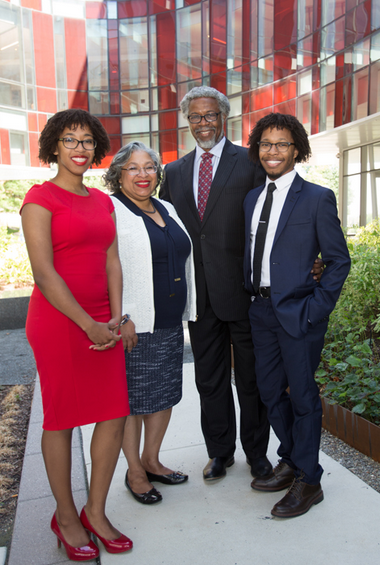
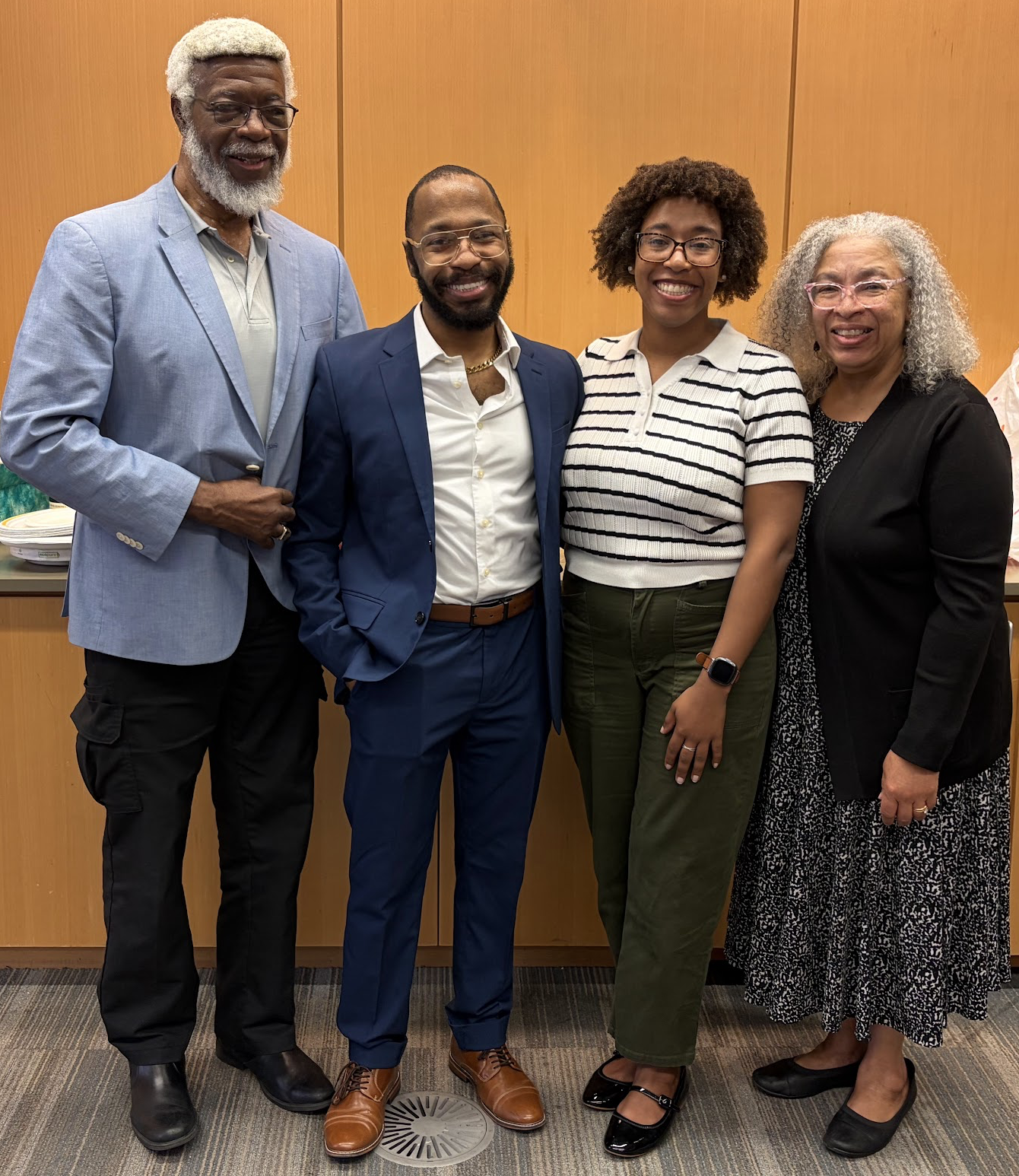
Sylvester grew up near College Park. His father, Distinguished University Professor of Physics Sylvester James Gates Jr., who goes by Jim, holds the Clark Leadership Chair in Science and has been at UMD since 1984. As kids, Sylvester and his twin, Delilah Gates (B.S. ’15, physics; B.S. ’15, mathematics), spent their free days with their dad in the John S. Toll Physics BuildingThe Gates family after Sylvester's graduation. From left: Sylvester James Gates Jr., Sylvester James Gates III, Delilah Gates, Dianna Abney. Photo courtesy of Sylvester James Gates III.The Gates family after Sylvester's graduation. From left: Sylvester James Gates Jr., Sylvester James Gates III, Delilah Gates, Dianna Abney. Photo courtesy of Sylvester James Gates III.

“The university always felt like a second home to me,” Sylvester said. 

So it was no surprise that both twins chose to stay in College Park for their bachelor’s degrees and they both became scientists. 

After graduating from UMD, Delilah earned her Ph.D. in physics from Harvard University in 2021, where she studied black holes in space. She completed a Future Faculty in the Physical Sciences Fellowship at Princeton University and then returned to Harvard as a postdoctoral fellow at the Center for Astrophysics | Harvard & Smithsonian and a member of the Black Hole Initiative. 

Sylvester, meanwhile, spent a brief stint in graduate school at Duke University before returning to Maryland for his Ph.D., where he studied how brain cells communicate. Working with Physics Professor Wolfgang Losert, Sylvester’s Ph.D. research developed new, nontraditional ways to measure brain cell activity—for example, by monitoring ions, stress compounds and the cell’s internal skeleton. He argues that gaining a more holistic picture of how the brain works could lead to more powerful artificial neural networks for computing and better drug discovery for brain diseases. 

When Sylvester presented this work during his dissertation defense in April, his whole family came to campus to watch. This month, they’ll return once more to cheer him on as he walks across the graduation stage. The milestone marks the end of a challenging but rewarding graduate school journey. 

“I'm incredibly proud of Sylvester,” Delilah said. “He's an amazing guy, as both a scientist and a human.”

Two Science Terps Are Born

What exactly does a kid do when they’re dragged into a university physics building? Actually, quite a lot, Sylvester and Delilah said. 

They have fond childhood memories of playing with physics demonstrations, mingling with employees and learning Japanese from a department staff member. Delilah even recalls playing physicist—much like many kids play doctor—scribbling gibberish on her dad’s blackboard and notepads as she pretended to do complex calculations. 

In many ways, the twins took after their parents. Their mother, Dianna Abney, is a pediatrician, child abuse specialist and the health officer for Charles County, Maryland. Like the kids, one of their parents studies physics, and the other is in the life sciences. Still, neither kid felt pressured by their parents to be scientists. In fact, both twins played the clarinet and considered majoring in music at UMD. 

“Though I have been deeply passionate about reaching my wish of becoming a scientist starting at age 4—as is similar to the case of my wife, Dianna, whose wish to become a medical doctor began around age 8—we shared a belief that parents should provide a safe environment with some structure, but stay out of the children's lanes of determining their lives' ambitions,” Jim said. 

That’s not to say Jim and Dianna did not influence their children’s careers at all. They were friends with other doctors, professors, lawyers and people with advanced degrees. Being around them helped the twins understand what went into pursuing those career paths, Delilah said. And, they were always invited to chat with the adults. 

“A lot of things that some people might think are hard discussions about science, the universe, planets, biology and medicine were commonplace, because that's just the language my mom and dad spoke,” Sylvester said. 

He added that representation was important. 

“It never felt like science was unapproachable to me,” Sylvester said. “This is one of the reasons why I believe that representation matters. Having a father and mother who were, respectively, a physicist and a pediatrician, both doctors in their own right, made being a doctor seem like something that my sister and I could do.”

Diverging Disciplines

Now that they’re both scientists, the twins study the world on vastly different scales—Sylvester works on microscopic cells, while Delilah researches the vast cosmos. The two siblings always had distinct dispositions, Sylvester said. He was always more artsy, and his sister was more drawn to math. So, he’s not surprised their interests diverged. 

Delilah initially planned to study particle physics like her father, but after taking a cosmology class in graduate school, she became fascinated by black holes. She was drawn to the discipline’s strong mathematical framework, which, like particle physics, builds on concepts like field theory and general relativity. Now, as a theoretical physicist, she’s developing new ways to measure the spin of black holes—a question that has vast implications for understanding how galaxies form and evolve.  

As for Sylvester, when he went to Duke University, he was planning to study cancer for his Ph.D. But living away from Maryland for the first time, he experienced culture shock—from the slower pace of life and the distance from the community he had spent two decades developing. For a year and a half, he struggled with his mental health and imposter syndrome. 

“Then, I was like, ‘I cannot do graduate school at this point in time,’” Sylvester said. “So I came back to Maryland. Thankfully, I had great support, so I was able to rebuild my scientific confidence.” 

Growing Together by Moving Apart

It was difficult for Delilah to watch her twin struggle, but ultimately, it brought them closer. Until that point in their lives, they had lived close enough to see each other and speak regularly. But they had to learn to be there for each other now that they lived hundreds of miles apart. 

“Him having struggled taught us how to support each other in a new way,” Delilah said. “It was difficult at first learning to be in different places and on different timelines, but it taught us a new way to communicate and connect.” 

The Gates family in 2015.The Gates family in 2015.When Delilah faced her own challenges about halfway through graduate school, that bond was invaluable.

“I always say I don't think I'll have a midlife crisis because I went through graduate school. I was struggling quite a lot. I was having severe anxiety. And it was to the point I would cry every day, sometimes several times a day,” she said. “I remember I used to call Sylvester most mornings and talk to him on the way to work, because talking to him made me less anxious.”

After supporting each other through tough times, the twins are closer than ever. They’re best friends and speak every day, whether that’s through text messages, phone calls or wordless exchanges of memes. After watching Sylvester bounce back from his struggles, Delilah was overjoyed as she watched her brother finally defend his Ph.D. It was her first time watching him deliver a scientific lecture, and she noted how calm, cool and collected he was—and also how well-dressed. 

“He's so much more fashionable than me,” she said with a laugh. “He looked really sharp.”

Delilah got emotional as she recounted the day’s events. 

“I was the last one he shouted out in detail in his acknowledgments, and I just bawled. I couldn't contain my joy and pride. I was so happy for him,” she said. “Even thinking about it now, I get a little verklempt.” 

Their father felt the same way. 

“It would take me writing a magnum opus to really express my feelings in the defense,” Jim said.

Now that he’s completed his Ph.D., Sylvester is still figuring out what’s next. He’s open to academia, or maybe a career in government or industry. Wherever he lands, he wants to continue studying how the brain works, whether that means developing artificial neural networks for computing, medicines for neurodegenerative diseases like Alzheimer’s or interventions to help military veterans dealing with brain trauma. 

And although the twins’ physics professor dad never pushed either child to pursue science, he’s thrilled by their accomplishments now that they have chosen the path for themselves. 

“Raising them was amazing. My wife and I still say that there is nothing else in life that we have done that was more fun,” Jim said. 

It’s hard for him to find the words to describe how he feels witnessing his children’s success. So, he turns to something of a family heirloom—cherished words his father once shared with him. 

“After I became the John S. Toll Professor of Physics, my father said to me, ‘You have exceeded any and all expectations that your mother, Charlie, and I ever had of and for you,” Jim said. “My twins have accomplished that also for their parents.”

Barkeshli Selected for Frontiers of Science Award

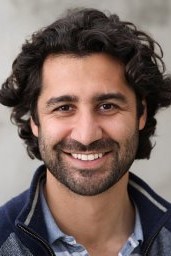
Research by Professor Maissam Barkeshli and colleagues has been selected by the International Congress of Basic Science (ICBS) as a recipient of the 2026 Frontiers of Science Award in Condensed Matter Physics. The paper cited was Symmetry fractionalization, defects, and gauging of topological phases by Barkeshli, Parsa Bonderson, Meng Cheng and Zhenghan Wang.Maissam BarkeshliMaissam Barkeshli

The Frontiers of Science Award, inaugurated in 2023 under the auspices of the ICBS, honors recent papers recognized for a major breakthrough in their respective fields and includes a nomination process and review by a panel of experts.

Awards will be presented at the International Congress of Basic Science in Beijing on August 9, 2026. 

Barkeshli has also received a Sloan Fellowship and an NSF Career Award, and was recently selected for a Simons Collaboration

Kara Hoffman Named Chair of Department of Physics

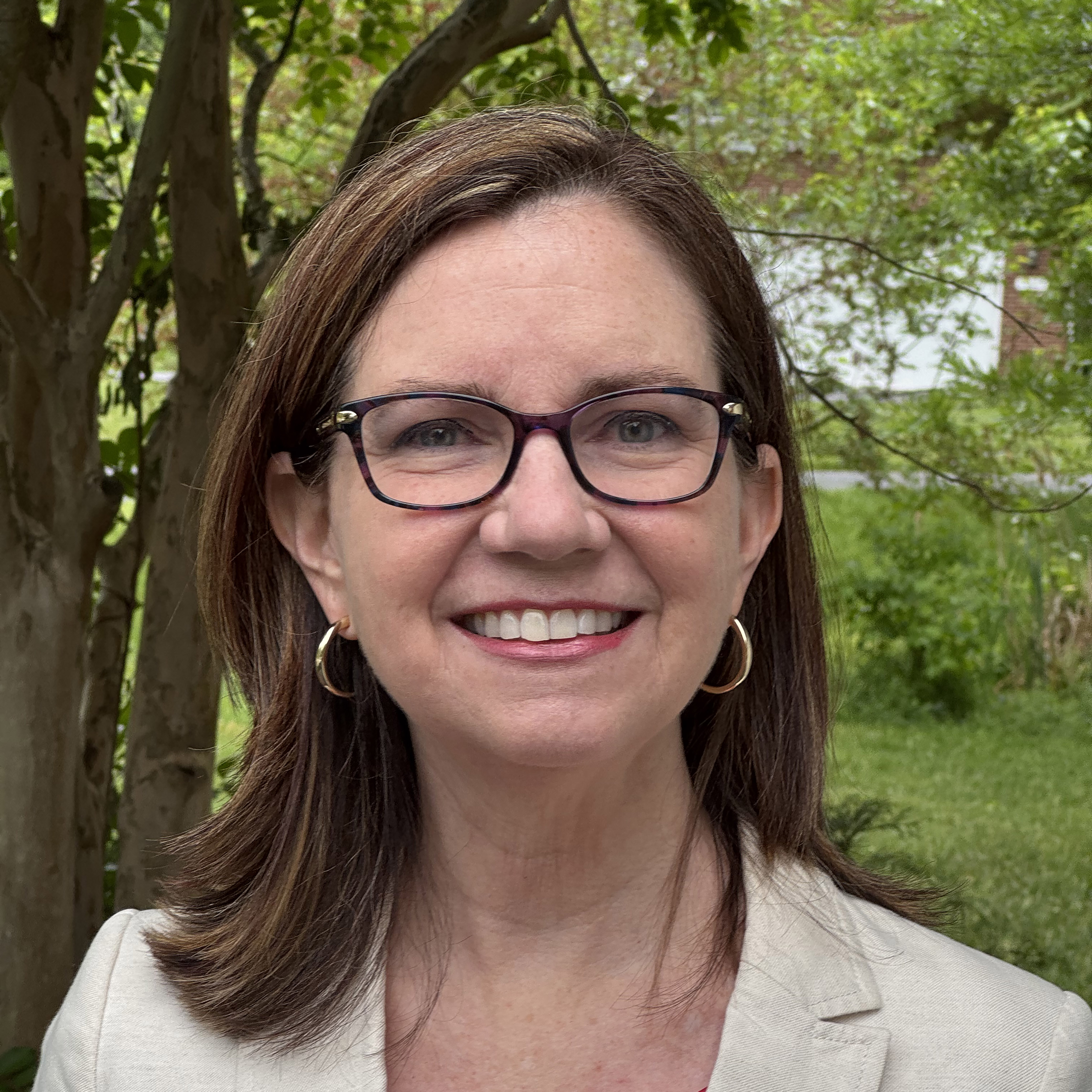
Professor Kara Hoffman was named chair of the Department of Physics, effective July 1, 2026.Kara Hoffman. Photo courtesy of same.Kara Hoffman. Photo courtesy of same.

“Kara Hoffman brings to this role a record of scholarly achievement and an understanding of the department's strengths and aspirations,” said Amitabh Varshney, dean of UMD’s College of Computer, Mathematical, and Natural Sciences. “As a longstanding member of our faculty, she is prepared to lead the department’s continued growth and success.”

The Department of Physics ranks No. 14 overall (and 5th among public institutions) in physics graduate programs according to U.S. News & World Report and has 50 tenured/tenure-track faculty members, nearly 600 students and annual research funding of over $30 million. 

“It is an honor to be chosen to chair a department of this prominence," Hoffman said. “The strength of the department derives from the talent of our faculty and students, the dedicated support of our staff, as well as our partnerships with some of the world’s preeminent research institutions.” 

Hoffman plans to continue recruiting outstanding faculty members and students and providing excellent opportunities outside the classroom for the large fraction of physics majors who conduct research.

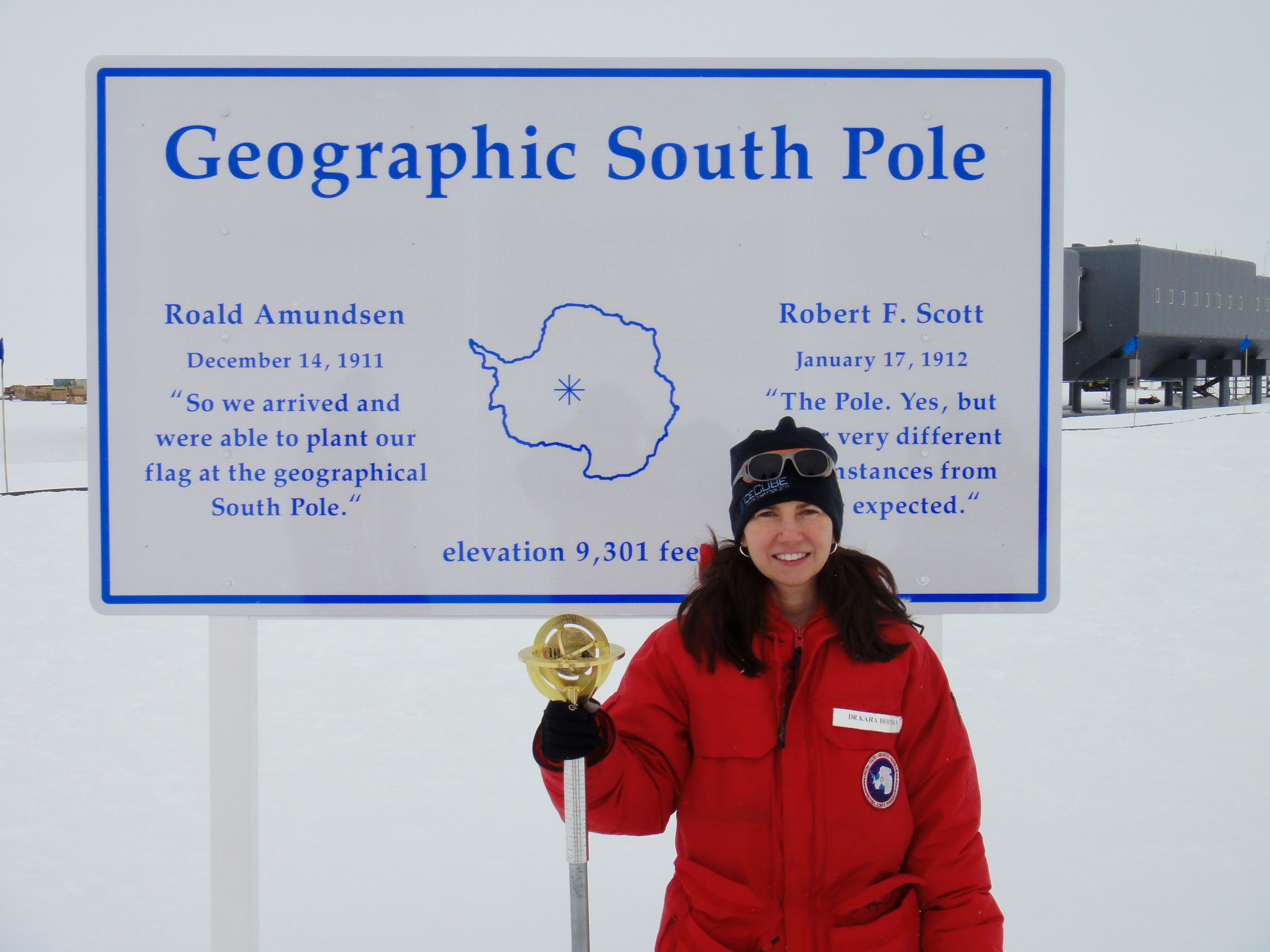
“As chair, I look forward to supporting these activities, as well as looking for new opportunities and initiatives,” Hoffman added. “While these are challenging times for research funding, I believe we can emerge even stronger.”Kara Hoffman at the South Pole. Photo courtesy of same.Kara Hoffman at the South Pole. Photo courtesy of same.

Hoffman, who joined UMD in 2004, serves as the principal investigator on the National Science Foundation (NSF) grant that supports the analysis of data taken with the world’s largest neutrino telescope, the IceCube Neutrino Observatory at the South Pole. She has been conducting research at the observatory since the construction of the telescope commenced in 2004. 

Scientists have used IceCube to discover a population of high-energy neutrinos originating from outside our galaxy and from within the Milky Way plane. In addition, IceCube has made several contributions to particle physics, including the first observation of the Glashow resonance. 

Hoffman’s research has focused on multimessenger astrophysics, which aims to correlate information across multiple telescopes—including optical, gamma-ray and gravitational-wave instruments—often in real time, to identify some of the most energetic objects in our universe and gain a deeper understanding of the physical processes that drive them. 

In addition, Hoffman received an NSF Major Research Instrumentation grant that funded the construction of a next-generation neutrino array, the Askaryan Radio Array, also at the South Pole. The array is one of a few instruments pioneering a new detection technique that would extend the sensitivity of neutrino telescopes to higher energies.

Hoffman has held various leadership roles at UMD, including as director of the Center for Experimental Fundamental Physics (2012-15), as a faculty senator (2015-18) and as the department’s associate chair for undergraduate education (2016-20). In the latter role, she restructured the undergraduate laboratory sequence, facilitated the inclusion of active learning in undergraduate courses, recruited new instructors and oversaw the transition to online learning during the pandemic.  Hoffman is also a Fellow of the Joint Space-Science Institute and has served in various leadership roles within her field, including as a member of the executive committee of the Division of Particles and Fields at the American Physical Society (2010-13).Kara Hoffman at the South Pole. Photo courtesy of same.Kara Hoffman at the South Pole. Photo courtesy of same.

She has mentored more than a dozen postdoctoral researchers and graduate students. Hoffman earned her Ph.D. in high-energy physics in 1998 and her master’s degree in physics in 1994 from Purdue University and her bachelor’s degree in physics from the University of Kentucky in 1992. Before joining UMD, she was a Fellow at CERN and a research associate at the University of Chicago’s Enrico Fermi Institute. 

Hoffman succeeds Steve Rolston, who completed a 10-year term as physics chair. During Rolston’s tenure as chair, he hired 14 faculty members, founded the Mid-Atlantic Quantum Alliance, sponsored the Conference for Undergraduate Women in Physics, and sponsored four Conferences for Undergraduate Underrepresented Minorities in Physics—while also successfully navigating the department’s operations during the pandemic. During the past decade, six physics faculty members were elected to the National Academy of Sciences, four were named Distinguished University Professors and four were named Distinguished Scholar-Teachers. While chair, Rolston also maintained his own quantum research program, authoring 32 publications and graduating eight Ph.D. students.