- Details
-
Category: Research News
-
Published: Friday, July 24 2026 01:34
Quantum computing and AI are among the most rapidly developing modern technologies. AI, in the form of machine learning, has been deployed for decades to recommend movies and TV shows and make it easier to search for images. Over the past several years, large language models have permeated even more facets of daily life, from writing emails to producing images, videos and songs following requests expressed in a few written lines.
Quantum computers, on the other hand, have remained almost exclusively in labs at universities and a handful of companies. Nevertheless, many researchers and engineers developing them are already looking for the earliest applications and predict a bright future in which quantum computers excel at certain tasks, like drug development and enabling new cryptographic techniques.
Despite machine learning and quantum computing both being heralded as revolutionary technologies, neither is a magic solution to every problem. They are each the products of a long line of research advances and are both still under active study.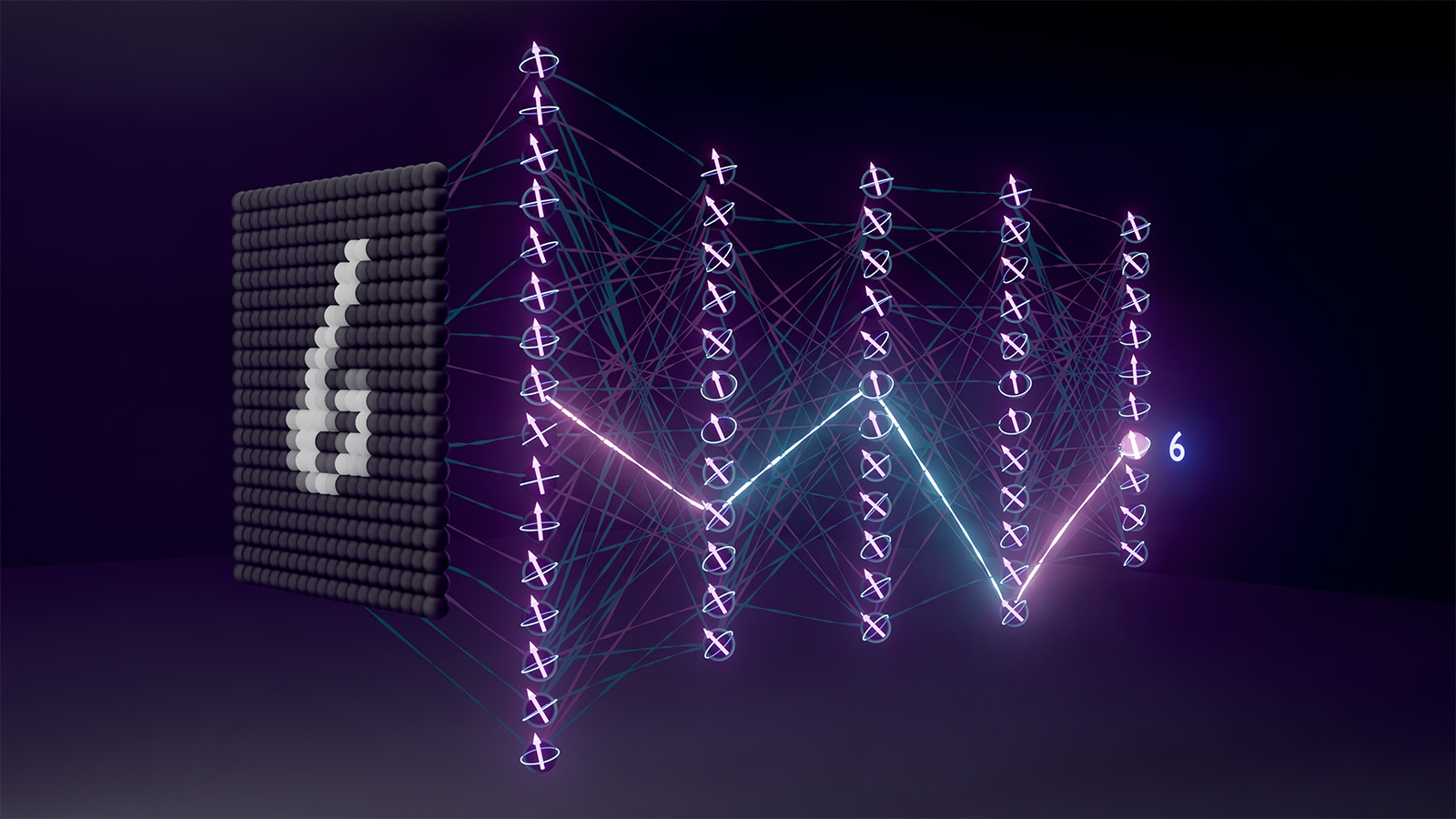 An artistic representation of a quantum neural network identifying a handwritten digit. Each ball containing an arrow represents a qubit that is serving as a neuron in the network. The neurons are organized in layers, and connections between neurons in adjacent layers control how the information is processed as it moves through the network. The final layer identifies the most likely digit. (Credit: Chris Cesare/JQI)
As the two technologies continue to mature, researchers are beginning to investigate ways to utilize them together. A collaboration between JQI Fellows Alaina Green, Norbert Linke, Victor Galitski and their colleagues recently reported on new experiments that explore how quantum computing influences—and might improve—machine learning. They used a variety of quantum computers to run a simple neural network—a type of machine learning inspired by the structures in real brains.
Neural networks are the foundation of many prominent AI technologies, including large language models like ChatGPT and Claude. They have been around for decades and have been used for many applications, including image recognition. For instance, banks used the neural network LeNet-5, which was developed in 1998, to identify handwritten zip codes. But making neural networks run on quantum computers is unexplored territory.
In an article published as an Editors’ Suggestion in the journal Physical Review Letters on July 22, 2026, the JQI researchers and their colleagues describe experiments running neural networks on several different quantum computing platforms. Their results demonstrated that a certain amount of intentional quantum randomness, arising from measurements, can be beneficial to a neural network. They also saw hints that the errors that plague current quantum computers might be able to play a useful role when running a neural network on a quantum computer.
“Measurement outputs on quantum systems are inherently random, and this can improve the performance of a neural net,” says Linke, who is also the IonQ Endowed Associate Professor of Physics at UMD, a senior investigator at the National Science Foundation Quantum Leap Challenge Institute for Robust Quantum Simulation (RQS) and the director of the National Quantum Laboratory (QLab) at UMD. “Additionally, operations on current quantum hardware are often imprecise. This limited control produces more randomness that, if it's not too large, can further boost the neural net performance.”
Designing a Quantum Neural Network
The new neural network experiment implemented an approach that Galitski, who is also a Chesapeake Chair Professor of Theoretical Physics in the Department of Physics at UMD, and two graduate students working in his group proposed in 2025. Their goal wasn’t to use a quantum computer to outperform existing neural networks. Instead, they wanted to use quantum computers to investigate when incorporating quantum features is helpful or harmful to a neural network.
Neural networks operate by transforming an input through a sequence of calculations to accomplish a goal. The information contained in the input—usually represented as a list of numbers—flows through a connected network of artificial “neurons” that systematically breaks apart the information and recombines it using calculations associated with each of the connections. The particular calculations that the network performs are tailored by a process called training, which involves testing many example inputs and adjusting the connections between neurons until the network reliably produces a desired result.
The network developed by Galitski and his colleagues was trained using traditional computers to perform a task that is straightforward for a neural network: identifying handwritten numbers. They focused on recognizing digits because it is an established exercise used to test image processing and machine learning models. The well-worn task allowed them to train and test the neural network using a set of images called the Modified National Institute of Standards and Technology database (MNIST), which provides examples of handwritten digits in a convenient standard format.
Examples of digits included in the MNIST dataset. (Credit: Suvanjanprasai, CC BY-SA 4.0, via Wikimedia Commons)
Their neural network takes an image as an input and at the end predicts the number it most likely depicts. The ready-made database and well-understood task provided a convenient starting point for the group to explore how quantum ingredients influence a neural network.
Galitski and the graduate students in his group described a way to make qubits—the basic building blocks of quantum computers—function as neurons. Their method lets them use quantum measurements to control the amount of quantum randomness intentionally included in the neural network’s operation on each run. The group designed their neural network architecture to be compatible with any of the various types of quantum computers being developed. There are many ways to make a quantum computer by starting with different qubits. However, all quantum computers rely on shared quantum principles.
The team took advantage of the way all qubits store information in their quantum states to incorporate different amounts of quantum randomness into their proposed model. A qubit will always be observed in one of two states when measured, but in between measurements it can be in a mixture of the two—called a superposition—where it is only possible to know the probability of finding it in one state or the other. A qubit can be put in a superposition where one or the other outcome is more likely to occur, but it’s not definitively in one state or the other until a measurement destroys the superposition and one of the states is observed.
In the proposal, the final state of the neurons is one of the two unmixed states of the qubits, and superposition and quantum measurements are used to inject randomness into the neural network. The approach allows different experimental runs of the neural network to use different superpositions. Each superposition provides a different chance that, at each step, the results might randomly flip between states and potentially alter the identification the neural network makes. Or researchers can perform a test without randomness by leaving the qubits exclusively in one state instead of a superposition. The approach provides a way to compare the success of neural networks featuring different amounts of quantum influence as well as to judge how the neural network operated on different quantum computers.
Testing a Quantum Neural Network
To test the proposal with experiments, Galitski shared it with experts at IBM as well as Linke and Green, who is also a physicist at the National Institute of Standards and Technology and a senior investigator at RQS. Galitski requested their help testing the neural network on real quantum computers, and they all agreed the idea was worth pursuing.
IBM’s quantum computer is built using superconducting circuits, while Green and Linke have built their quantum computers using trapped ions—electrically charged atoms contained and manipulated with light waves. Linke and Green can operate their quantum computers by manipulating ions in two different ways—one using microwave light and the other using laser light. The opportunity to test the neural network on these three distinct systems gave them the chance to look for differences in how the neural network operated on each platform and to get a more complete picture of how the quantum neural network performed.
“We showed that for this architecture, you can see improvement in classification of images when you tune the quantumness from zero to some golden spot,” says Djamil Lakhdar-Hamina, a JQI graduate student and the first author of the paper.
The neural network performed slightly differently on each quantum computer. On all the platforms, the results showed that a limited amount of randomness from the quantum measurements improved the neural network’s performance compared to cases with no intentional randomness, but at some point, additional randomness made the neural network perform worse.
This outcome wasn’t completely surprising. A little bit of randomness is known to be a useful ingredient in machine learning—although it is normally incorporated in a different way and at a different time. This is because perfectly following a single fixed path inevitably gets the same answer every time, which can be a problem. Without any randomness to provide wiggle room in exploring all the options, a computer program or the training of a neural network is more likely to get stuck at a wrong answer that is almost correct. For instance, attempts to identify handwritten digits may mistake a sloppy seven as a one and lock onto that wrong answer. By contrast, a similar approach with some randomness to shake things up can often break free of the almost right answer and move on to the correct one.
When researchers develop neural networks, they often incorporate randomness into the training. In this experiment, the team looked for a benefit from using quantum measurements to inject randomness during the actual identification. The team saw that there were certain images that the neural network falsely identified when there was no quantum randomness, but it identified more images correctly when just the right amount of randomness was added to the quantum measurements. The group focused on these troublesome cases and did repeated experiments using a particular image that the neural network identified incorrectly when they didn’t add randomness. They showed that with the optimal amount of randomness added, the trapped-ion quantum computer could almost always identify the number and IBM’s quantum computer succeeded around 90% of the time.
Development Opportunities
The researchers also considered sources of randomness beyond what they introduced using quantum measurements. Quantum computers all experience noise—random errors from things like heat fluctuations that throw off their operations, and the group looked for signs of these errors influencing their results. The errors in quantum computers are currently a significant impediment to putting them to useful work, and researchers are looking for the most practical problems that can be tackled with imperfect devices that we have or expect to build soon.
“We're living in the era of what's called NISQ—noisy intermediate scale quantum computing,” Lakhdar-Hamina says. “So the question is, rather than this being a bad thing, can we harness the noise to positive ends?”
Based on the experiment, the researchers hope that machine learning is an area where quantum noise can be a benefit and not just a hindrance. They saw a couple of signs of the extra randomness being beneficial. The fact that the results varied a little when the team ran identical versions of the neural network on each computer suggests the imperfections of each are playing a noticeable role. Additionally, the researchers saw better results in the experiments both with and without randomness from measurements than they expected from their simulations of how the neural network would perform. The team attributed these results to the different imperfections and noise of each computer and concluded that the noise helped by contributing some amount of useful randomness.
The team’s results suggest that both intentional quantum randomness from measurements and the noise of quantum computers might serve a useful role in some neural networks. Even with these encouraging results, the researchers don’t propose that their current neural network design will produce the best possible neural network or even the best quantum neural network. However, the ability to tune the quantum randomness provides a tool to study the effect it plays and to learn how quantum computers might effectively be used with future neural networks.
Moving forward, they plan to develop a neural network that lets them explore even more quantum effects. In particular, they’re interested in exploring the potential benefit of utilizing entanglement, which links quantum particles together independent of their separation in space. They hope these neural networks will help them identify cases where quantum computing and machine learning can boost each other’s potential and demonstrate their combined power to solve challenging problems.
“Machine learning is not only socially and economically important, but is a fascinating part of computer science,” Lakhdar-Hamina says. “I think that it is one of the rare instances where we might actually find quantum advantage. And so this was a first step in what I think is going to be a big project for many, many people trying to find that quantum advantage within machine learning.”
Original story by Bailey Bedford: https://jqi.umd.edu/news/researchers-explore-how-quantum-computers-and-their-errors-may-enhance-ai
In addition to Galitski, Linke, Green and Lakhdar-Hamina, co-authors of the paper include former JQI graduate students Richard Barney and Xingxin Liu and Sarah Miller, who is a Research Scientist at UMD's Applied Research Laboratory for Intelligence & Security and an expert on machine learning and artificial intelligence.
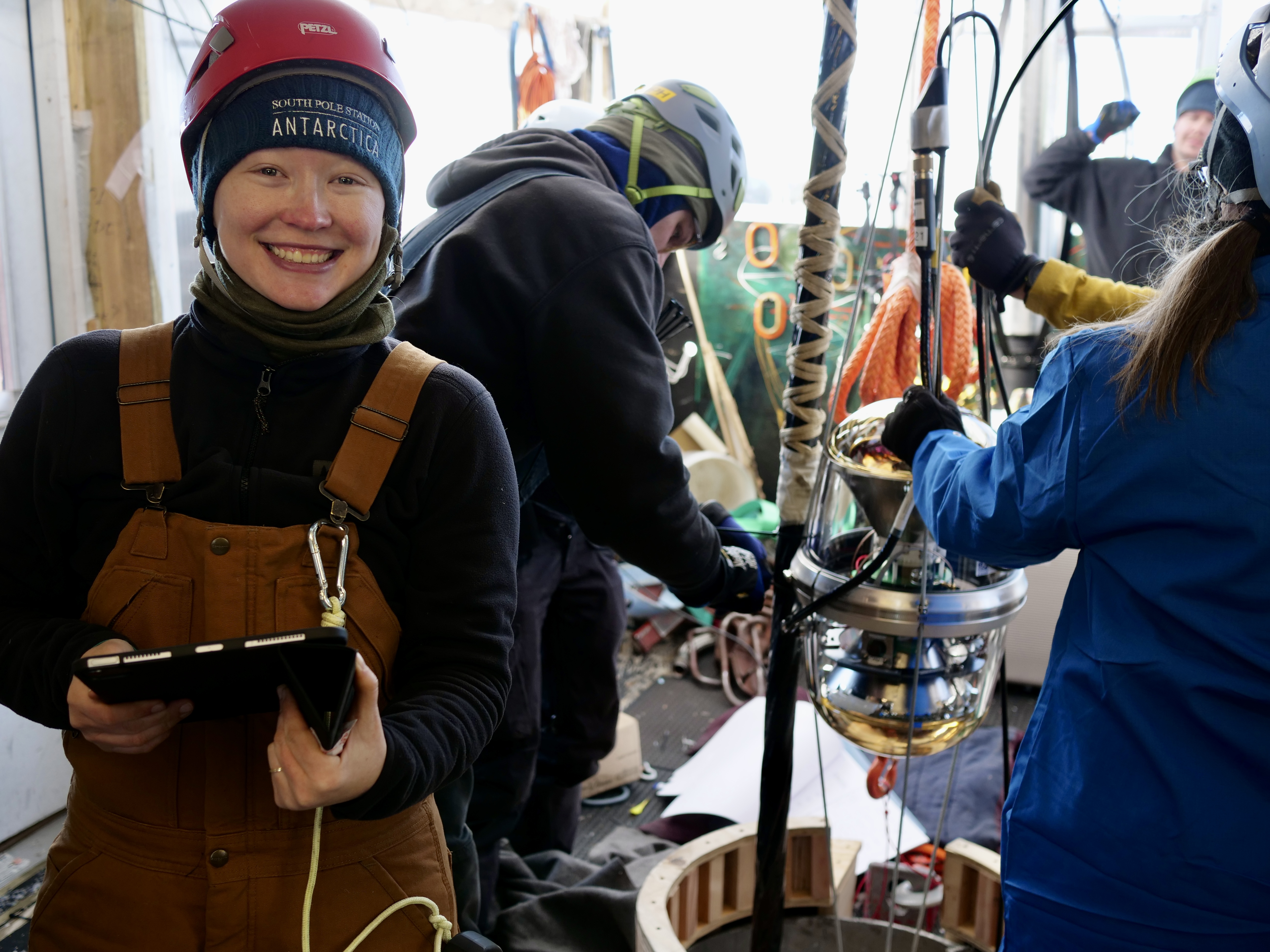 Rachel Procter-Murphy in Antarctica assisting with an installation at the IceCube observatory. Photo courtesy of same. by dust clouds—so they streak through the Earth (and our bodies) in a straight line, mostly unnoticed. Despite their abundance, scientists can only detect them on the rare occasion that they interact with something—like ice.
 Drilling into the ice to install a new string of neutrino sensors at the IceCube observatory. Photo courtesy of Rachel Procter-Murphy.
 Rachel Procter-Murphy leaps for joy at the South Pole. Photo courtesy of same.Procter-Murphy credits much of her Antarctic success to the people around her.